

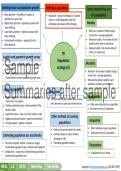
Limiting factors to population growth Defining a population Factors determining size
• Biotic potential – the ability of a species to • Population – group of individuals of 1 species of a population
reproduce at a given rate. living in a certain geographic area that
• Higher biotic potential – reproduces quicker with interbreed and produce fertile offspring. Natality
more offspring.
• Lower biotic potential – reproduces slower with • Birth rate = number of births during a
fewer offspring. certain time ÷ average population.
• Environmental resistance – opposing force to • Maximum natality - the number of births
biotic potential. possible under ideal circumstances.
• Realised natality - the actual number of
births in a certain time.
T9:
Logistic and geometric growth curves
Population
•
• Sample
J-curved graph – exponential/geometric growth of
population.
S-curve graph (sigmoid graph) – a plateau is
reached which is where exponential growth stops.
ecology (A)
Mortality
•
•
Mortality = the number of deaths during a
certain time ÷ average population.
Influenced by famine, epidemics and
pandemics, pollution and predators.
•
•
Summaries after sample
Carrying capacity
Maximum number of individuals of a species that the
environment can support.
Positive acceleration phase - biotic potential of the
•
True census
The South African government takes a census
every few years to plan and provide services.
Immigration
• When new individuals join a population.
species is high. • Increases the size of a population.
• Logarithmic phase - sharp rise in the number of cells.
• Negative acceleration phase - growth rate decreases.
Other methods of counting
• Carrying capacity - plateau is reached. populations Emigration
• Radio tracking and radioactive trackers. • When individuals leave a population.
• Estimates based on tracks, feathers, • Decreases the size of a population.
Estimating population size and density
droppings or calls.
• The mark-recapture method - animals are caught, • Calculating population density.
marked with tags/spots of dye, released and recaptured.
Fluctuations
• Sample plots - a large area is divided into equal blocks to • Population size isn’t stable.
estimate plant population size.
GR11 LS S3:T9 Mind Map Via Afrika Copyright © www.summariessa.co.za (DO NOT COPY)
,Sample
Summaries after sample
, Sample
Summaries after sample
• Biotic potential – the ability of a species to • Population – group of individuals of 1 species of a population
reproduce at a given rate. living in a certain geographic area that
• Higher biotic potential – reproduces quicker with interbreed and produce fertile offspring. Natality
more offspring.
• Lower biotic potential – reproduces slower with • Birth rate = number of births during a
fewer offspring. certain time ÷ average population.
• Environmental resistance – opposing force to • Maximum natality - the number of births
biotic potential. possible under ideal circumstances.
• Realised natality - the actual number of
births in a certain time.
T9:
Logistic and geometric growth curves
Population
•
• Sample
J-curved graph – exponential/geometric growth of
population.
S-curve graph (sigmoid graph) – a plateau is
reached which is where exponential growth stops.
ecology (A)
Mortality
•
•
Mortality = the number of deaths during a
certain time ÷ average population.
Influenced by famine, epidemics and
pandemics, pollution and predators.
•
•
Summaries after sample
Carrying capacity
Maximum number of individuals of a species that the
environment can support.
Positive acceleration phase - biotic potential of the
•
True census
The South African government takes a census
every few years to plan and provide services.
Immigration
• When new individuals join a population.
species is high. • Increases the size of a population.
• Logarithmic phase - sharp rise in the number of cells.
• Negative acceleration phase - growth rate decreases.
Other methods of counting
• Carrying capacity - plateau is reached. populations Emigration
• Radio tracking and radioactive trackers. • When individuals leave a population.
• Estimates based on tracks, feathers, • Decreases the size of a population.
Estimating population size and density
droppings or calls.
• The mark-recapture method - animals are caught, • Calculating population density.
marked with tags/spots of dye, released and recaptured.
Fluctuations
• Sample plots - a large area is divided into equal blocks to • Population size isn’t stable.
estimate plant population size.
GR11 LS S3:T9 Mind Map Via Afrika Copyright © www.summariessa.co.za (DO NOT COPY)
,Sample
Summaries after sample
, Sample
Summaries after sample


