
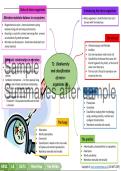
Roles of micro-organisms Introducing the micro-organisms
Microbes maintain balance in ecosystems • Micro-organisms = small life forms that can’t
be seen with the naked eye.
• Biogeochemical cycles - chemical elements cycling
between living and non-living environments.
• Recycling is crucial for nutrient and energy flow - prevent
accumulation of growth and waste. The viruses
• Microbes are decomposers - break down dead plant and
animal material. • Ultramicroscopic and filterable.
• • Acellular.
• Can only reproduce inside a host cell.
Symbiotic relationships in microbes • Classified by the disease they cause; the
•
Sample
Interspecific interactions – important
relationships formed by microbes with other
species.
• Symbiotic interactions – 2 or more species living
T1: Biodiversity
and classification
of micro-
•
kind of organism they infect, or the kind of
outer cover they have.
The host cell is forced to reproduce new
viruses by the virus.
in direct and intimate nutritional relationships. organisms (A)
Summaries after sample
- Mutualism – both species benefit.
- Commensalism – one of the species benefits
and the other isn’t harmed.
- Parasitism – the parasite benefits and the host
is harmed.
•
•
•
The bacteria
Microscopic.
Prokaryotes.
Unicellular.
•
• Classified by studying their morphology,
using a staining reaction, nutrition and
ecological characteristics.
The fungi • Reproduce asexually and sexually.
• Eukaryotes.
• Mostly saprophytes.
• Coenocytic. The protists
• Classification is based on the cross walls
of hyphae and method reproduction. • Heterotrophic, photosynthetic or saprophytic.
• Reproduce asexually and sexually. • Eukaryotes.
• Mostly unicellular.
• Reproduce asexually and sexually.
GR11 LS S1:T1 Mind Map Via Afrika Copyright © www.summariessa.co.za (DO NOT COPY)
,Sample
Summaries after sample
,Sexual reproduction Plant reproduction Plant biodiversity (cont.)
• Uses male and female gametes. Asexual reproduction
Plant adaptations for survival
• Male gametes often small and motile. • Only 1 parent organism/cell.
• Female gametes are large and • Adaptations for survival in water:
• Offspring are identical to parent.
stationary. - Small form.
• Types = binary fission, budding, spore
- No true roots, stems, leaves or reproductive structures.
production and vegetative.
- Simple tissues with specialised functions.
Mitosis and meiosis - Gametophyte dominant, and sporophyte dependent.
- Simple reproductive structures.
• Mitosis – cells dividing to produce identical - No flowers, pollen, seeds or fruit.
daughter cells in asexual reproduction and growth.
• Meiosis – cells division to produce male and female • Adaptations for survival on land:
Sample
gametes in sexual reproduction. - Small to large forms.
T2: Plant - True roots, stems, leaves and reproductive structures.
biodiversity and - Simple and complex specialised tissues.
Life cycles and alternation - Sporophyte dominant, and gametophyte dependent.
of generations reproduction (B) - Specialised reproductive organs.
- Makes flowers, pollen, seeds and fruit.
Summaries after sample
• Gametophyte generation – gamete-producing body
form/tissue that reproduces sexually and is
dependent on water.
• Sporophyte generation – spore-producing body
Flowers and sexual reproduction
form, organ/tissue that reproduces asexually and is
adapted to life on land. • Self-pollination – pollen can be transferred from one
• Alternation of generations – method plants use by flower to another on the same plant, or pollen is
alternating gametophyte generation with the transferred from the anther of a flower to the
sporophyte generation. stigma of the same flower.
• Cross pollination – transfer of pollen from one
Significance of seeds
flower to another on a different plant.
• Seeds are crucial for the future biodiversity of plants and animals. • Endosperm – used by the young plant as food during
• Seed dispersal - the movement of seeds from the parent to a suitable surface. germination due to its nutritional compounds.
• Natural seed banks - dispersal depends on the parent plant, seed structure, • Pollinating agents in Angiosperms = wind, insects,
dispersal agents and germination factors. birds, mammals and water.
• Artificial seed banks - collect wild plant species and keep them in sterile
conditions.
GR11 LS S1:T2 Mind Map Via Afrika Copyright © www.summariessa.co.za (DO NOT COPY)
, Sample
Summaries after sample
Microbes maintain balance in ecosystems • Micro-organisms = small life forms that can’t
be seen with the naked eye.
• Biogeochemical cycles - chemical elements cycling
between living and non-living environments.
• Recycling is crucial for nutrient and energy flow - prevent
accumulation of growth and waste. The viruses
• Microbes are decomposers - break down dead plant and
animal material. • Ultramicroscopic and filterable.
• • Acellular.
• Can only reproduce inside a host cell.
Symbiotic relationships in microbes • Classified by the disease they cause; the
•
Sample
Interspecific interactions – important
relationships formed by microbes with other
species.
• Symbiotic interactions – 2 or more species living
T1: Biodiversity
and classification
of micro-
•
kind of organism they infect, or the kind of
outer cover they have.
The host cell is forced to reproduce new
viruses by the virus.
in direct and intimate nutritional relationships. organisms (A)
Summaries after sample
- Mutualism – both species benefit.
- Commensalism – one of the species benefits
and the other isn’t harmed.
- Parasitism – the parasite benefits and the host
is harmed.
•
•
•
The bacteria
Microscopic.
Prokaryotes.
Unicellular.
•
• Classified by studying their morphology,
using a staining reaction, nutrition and
ecological characteristics.
The fungi • Reproduce asexually and sexually.
• Eukaryotes.
• Mostly saprophytes.
• Coenocytic. The protists
• Classification is based on the cross walls
of hyphae and method reproduction. • Heterotrophic, photosynthetic or saprophytic.
• Reproduce asexually and sexually. • Eukaryotes.
• Mostly unicellular.
• Reproduce asexually and sexually.
GR11 LS S1:T1 Mind Map Via Afrika Copyright © www.summariessa.co.za (DO NOT COPY)
,Sample
Summaries after sample
,Sexual reproduction Plant reproduction Plant biodiversity (cont.)
• Uses male and female gametes. Asexual reproduction
Plant adaptations for survival
• Male gametes often small and motile. • Only 1 parent organism/cell.
• Female gametes are large and • Adaptations for survival in water:
• Offspring are identical to parent.
stationary. - Small form.
• Types = binary fission, budding, spore
- No true roots, stems, leaves or reproductive structures.
production and vegetative.
- Simple tissues with specialised functions.
Mitosis and meiosis - Gametophyte dominant, and sporophyte dependent.
- Simple reproductive structures.
• Mitosis – cells dividing to produce identical - No flowers, pollen, seeds or fruit.
daughter cells in asexual reproduction and growth.
• Meiosis – cells division to produce male and female • Adaptations for survival on land:
Sample
gametes in sexual reproduction. - Small to large forms.
T2: Plant - True roots, stems, leaves and reproductive structures.
biodiversity and - Simple and complex specialised tissues.
Life cycles and alternation - Sporophyte dominant, and gametophyte dependent.
of generations reproduction (B) - Specialised reproductive organs.
- Makes flowers, pollen, seeds and fruit.
Summaries after sample
• Gametophyte generation – gamete-producing body
form/tissue that reproduces sexually and is
dependent on water.
• Sporophyte generation – spore-producing body
Flowers and sexual reproduction
form, organ/tissue that reproduces asexually and is
adapted to life on land. • Self-pollination – pollen can be transferred from one
• Alternation of generations – method plants use by flower to another on the same plant, or pollen is
alternating gametophyte generation with the transferred from the anther of a flower to the
sporophyte generation. stigma of the same flower.
• Cross pollination – transfer of pollen from one
Significance of seeds
flower to another on a different plant.
• Seeds are crucial for the future biodiversity of plants and animals. • Endosperm – used by the young plant as food during
• Seed dispersal - the movement of seeds from the parent to a suitable surface. germination due to its nutritional compounds.
• Natural seed banks - dispersal depends on the parent plant, seed structure, • Pollinating agents in Angiosperms = wind, insects,
dispersal agents and germination factors. birds, mammals and water.
• Artificial seed banks - collect wild plant species and keep them in sterile
conditions.
GR11 LS S1:T2 Mind Map Via Afrika Copyright © www.summariessa.co.za (DO NOT COPY)
, Sample
Summaries after sample


