

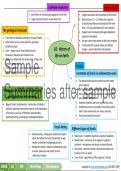
Cambrian explosion History of life
• Early forms of animal groups appeared in this time. • Oxygen levels were very low when earth formed.
• Huge diversity formed in a very short time. • Bacteria arose 3,5 – 2,5 billion years ago that
could photosynthesise and produced their own
food – CO2 was absorbed and O2 was released.
The geological timescale • Oxygen levels increased and oxygen-dependent
• Time units are divided according to the age of fossils. organisms developed.
• Index fossils can be used to identify a particular • Ice ages cause many species to die out or migrate.
period/rock layer. • Continental drift caused climate and habitat
• Aeon – largest unit of time divided into the U2: History of change – caused extinction and adaption.
Palaeozoic, Mesozoic and Cenozoic eras. life on Earth
• Each era is divided into the Quaternary, Tertiary and
•
Sample
Cretaceous periods.
Transitional fossils – rare intermediate forms that link
distinct groups of organisms.
Fossils
Formation of fossils in sedimentary rocks
• The plant/animal must be buried soon after death
with sediment.
•
Summaries after sample
The impact of humans on biodiversity
and the natural environment
Biggest threats to biodiversity – destruction of habitats,
•
•
•
•
Soft tissues decompose and hard parts remain intact.
More sediment layers form above it and cause high
pressure and temperature.
Sediment solidifies and forms sedimentary rocks.
Sedimentary rocks are pushed to the surface due to
pollution, planting invasive/alien species, over-exploitation
earth’s slow movements over many centuries.
of resources, over-use of fertilisers and pesticides,
poaching/hunting, and trading in endangered species. • Fossils are exposed by erosion.
Fossil dating Different types of fossils
• Relative dating - studying the sedimentary layers
• Body fossils – complete organisms or parts of organisms.
above and below the fossil to determine its age
• Mould fossils - hard parts of an organism trapped in
relative to another fossil/geological event.
sediment – decomposes and leaves an imprint/mould.
• Radiometric dating - based on radioactivity using
• Cast fossils - when the mould is filled with minerals and
uranium, potassium and carbon to form
fossilise to form a replica.
radioactive isotopes.
• Trace fossils - signs/marks of the organism’s activity.
GR10 LS M4 Mind Map The Answer Copyright © www.summariessa.co.za (DO NOT COPY)
, Sample
Summaries after sample
• Early forms of animal groups appeared in this time. • Oxygen levels were very low when earth formed.
• Huge diversity formed in a very short time. • Bacteria arose 3,5 – 2,5 billion years ago that
could photosynthesise and produced their own
food – CO2 was absorbed and O2 was released.
The geological timescale • Oxygen levels increased and oxygen-dependent
• Time units are divided according to the age of fossils. organisms developed.
• Index fossils can be used to identify a particular • Ice ages cause many species to die out or migrate.
period/rock layer. • Continental drift caused climate and habitat
• Aeon – largest unit of time divided into the U2: History of change – caused extinction and adaption.
Palaeozoic, Mesozoic and Cenozoic eras. life on Earth
• Each era is divided into the Quaternary, Tertiary and
•
Sample
Cretaceous periods.
Transitional fossils – rare intermediate forms that link
distinct groups of organisms.
Fossils
Formation of fossils in sedimentary rocks
• The plant/animal must be buried soon after death
with sediment.
•
Summaries after sample
The impact of humans on biodiversity
and the natural environment
Biggest threats to biodiversity – destruction of habitats,
•
•
•
•
Soft tissues decompose and hard parts remain intact.
More sediment layers form above it and cause high
pressure and temperature.
Sediment solidifies and forms sedimentary rocks.
Sedimentary rocks are pushed to the surface due to
pollution, planting invasive/alien species, over-exploitation
earth’s slow movements over many centuries.
of resources, over-use of fertilisers and pesticides,
poaching/hunting, and trading in endangered species. • Fossils are exposed by erosion.
Fossil dating Different types of fossils
• Relative dating - studying the sedimentary layers
• Body fossils – complete organisms or parts of organisms.
above and below the fossil to determine its age
• Mould fossils - hard parts of an organism trapped in
relative to another fossil/geological event.
sediment – decomposes and leaves an imprint/mould.
• Radiometric dating - based on radioactivity using
• Cast fossils - when the mould is filled with minerals and
uranium, potassium and carbon to form
fossilise to form a replica.
radioactive isotopes.
• Trace fossils - signs/marks of the organism’s activity.
GR10 LS M4 Mind Map The Answer Copyright © www.summariessa.co.za (DO NOT COPY)
, Sample
Summaries after sample


