

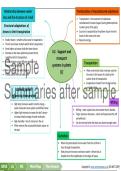
Relationship between water Translocation of manufactured substances
loss and the structure of a leaf • Translocation – the movement of substances
manufactured in leaves (sugars) during photosynthesis
Structural adaptations of to other parts of the plant.
leaves to limit transpiration • Sucrose is transported by the phloem tissue from the
leaves to the stems and roots.
• Smaller leaves = smaller surface area for evaporation. • Requires energy.
• Thorns have fewer stomata which limits transpiration.
• Some higher up leaves shade the lower leaves.
• Stomata on the lower epidermis prevent direct U1: Support and
sunlight and limit transpiration. transport
Sample
• Sunken stomata cause diffusion gradient and
systems in plants Transpiration
transpiration to be low.
• Hairs on leaves trap water vapour. • Water and mineral salts are drawn up from
• A thick cuticle restricts water loss.
(C) the roots to the leaves of a plant by the
suction force of transpiration.
• Evaporation of water from the leaf surface
Summaries after sample
External factors
influencing transpiration
• High temp increases water’s kinetic energy –
cools the plant.
Wilting
water molecules move quicker and diffuse faster. • Wilting – when a plant loses more water than it absorbs.
• Higher light intensity increases the leaf’s temp – • Turgor pressure decreases – stems and leaves become soft
increases kinetic energy of water molecules. and withered.
• High humidity = lots of moisture in the air. • Can be reversed when the plant can absorb enough water.
• Wind removes the accumulated water vapour on
the leaf.
Guttation
• When the plant absorbs more water from the soil than it
loses through transpiration.
• Root pressure increases and excess water is forced out as
droplets from the hydathodes on the edges of leaves.
GR10 LS M2 Mind Map The Answer Copyright © www.summariessa.co.za (DO NOT COPY)
,Sample
Summaries after sample
,Sample
Summaries after sample
, Dicotyledonous stem Dicotyledonous root
Main functions Main functions
• Bears leaves in a favourable position for light absorption. • Absorbs water and mineral salts from the soil.
• Bears flowers in a favourable position for pollination. • Anchors the plant.
• Bears fruits in a favourable position for seed distribution.
• Transports water and mineral salts from the roots.
• Transports organic substances from the leaves. External structure
• Stores reserve nutrients and water.
• 5 regions of the main root:
U1: Support and o Root cap – surrounds and protects.
External structure transport o Meristematic region – continuously forms new
cells.
• Node – where leaves, flowers and side branches develop. systems in plants o Region of elongation – new cells elongate
• Internode – region between 2 nodes. here.
• Terminal bud – meristematic tissue at the tip of stem
(A) o Root hair region – unicellular, epidermal
that forms new cells and results in primary growth. outgrowths that increase the absorption
• Axillary buds – develop into lateral branches/flowers and surface.
occur between the stem and a leaf stalk. o Mature region – lateral roots develop here to
increase the absorption surface and anchor
the plant.
Internal structure o
• Epidermis - outer layer consisting of thin-walled,
brick-shaped cells.
Internal structure
• Cortex - under the epidermis consisting of 3 layers • Catabolic
Epidermis – outer layer of the root.reaction
(collenchyma, parenchyma and endodermis). • Cortex – broad band under the epidermis:
s
• Central cylinder: o Endodermis – innermost layer of the cortex
o Xylem on the inside and phloem on the outside. which is a single layer of modified
o Cambium – allows for secondary thickening. parenchyma cells.
o Pith – large thin-walled parenchyma cells with • Central cylinder (stele) - all tissue enclosed by
large intercellular spaces. the endodermis.
o Medullary rays – transports substances between
the pith and cortex.
GR10 LS M2 Mind Map The Answer Copyright © www.summariessa.co.za (DO NOT COPY)
loss and the structure of a leaf • Translocation – the movement of substances
manufactured in leaves (sugars) during photosynthesis
Structural adaptations of to other parts of the plant.
leaves to limit transpiration • Sucrose is transported by the phloem tissue from the
leaves to the stems and roots.
• Smaller leaves = smaller surface area for evaporation. • Requires energy.
• Thorns have fewer stomata which limits transpiration.
• Some higher up leaves shade the lower leaves.
• Stomata on the lower epidermis prevent direct U1: Support and
sunlight and limit transpiration. transport
Sample
• Sunken stomata cause diffusion gradient and
systems in plants Transpiration
transpiration to be low.
• Hairs on leaves trap water vapour. • Water and mineral salts are drawn up from
• A thick cuticle restricts water loss.
(C) the roots to the leaves of a plant by the
suction force of transpiration.
• Evaporation of water from the leaf surface
Summaries after sample
External factors
influencing transpiration
• High temp increases water’s kinetic energy –
cools the plant.
Wilting
water molecules move quicker and diffuse faster. • Wilting – when a plant loses more water than it absorbs.
• Higher light intensity increases the leaf’s temp – • Turgor pressure decreases – stems and leaves become soft
increases kinetic energy of water molecules. and withered.
• High humidity = lots of moisture in the air. • Can be reversed when the plant can absorb enough water.
• Wind removes the accumulated water vapour on
the leaf.
Guttation
• When the plant absorbs more water from the soil than it
loses through transpiration.
• Root pressure increases and excess water is forced out as
droplets from the hydathodes on the edges of leaves.
GR10 LS M2 Mind Map The Answer Copyright © www.summariessa.co.za (DO NOT COPY)
,Sample
Summaries after sample
,Sample
Summaries after sample
, Dicotyledonous stem Dicotyledonous root
Main functions Main functions
• Bears leaves in a favourable position for light absorption. • Absorbs water and mineral salts from the soil.
• Bears flowers in a favourable position for pollination. • Anchors the plant.
• Bears fruits in a favourable position for seed distribution.
• Transports water and mineral salts from the roots.
• Transports organic substances from the leaves. External structure
• Stores reserve nutrients and water.
• 5 regions of the main root:
U1: Support and o Root cap – surrounds and protects.
External structure transport o Meristematic region – continuously forms new
cells.
• Node – where leaves, flowers and side branches develop. systems in plants o Region of elongation – new cells elongate
• Internode – region between 2 nodes. here.
• Terminal bud – meristematic tissue at the tip of stem
(A) o Root hair region – unicellular, epidermal
that forms new cells and results in primary growth. outgrowths that increase the absorption
• Axillary buds – develop into lateral branches/flowers and surface.
occur between the stem and a leaf stalk. o Mature region – lateral roots develop here to
increase the absorption surface and anchor
the plant.
Internal structure o
• Epidermis - outer layer consisting of thin-walled,
brick-shaped cells.
Internal structure
• Cortex - under the epidermis consisting of 3 layers • Catabolic
Epidermis – outer layer of the root.reaction
(collenchyma, parenchyma and endodermis). • Cortex – broad band under the epidermis:
s
• Central cylinder: o Endodermis – innermost layer of the cortex
o Xylem on the inside and phloem on the outside. which is a single layer of modified
o Cambium – allows for secondary thickening. parenchyma cells.
o Pith – large thin-walled parenchyma cells with • Central cylinder (stele) - all tissue enclosed by
large intercellular spaces. the endodermis.
o Medullary rays – transports substances between
the pith and cortex.
GR10 LS M2 Mind Map The Answer Copyright © www.summariessa.co.za (DO NOT COPY)


