

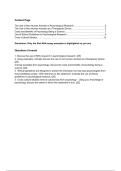
Content Page
The Use of Non-Human Animals in Psychological Research……………………………………2
The Use of Non-Human Animals as a Therapeutic Device………………………………………5
Costs and Benefits of Psychology Being a Science………………………………………………7
Use of Ethical Guidelines in Psychological Research…………………………………………….9
Cross Cultural Studies……………………………………………………………………………...12
Disclaimer: Only the first NHA essay exemplar is highlighted as you see
Questions Covered
1. Discuss the use of NHA research in psychological research. [25]
2. Using examples, critically discuss the use of non-human animals as a therapeutic device.
[25]
3.Using examples from psychology, discuss the costs and benefits of psychology being a
science. [25]
4. “Ethical guidelines are designed to protect the individual, but may stop psychologists from
truly benefitting society.” With reference to this statement, evaluate the use of ethical
guidelines in psychological research. [25]
5. ‘Cross cultural studies remove cultural bias from psychology’. Using your knowledge of
psychology, discuss the extent to which this statement is true. [25]
, 1. Discuss the use of NHA research in psychological research. [25]
4 Learning Objectives - Research - A02 - A03
The research of non-human animals has been a long-winded debate and the key issue is
whether psychologists should be using non-human animals in research.
First, ethological research has been important in adding to and teaching us about the
animals themselves. For example, Dian Fossey spent 2000 hours in the forests of Central
Africa studying primates such as great apes and, throughout the process, learnt multiple
behavioural habits of gorillas. This kind of research has no negative effects on the animals
and is essential in building our understanding of other species. It supports the use of
non-human animals in psychological research because it brings benefit to both the animals
and humans by correcting our behaviour.
Comparative research has used the discovery of animals similar to humans and extrapolated
that information to apply to humans. It’s also easier to control variables and objectivity in
research procedures, such as investigating an animal’s life from generation to generation for
rodents. This is illustrated by Harry Harlow’s monkey research. He placed monkeys within
containment with two surrogate mothers, a wire mother that could nurse and a cloth mother.
At the end of his research, he found that the monkeys stayed with the cloth mother most of
the time and only went to the wire mother to nurse. Additionally, when the cloth mother was
present, the monkey was braver when exploring new objects presented to them.
The findings told him feeding wasn’t the basis of attachment between the caregiver and the
infant. However, this study has been widely criticised due to its ethics and unnecessary harm
caused to the animal. Another, less controlled but more ethical study, found the same
results. In the Glasgow baby study, Schaffer and Emerson found that feeding and bathing
weren’t good indicators of attachment to caregivers but instead, quality time spent together.
It brings up the question of why Harlow’s research was necessary in the first place when
there were other suitable alternatives. It had mixed opinions when using non-human animals
and highlighted the fact that objectivity in research shouldn’t be the only reason that
researchers use NHA in their research. It places an important emphasis that alternatives
should be used whenever possible. However, Harry Harlow’s research had set the basis for
theories of attachment that were important for further research and understanding of both
humans and animals.
Another use of animals is animals in therapeutic settings. Karren Allen performed a recent
study to test the effect of spouses, friends and pets on cardiovascular activity (through blood
pressure and heart rate). This study assigned procedures such as a cold pressor and
arithmetic questions to the participants in randomly assigned situations, whether it may be
with their partner, friend or pets. In conclusion, their findings suggested that pets were the
most effective in terms of stress relief. Research like this has increased the possibilities of
similar animal-based research, such as allowing the elderly and patients to have in-care
homes and improve their health in the long term. Other research has also supported the use
of animals in prison environments and how it reduces aggression. This piece of research
supports the use of non-human animals because it has positively affected different stressful
environments by improving mental health. Due to the care of the animal during this process,
The Use of Non-Human Animals in Psychological Research……………………………………2
The Use of Non-Human Animals as a Therapeutic Device………………………………………5
Costs and Benefits of Psychology Being a Science………………………………………………7
Use of Ethical Guidelines in Psychological Research…………………………………………….9
Cross Cultural Studies……………………………………………………………………………...12
Disclaimer: Only the first NHA essay exemplar is highlighted as you see
Questions Covered
1. Discuss the use of NHA research in psychological research. [25]
2. Using examples, critically discuss the use of non-human animals as a therapeutic device.
[25]
3.Using examples from psychology, discuss the costs and benefits of psychology being a
science. [25]
4. “Ethical guidelines are designed to protect the individual, but may stop psychologists from
truly benefitting society.” With reference to this statement, evaluate the use of ethical
guidelines in psychological research. [25]
5. ‘Cross cultural studies remove cultural bias from psychology’. Using your knowledge of
psychology, discuss the extent to which this statement is true. [25]
, 1. Discuss the use of NHA research in psychological research. [25]
4 Learning Objectives - Research - A02 - A03
The research of non-human animals has been a long-winded debate and the key issue is
whether psychologists should be using non-human animals in research.
First, ethological research has been important in adding to and teaching us about the
animals themselves. For example, Dian Fossey spent 2000 hours in the forests of Central
Africa studying primates such as great apes and, throughout the process, learnt multiple
behavioural habits of gorillas. This kind of research has no negative effects on the animals
and is essential in building our understanding of other species. It supports the use of
non-human animals in psychological research because it brings benefit to both the animals
and humans by correcting our behaviour.
Comparative research has used the discovery of animals similar to humans and extrapolated
that information to apply to humans. It’s also easier to control variables and objectivity in
research procedures, such as investigating an animal’s life from generation to generation for
rodents. This is illustrated by Harry Harlow’s monkey research. He placed monkeys within
containment with two surrogate mothers, a wire mother that could nurse and a cloth mother.
At the end of his research, he found that the monkeys stayed with the cloth mother most of
the time and only went to the wire mother to nurse. Additionally, when the cloth mother was
present, the monkey was braver when exploring new objects presented to them.
The findings told him feeding wasn’t the basis of attachment between the caregiver and the
infant. However, this study has been widely criticised due to its ethics and unnecessary harm
caused to the animal. Another, less controlled but more ethical study, found the same
results. In the Glasgow baby study, Schaffer and Emerson found that feeding and bathing
weren’t good indicators of attachment to caregivers but instead, quality time spent together.
It brings up the question of why Harlow’s research was necessary in the first place when
there were other suitable alternatives. It had mixed opinions when using non-human animals
and highlighted the fact that objectivity in research shouldn’t be the only reason that
researchers use NHA in their research. It places an important emphasis that alternatives
should be used whenever possible. However, Harry Harlow’s research had set the basis for
theories of attachment that were important for further research and understanding of both
humans and animals.
Another use of animals is animals in therapeutic settings. Karren Allen performed a recent
study to test the effect of spouses, friends and pets on cardiovascular activity (through blood
pressure and heart rate). This study assigned procedures such as a cold pressor and
arithmetic questions to the participants in randomly assigned situations, whether it may be
with their partner, friend or pets. In conclusion, their findings suggested that pets were the
most effective in terms of stress relief. Research like this has increased the possibilities of
similar animal-based research, such as allowing the elderly and patients to have in-care
homes and improve their health in the long term. Other research has also supported the use
of animals in prison environments and how it reduces aggression. This piece of research
supports the use of non-human animals because it has positively affected different stressful
environments by improving mental health. Due to the care of the animal during this process,


