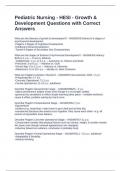
Pediatric Nursing - HESI - Growth &
Development Questions with Correct
Answers
What are the theories of growth & development? - ANSWERS-Erikson's 8 stages of
psychosocial development
-Piaget's 4 Stages of Cognitive Development
-Kohlberg's Moral Development
-Tanner's Stages of Secondary Sex Characteristics
What are the stages of Erikson's Psychosocial Development? - ANSWERS-Infancy:
Birth to 1 y.o. -- Trust vs. Mistrust
-Toddlerhood: 1 y.o. to 3 y.o. -- Autonomy vs. Shame and doubt
-Preschool: 3 to 6 y.o. -- Initiative vs. Guilt
-School Age: 6 to 12 y.o. -- Industry vs. Inferiority
-Adolescent: 12 to 18+ y.o. -- Identity vs. Role Confusion
What are Piaget's Cognitive Theories? - ANSWERS-Sensorimotor: Birth - 2 y.o.
-Preoperational: 2-7 y.o.
-Concrete Operational: 7-11 y.o.
-Formal Operational: 11-15 y.o., adulthood
Describe Piaget's Sensorimotor stage. - ANSWERSBirth - 2 y.o.
-object permanence (object exists even though it is not longer visible)
-governed by sensations in which simple learning takes place -- imitative behavior,
cause & effect, problem solving by trial & error.
Describe Piaget's Preoperational Stage. - ANSWERS2-7 y.o.
-Egocentrism
-intuitive (e.g. reasoning = stars have to go to bed just as they do);
-transducive (because two events occur together, they cause each other—e.g. all
women w/ big bellies have babies).
Describe Piaget's Concrete Operational Stage: - ANSWERS7-11 y.o.
-Conservation (realize that physical factors such as volume, weight, & number remain
the same even though outward appearances are changed);
-Inductive (based on evidence, conclusion is probably true).
Describe Piaget's Formal Operational Stage: - ANSWERS11 - 15 y.o., adulthood
-Adaptability & flexibility.
-Abstract thinking.
, Describe Erikson's Trust vs. Mistrust stage - ANSWERSBirth to 1 y.o.
-Basic trust; exists only in relation to something or someone, therefore consistent loving
care is essential.
*faith & optimism
Describe Erikson's Autonomy vs. Shame/Doubt - ANSWERS1 to 3 y.o. (Toddlerhood)
-Childs ability to control their bodies, themselves, and their environment.
-Learning through imitation
-Children are made to feel small and self conscious when their choices are disastrous or
they're forced to be dependent.
*Self-control & willpower.
Describe Erikson's Initiative vs. Guilt - ANSWERS3 to 6 y.o. (preschool)
-Magical Thinking!!
-Belief that thoughts are all powerful (if sister gets sick, they will feel its their fault for
"wishing" it)
-Develop conscience
*Direction & Purpose
Describe Erikson's Industry vs. Inferiority - ANSWERS6 to 12 y.o. (School Age)
-Ready to be workers & producers
-They learn the rules
-Decisive period in social relationships
-May feel inadequate if they cannot measure up to standards.
*Competence
Describe Erikson's Identity vs. Role Confusion - ANSWERS12 to 18 y.o.+
(Adolescence)
-Rapid & marked physical changes
-Preoccupied by perception of others
-inability to solve core conflict results in role confusion
*Devotion & fidelity
When does birth weight double? - ANSWERS6 months
When does birth weight triple? - ANSWERS12 months (1 year)
When does birth length increase by 50%? - ANSWERS12 months (1 year)
When do the posterior fontanels close? - ANSWERS8 weeks
When do the anterior fontanels close? - ANSWERS12-18 months
When does a child smile and make "cooing" sounds - ANSWERS2 months
When does the head turn to locate sounds? - ANSWERS3 months
Development Questions with Correct
Answers
What are the theories of growth & development? - ANSWERS-Erikson's 8 stages of
psychosocial development
-Piaget's 4 Stages of Cognitive Development
-Kohlberg's Moral Development
-Tanner's Stages of Secondary Sex Characteristics
What are the stages of Erikson's Psychosocial Development? - ANSWERS-Infancy:
Birth to 1 y.o. -- Trust vs. Mistrust
-Toddlerhood: 1 y.o. to 3 y.o. -- Autonomy vs. Shame and doubt
-Preschool: 3 to 6 y.o. -- Initiative vs. Guilt
-School Age: 6 to 12 y.o. -- Industry vs. Inferiority
-Adolescent: 12 to 18+ y.o. -- Identity vs. Role Confusion
What are Piaget's Cognitive Theories? - ANSWERS-Sensorimotor: Birth - 2 y.o.
-Preoperational: 2-7 y.o.
-Concrete Operational: 7-11 y.o.
-Formal Operational: 11-15 y.o., adulthood
Describe Piaget's Sensorimotor stage. - ANSWERSBirth - 2 y.o.
-object permanence (object exists even though it is not longer visible)
-governed by sensations in which simple learning takes place -- imitative behavior,
cause & effect, problem solving by trial & error.
Describe Piaget's Preoperational Stage. - ANSWERS2-7 y.o.
-Egocentrism
-intuitive (e.g. reasoning = stars have to go to bed just as they do);
-transducive (because two events occur together, they cause each other—e.g. all
women w/ big bellies have babies).
Describe Piaget's Concrete Operational Stage: - ANSWERS7-11 y.o.
-Conservation (realize that physical factors such as volume, weight, & number remain
the same even though outward appearances are changed);
-Inductive (based on evidence, conclusion is probably true).
Describe Piaget's Formal Operational Stage: - ANSWERS11 - 15 y.o., adulthood
-Adaptability & flexibility.
-Abstract thinking.
, Describe Erikson's Trust vs. Mistrust stage - ANSWERSBirth to 1 y.o.
-Basic trust; exists only in relation to something or someone, therefore consistent loving
care is essential.
*faith & optimism
Describe Erikson's Autonomy vs. Shame/Doubt - ANSWERS1 to 3 y.o. (Toddlerhood)
-Childs ability to control their bodies, themselves, and their environment.
-Learning through imitation
-Children are made to feel small and self conscious when their choices are disastrous or
they're forced to be dependent.
*Self-control & willpower.
Describe Erikson's Initiative vs. Guilt - ANSWERS3 to 6 y.o. (preschool)
-Magical Thinking!!
-Belief that thoughts are all powerful (if sister gets sick, they will feel its their fault for
"wishing" it)
-Develop conscience
*Direction & Purpose
Describe Erikson's Industry vs. Inferiority - ANSWERS6 to 12 y.o. (School Age)
-Ready to be workers & producers
-They learn the rules
-Decisive period in social relationships
-May feel inadequate if they cannot measure up to standards.
*Competence
Describe Erikson's Identity vs. Role Confusion - ANSWERS12 to 18 y.o.+
(Adolescence)
-Rapid & marked physical changes
-Preoccupied by perception of others
-inability to solve core conflict results in role confusion
*Devotion & fidelity
When does birth weight double? - ANSWERS6 months
When does birth weight triple? - ANSWERS12 months (1 year)
When does birth length increase by 50%? - ANSWERS12 months (1 year)
When do the posterior fontanels close? - ANSWERS8 weeks
When do the anterior fontanels close? - ANSWERS12-18 months
When does a child smile and make "cooing" sounds - ANSWERS2 months
When does the head turn to locate sounds? - ANSWERS3 months