
Amines
Types of Amines
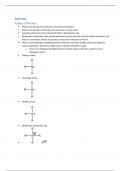
Amines can be classed as primary, secondary and tertiary
Amines are related to ammonia, but ammonia is not an amine
Aromatic amines have the N joined directly to the benzene ring
Quaternary ammonium salts contain quaternary ammonium ions and are related to amines, but
they are not amines and do not possess a lone pair of electrons on the N
There is some hydrogen bonding between molecules and many simple amines are liquids at
room temperature, but this is weaker than in alcohols (CH 3NH2 is a gas)
o There is no hydrogen bonding between tertiary amine molecules as there is no H
attached to the N
Primary amine
Secondary amine
Tertiary amine
Quaternary ammonium salt
, Amines as Bases
Amines are Bronsted-Lowry bases (proton acceptors)
They are weak bases and act as bases because the lone pair on the N atom can readily accept a
proton
NH3 + HCl -> NH4+Cl–
RNH2 + HCl -> RNH3+Cl–
(R)2NH + HCl -> (R)2NH2+Cl–
(R)3N + HCl -> (R)3NH+Cl–
Base Strength of Amines
The ability of ammonia or amine to act as a base depends on how well the lone pair on the N
atom can accept H+
The higher the electron density of the lone pair on the N, the better it will be able to accept H +
so the stronger the base
In general, the order of base strength is:
o Tertiary amine > Secondary amine > Primary amine > Ammonia > Aromatic amine
Compared to ammonia, the more akyl groups that are substituted onto the N atom in place of H
atoms, the more electron density is pushed onto the N atom due to the inductive effect of alkyl
groups compared to H atoms, so there is higher electron density on the lone pair, making it
more available, and thus the base is stronger
The lone pair on the N in aromatic amines is partially delocalised into the benzene ring, leading
to a reduction in the electron density on the N atom and so weaker base strength
Nucleophilic Substitution Reactions
NH3 reacts with halogenoalkanes to form primary amines initially
The overall reaction is nucleophilic substitution, with ammonia acting as a nucleophile through
the lone pair on the N atom attacking the electron deficient δ+ C atom of the C-halogen bond
R-X + 2NH3 -> R-NH2 + NH4X
Types of Amines
Amines can be classed as primary, secondary and tertiary
Amines are related to ammonia, but ammonia is not an amine
Aromatic amines have the N joined directly to the benzene ring
Quaternary ammonium salts contain quaternary ammonium ions and are related to amines, but
they are not amines and do not possess a lone pair of electrons on the N
There is some hydrogen bonding between molecules and many simple amines are liquids at
room temperature, but this is weaker than in alcohols (CH 3NH2 is a gas)
o There is no hydrogen bonding between tertiary amine molecules as there is no H
attached to the N
Primary amine
Secondary amine
Tertiary amine
Quaternary ammonium salt
, Amines as Bases
Amines are Bronsted-Lowry bases (proton acceptors)
They are weak bases and act as bases because the lone pair on the N atom can readily accept a
proton
NH3 + HCl -> NH4+Cl–
RNH2 + HCl -> RNH3+Cl–
(R)2NH + HCl -> (R)2NH2+Cl–
(R)3N + HCl -> (R)3NH+Cl–
Base Strength of Amines
The ability of ammonia or amine to act as a base depends on how well the lone pair on the N
atom can accept H+
The higher the electron density of the lone pair on the N, the better it will be able to accept H +
so the stronger the base
In general, the order of base strength is:
o Tertiary amine > Secondary amine > Primary amine > Ammonia > Aromatic amine
Compared to ammonia, the more akyl groups that are substituted onto the N atom in place of H
atoms, the more electron density is pushed onto the N atom due to the inductive effect of alkyl
groups compared to H atoms, so there is higher electron density on the lone pair, making it
more available, and thus the base is stronger
The lone pair on the N in aromatic amines is partially delocalised into the benzene ring, leading
to a reduction in the electron density on the N atom and so weaker base strength
Nucleophilic Substitution Reactions
NH3 reacts with halogenoalkanes to form primary amines initially
The overall reaction is nucleophilic substitution, with ammonia acting as a nucleophile through
the lone pair on the N atom attacking the electron deficient δ+ C atom of the C-halogen bond
R-X + 2NH3 -> R-NH2 + NH4X


