Carboxylic Acids
Weak acids – do not disassociate fully, small fraction of molecules ionise when added to water
to release H+ ions
React with alkalis, metals, carbonates and ammonia like other acids but the reaction is slower
Sodium carbonate chemical test for carboxylic acid – gentle fizzing
Esters
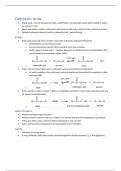
Esters are produced when alcohols react with carboxylic acids (esterification)
o Esterification is reversible and slow
o Concentrated acid catalyst often used but still a slow reaction
o Better ways to make esters – reaction between an alcohol and an acid anhydride often
used instead (not reversible, higher yield)
o
Esters can be broken down into a carboxylic acid and alcohol (ester hydrolysis)
o In acidic conditions the carboxylic acid and alcohol are formed but the reaction is slow
and reversible
o
If the reaction is done in alkali, it goes to completion and forms a salt of the carboxylic acid and
an alcohol (saponification)
o
Uses of esters
Many food flavourings are esters
Many perfumes contain mixtures of esters in a solvent that quickly evaporates (e.g. ethanol)
Esters are often used as solvents (ethyl ethanoate in nail varnish)
Esters can be used as plasticisers to make polymers more flexible
Lipids
Naturally occurring esters
3 long carboxylic acids (fatty acids) joined through the alcohol propane-1,2,3-triol (glycerol)
,
Fatty acids can be saturated or unsaturated
Lipids that are liquids at room temperature are called oils and tend to contain unsaturated fatty
acids
Lipids that are solids at room temperature are called fats and tend to contain saturated fatty
acids
Glycerol is able to form hydrogen bonds
Making soap
Saponification of lipids produces salts of fatty acids and glycerol
This mixture is used as soap and is often made by boiling lipids with potassium hydroxide (alkali
hydrolysis)
Biodiesel
Lipid is broken down into 3 fatty acids and glycerol by reaction with potassium hydroxide
The fatty acids are then converted to 3 new esters using methanol (transesterification)
The potassium hydroxide is not used up and so acts as a catalyst
Biodiesel can be used in most diesel engines in place of diesel made from crude oil.
Diesel sold in the UK is 95% crude oil diesel and 5% biodiesel (made from rapeseed oil)
Biodiesel is potentially a carbon neutral fuel (no net release of CO 2 to the atmosphere as same
amount of CO2 is released when the fuel is burned as the crops it was made from absorbed from
photosynthesis
Weak acids – do not disassociate fully, small fraction of molecules ionise when added to water
to release H+ ions
React with alkalis, metals, carbonates and ammonia like other acids but the reaction is slower
Sodium carbonate chemical test for carboxylic acid – gentle fizzing
Esters
Esters are produced when alcohols react with carboxylic acids (esterification)
o Esterification is reversible and slow
o Concentrated acid catalyst often used but still a slow reaction
o Better ways to make esters – reaction between an alcohol and an acid anhydride often
used instead (not reversible, higher yield)
o
Esters can be broken down into a carboxylic acid and alcohol (ester hydrolysis)
o In acidic conditions the carboxylic acid and alcohol are formed but the reaction is slow
and reversible
o
If the reaction is done in alkali, it goes to completion and forms a salt of the carboxylic acid and
an alcohol (saponification)
o
Uses of esters
Many food flavourings are esters
Many perfumes contain mixtures of esters in a solvent that quickly evaporates (e.g. ethanol)
Esters are often used as solvents (ethyl ethanoate in nail varnish)
Esters can be used as plasticisers to make polymers more flexible
Lipids
Naturally occurring esters
3 long carboxylic acids (fatty acids) joined through the alcohol propane-1,2,3-triol (glycerol)
,
Fatty acids can be saturated or unsaturated
Lipids that are liquids at room temperature are called oils and tend to contain unsaturated fatty
acids
Lipids that are solids at room temperature are called fats and tend to contain saturated fatty
acids
Glycerol is able to form hydrogen bonds
Making soap
Saponification of lipids produces salts of fatty acids and glycerol
This mixture is used as soap and is often made by boiling lipids with potassium hydroxide (alkali
hydrolysis)
Biodiesel
Lipid is broken down into 3 fatty acids and glycerol by reaction with potassium hydroxide
The fatty acids are then converted to 3 new esters using methanol (transesterification)
The potassium hydroxide is not used up and so acts as a catalyst
Biodiesel can be used in most diesel engines in place of diesel made from crude oil.
Diesel sold in the UK is 95% crude oil diesel and 5% biodiesel (made from rapeseed oil)
Biodiesel is potentially a carbon neutral fuel (no net release of CO 2 to the atmosphere as same
amount of CO2 is released when the fuel is burned as the crops it was made from absorbed from
photosynthesis