
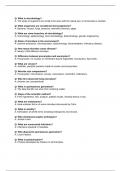
Q: What is microbiology?
A: The study of organisms too small to be seen with the naked eye; a microscope is needed.
Q: What organisms are considered microorganisms?
A: Bacteria, viruses, fungi, protozoa, helminths (worms), algae.
Q: What are some branches of microbiology?
A: Immunology, epidemiology, food microbiology, biotechnology, genetic engineering.
Q: Roles of microbes in the environment?
A: Nutrient production, decomposition, biotechnology, bioremediation, infectious disease.
Q: How many microbes cause disease?
A: Nearly 2,000 different microbes.
Q: Difference between procaryotes and eucaryotes?
A: Procaryotes: no nucleus or membrane-bound organelles. Eucaryotes: have both.
Q: What are viruses?
A: Acellular, parasitic particles made of nucleic acid and protein.
Q: Microbe size comparisons?
A: Procaryotes: micrometers, viruses: nanometers, helminths: millimeters.
Q: Who first observed living microbes?
A: Antonie van Leeuwenhoek.
Q: What is spontaneous generation?
A: The idea that life can arise from nonliving matter.
Q: Steps of the scientific method?
A: Form hypothesis, test, analyze, publish results, develop theory or law.
Q: What are endospores?
A: Heat-resistant forms of some microbes discovered by Cohn.
Q: What is sterility?
A: Elimination of all life forms including endospores and viruses.
Q: Who introduced aseptic techniques?
A: Joseph Lister.
Q: What are nosocomial infections?
A: Infections acquired in hospitals.
Q: Who disproved spontaneous generation?
A: Louis Pasteur.
Q: What is pasteurization?
A: Process developed by Pasteur to kill microbes.
A: The study of organisms too small to be seen with the naked eye; a microscope is needed.
Q: What organisms are considered microorganisms?
A: Bacteria, viruses, fungi, protozoa, helminths (worms), algae.
Q: What are some branches of microbiology?
A: Immunology, epidemiology, food microbiology, biotechnology, genetic engineering.
Q: Roles of microbes in the environment?
A: Nutrient production, decomposition, biotechnology, bioremediation, infectious disease.
Q: How many microbes cause disease?
A: Nearly 2,000 different microbes.
Q: Difference between procaryotes and eucaryotes?
A: Procaryotes: no nucleus or membrane-bound organelles. Eucaryotes: have both.
Q: What are viruses?
A: Acellular, parasitic particles made of nucleic acid and protein.
Q: Microbe size comparisons?
A: Procaryotes: micrometers, viruses: nanometers, helminths: millimeters.
Q: Who first observed living microbes?
A: Antonie van Leeuwenhoek.
Q: What is spontaneous generation?
A: The idea that life can arise from nonliving matter.
Q: Steps of the scientific method?
A: Form hypothesis, test, analyze, publish results, develop theory or law.
Q: What are endospores?
A: Heat-resistant forms of some microbes discovered by Cohn.
Q: What is sterility?
A: Elimination of all life forms including endospores and viruses.
Q: Who introduced aseptic techniques?
A: Joseph Lister.
Q: What are nosocomial infections?
A: Infections acquired in hospitals.
Q: Who disproved spontaneous generation?
A: Louis Pasteur.
Q: What is pasteurization?
A: Process developed by Pasteur to kill microbes.


