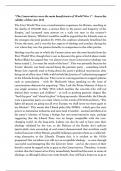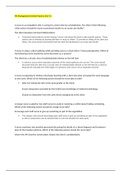
“The Conservatives were the main beneficiaries of World War 1”. Assess the
validity of this view [25]
The First World War was a transformative experience for Britain, resulting in
the deaths of 700,000 men, a serious blow to the power and longevity of the
Empire, and increased state powers on a scale not seen in the country’s
democratic history. Whilst it would be could be argued that the Liberals were in
the strongest electoral position by 1918, the coalition ultimately benefitted the
Tories the most, and it was the key aspects of ideology and conduct during the
war where they saw the greatest benefits in comparison to the other parties.
Ideology was the area in which the Conservatives saw the most benefit from the
First World War, though that is not to discount the gains which Labour made.
Robert Blake has argued that “on almost every issue Conservative ideology was
better suited [...] to meet the needs of the hour”. This was primarily because the
Tories’ identity was built around being the patriotic party – something which
Bonar Law expertly used to bring about the party’s political resurrection after
being out of office since 1906, with his bold declaration of “unhesitating support”
to the Liberals during the war. They were in a strong position to support policies
such as conscription – with Sir Hedworth Meux speaking on the issue of
conscientious objectors by enquiring: “May I ask the Prime Minister if there is
one single sentence in Holy Writ which justifies the cowards who will not
defend their women and children” - as well as pushing patriotic slogans like
“feed the guns” and “share his glory” to keep up morale. Meanwhile, the Liberals
were a peacetime party, in a time where, in the words of Sir Edward Grey, “The
lights [of peace] are going out all over Europe; we shall never see them again in
my lifetime”. This meant that Liberal policy like DORA – which gave the state
power to nationalise industries and seize land if needed – seemed antithetical to
the party’s identity of being a benign but non-interventionist state, perhaps
suggesting that the Liberal Party was no longer compatible with the ever-
changing world. In the long-term, Labour can also be said to have seen their
ideology validated by the war, as the Defence of the Realm Act’s policies
(particularly state ownership of coal mines) demonstrated that socialism could
indeed function within Britain, possibly helping to position them as a viable left-
wing alternative to the Liberals. Despite this, it is evident as the 1920s
progressed that socialism was still not an acceptable ideology – as seen through
successful scaremongering like the Zinoviev letter – and so the extent of their
benefit cannot be argued to be as great as the Conservatives. Therefore, it seems
evident that the Conservative Party immediately benefitted the most in terms of
ideology, as although Labour saw some benefit, they still had a long way to go to
validity of this view [25]
The First World War was a transformative experience for Britain, resulting in
the deaths of 700,000 men, a serious blow to the power and longevity of the
Empire, and increased state powers on a scale not seen in the country’s
democratic history. Whilst it would be could be argued that the Liberals were in
the strongest electoral position by 1918, the coalition ultimately benefitted the
Tories the most, and it was the key aspects of ideology and conduct during the
war where they saw the greatest benefits in comparison to the other parties.
Ideology was the area in which the Conservatives saw the most benefit from the
First World War, though that is not to discount the gains which Labour made.
Robert Blake has argued that “on almost every issue Conservative ideology was
better suited [...] to meet the needs of the hour”. This was primarily because the
Tories’ identity was built around being the patriotic party – something which
Bonar Law expertly used to bring about the party’s political resurrection after
being out of office since 1906, with his bold declaration of “unhesitating support”
to the Liberals during the war. They were in a strong position to support policies
such as conscription – with Sir Hedworth Meux speaking on the issue of
conscientious objectors by enquiring: “May I ask the Prime Minister if there is
one single sentence in Holy Writ which justifies the cowards who will not
defend their women and children” - as well as pushing patriotic slogans like
“feed the guns” and “share his glory” to keep up morale. Meanwhile, the Liberals
were a peacetime party, in a time where, in the words of Sir Edward Grey, “The
lights [of peace] are going out all over Europe; we shall never see them again in
my lifetime”. This meant that Liberal policy like DORA – which gave the state
power to nationalise industries and seize land if needed – seemed antithetical to
the party’s identity of being a benign but non-interventionist state, perhaps
suggesting that the Liberal Party was no longer compatible with the ever-
changing world. In the long-term, Labour can also be said to have seen their
ideology validated by the war, as the Defence of the Realm Act’s policies
(particularly state ownership of coal mines) demonstrated that socialism could
indeed function within Britain, possibly helping to position them as a viable left-
wing alternative to the Liberals. Despite this, it is evident as the 1920s
progressed that socialism was still not an acceptable ideology – as seen through
successful scaremongering like the Zinoviev letter – and so the extent of their
benefit cannot be argued to be as great as the Conservatives. Therefore, it seems
evident that the Conservative Party immediately benefitted the most in terms of
ideology, as although Labour saw some benefit, they still had a long way to go to