
Periodicity
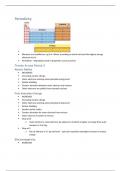
Elements are classified as s,p,d or f block, according to which sub-level the highest energy
electrons are in
Periodicity – Repeating trends in properties across a period
Trends Across Period 3
Atomic Radius
DECREASES
Increasing nuclear charge
Outer electrons entering same principle energy level
Similar shielding
Greater attraction between outer electron and nucleus
Outer electrons are pulled closer towards nucleus
First Ionisation Energy
INCREASES
Increasing nuclear charge
Outer electrons entering same principal energy level
Similar shielding
Smaller atomic radius
Greater attraction for outer electron from nucleus
Outer electron is harder to remove
Drop at Al
o Outer electron is removed from 3p sublevel in Al which is higher in energy than outer
electron in 3s in Mg
Drop at S
o Pair of eletrons in S’s 3p sub-level – spin-pair repulsion outweighs increase in nuclear
charge
Electronegativity
INCREASES
, Increasing nuclear charge
Outer electrons entering same principal energy level
Similar shielding
Smaller atomic radius
Greater attraction for outer electron from nucleus
Melting & Boiling Points
Metallic – Na,Mg,Al
High melting points
o Strong electrostatic forces of attraction between metal cations and sea of delocalised
electrons
Increasing charge on ion – Na+ to Al3+
More delocalised electrons
Stronger metallic bonding
Giant Covalent – Si
Many strong covalent bonds which require lots of energy to break – high melting point
o Each Si atom is covalently bonded to 4 other Si atoms in a 3D lattice
Boiling point not as high relative to other elements as melting point
o Majority of covalent bonds have already been broken, only forces in the liquid need to
be overcome
Simple Molecular – P4,S8,Cl2
All have weak Van der Waals forces between the molecules which require little energy to
overcome
Van der Waals forces depend on molecular mass
Atomic – Ar
Only very weak Van der Waals forces between atoms
Ar has low Ar, weaked attractive forces, lowest melting point
Reactions with Water
Na
Fizzes, floats, moves around surface and melts into ball
2Na(s) + 2H2O(l) -> 2NaOH(aq) + H2(g)
Mg
Very slow reaction in water
In steam burns with bright white light
Mg(s) + 2H2O(l) -> Mg(OH)2(aq) + H2(g)
Mg(s) + 2H2O(g) -> Mg(OH)2(s) + H2(g)
Cl
Dissolves into pale green solution
Cl2 + H2O ⇌ HCl + HClO
Elements are classified as s,p,d or f block, according to which sub-level the highest energy
electrons are in
Periodicity – Repeating trends in properties across a period
Trends Across Period 3
Atomic Radius
DECREASES
Increasing nuclear charge
Outer electrons entering same principle energy level
Similar shielding
Greater attraction between outer electron and nucleus
Outer electrons are pulled closer towards nucleus
First Ionisation Energy
INCREASES
Increasing nuclear charge
Outer electrons entering same principal energy level
Similar shielding
Smaller atomic radius
Greater attraction for outer electron from nucleus
Outer electron is harder to remove
Drop at Al
o Outer electron is removed from 3p sublevel in Al which is higher in energy than outer
electron in 3s in Mg
Drop at S
o Pair of eletrons in S’s 3p sub-level – spin-pair repulsion outweighs increase in nuclear
charge
Electronegativity
INCREASES
, Increasing nuclear charge
Outer electrons entering same principal energy level
Similar shielding
Smaller atomic radius
Greater attraction for outer electron from nucleus
Melting & Boiling Points
Metallic – Na,Mg,Al
High melting points
o Strong electrostatic forces of attraction between metal cations and sea of delocalised
electrons
Increasing charge on ion – Na+ to Al3+
More delocalised electrons
Stronger metallic bonding
Giant Covalent – Si
Many strong covalent bonds which require lots of energy to break – high melting point
o Each Si atom is covalently bonded to 4 other Si atoms in a 3D lattice
Boiling point not as high relative to other elements as melting point
o Majority of covalent bonds have already been broken, only forces in the liquid need to
be overcome
Simple Molecular – P4,S8,Cl2
All have weak Van der Waals forces between the molecules which require little energy to
overcome
Van der Waals forces depend on molecular mass
Atomic – Ar
Only very weak Van der Waals forces between atoms
Ar has low Ar, weaked attractive forces, lowest melting point
Reactions with Water
Na
Fizzes, floats, moves around surface and melts into ball
2Na(s) + 2H2O(l) -> 2NaOH(aq) + H2(g)
Mg
Very slow reaction in water
In steam burns with bright white light
Mg(s) + 2H2O(l) -> Mg(OH)2(aq) + H2(g)
Mg(s) + 2H2O(g) -> Mg(OH)2(s) + H2(g)
Cl
Dissolves into pale green solution
Cl2 + H2O ⇌ HCl + HClO


