
Energetics
Calorimetry
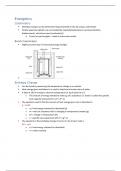
Enthalpy changes can be determined experimentally in the lab using a calorimeter
Simple apparatus (plastic cup surrounded by expanded polystyrene cup (neutralisation,
displacement), aluminium cans (combustion))
o Prone to heat loss/gain – leads to inaccurate results
Bomb Calorimeter
Highly accurate way of measuring energy changes
Enthalpy Change
Can be found by measuring the temperature change in a reaction
Heat energy given out/taken in is used to heat/cool a known mass of water
It takes 4.18J of energy to raise the temperature of 1g of water by 1°C
o The amount of energy needed to make 1g of a substance 1°C hotter is called the specific
heat capacity (measured in J g^-1 K^-1)
The equation used to find the amount of heat energy given out or absorbed is
q = mcΔT
o q = heat energy released (or absorbed) (J)
o m = mass of substance that is changing in temperature (water) (g)
o ΔT = change in temperature (K)
o c = specific heat capacity (4.18 J K^-1 g^-1)
The equation to find enthalpy change in terms of J (or kJ) per mole is
ΔH = -q/n
o q = heat energy released (or absorbed)
o n = moles reacting
,
First Law of Thermodynamics – Energy cannot be created or destroyed, it can only be changed
from one form to another
Enthalpy change – Heat energy change at constant pressure
Exothermic and Endothermic Reactions
Exothermic
o
o Energy is transferred from system to surroundings
o Increase in temperature
o Combustion
o Displacement
o Neutralisation
o Respiration
Endothermic
Calorimetry
Enthalpy changes can be determined experimentally in the lab using a calorimeter
Simple apparatus (plastic cup surrounded by expanded polystyrene cup (neutralisation,
displacement), aluminium cans (combustion))
o Prone to heat loss/gain – leads to inaccurate results
Bomb Calorimeter
Highly accurate way of measuring energy changes
Enthalpy Change
Can be found by measuring the temperature change in a reaction
Heat energy given out/taken in is used to heat/cool a known mass of water
It takes 4.18J of energy to raise the temperature of 1g of water by 1°C
o The amount of energy needed to make 1g of a substance 1°C hotter is called the specific
heat capacity (measured in J g^-1 K^-1)
The equation used to find the amount of heat energy given out or absorbed is
q = mcΔT
o q = heat energy released (or absorbed) (J)
o m = mass of substance that is changing in temperature (water) (g)
o ΔT = change in temperature (K)
o c = specific heat capacity (4.18 J K^-1 g^-1)
The equation to find enthalpy change in terms of J (or kJ) per mole is
ΔH = -q/n
o q = heat energy released (or absorbed)
o n = moles reacting
,
First Law of Thermodynamics – Energy cannot be created or destroyed, it can only be changed
from one form to another
Enthalpy change – Heat energy change at constant pressure
Exothermic and Endothermic Reactions
Exothermic
o
o Energy is transferred from system to surroundings
o Increase in temperature
o Combustion
o Displacement
o Neutralisation
o Respiration
Endothermic


