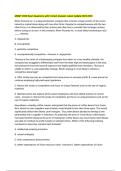
ATI Mental Health B Proctored Exam (2019)
This exam for the ATI Mental Health B Proctored Exam (2019), focusing on mental health
nursing concepts, including therapeutic interventions, client behaviors, medication management,
and nursing care for disorders like schizophrenia, bipolar disorder, borderline personality
disorder, and substance use disorders. The exam includes 50 multiple-choice questions with
verified answers in blue and detailed clinical rationales, aligned with the 2019 exam
Exam Questions
1. A nurse is planning strategies for a client with borderline personality disorder.
Which strategy is the priority to incorporate into the care plan?
o A) Discuss the appropriate use of assertive behavior
o B) Encourage weekly support group meetings
o C) Assist the client to maintain awareness of thoughts and feelings
o D) Implement measures to prevent intentional self-inflicted injury
o Answer: D
o Rationale: Preventing intentional self-inflicted injury is the priority for clients
with borderline personality disorder due to their high risk of self-harm. Other
strategies (A, B, C) are important but secondary to safety.,
2. A nurse is admitting a client with generalized anxiety disorder. Which action should
the nurse take first?
o A) Provide a quiet environment
o B) Determine how the client handles stress
o C) Teach guided imagery
o D) Ask the client to identify strengths
o Answer: A
o Rationale: Providing a quiet environment reduces stimuli and anxiety, making it
the first action. Assessing stress (B), teaching imagery (C), and identifying
strengths (D) follow after stabilizing the environment.,
3. A nurse is interviewing a client experiencing mania. Which finding should the nurse
report to the provider?
o A) Hasn’t bathed in 2 days
o B) Reports eating twice in the past two weeks
o C) Makes inappropriate sexual comments
o D) Speaks in rhyming sentences
o Answer: B
o Rationale: Eating only twice in two weeks indicates severe nutritional risk,
requiring immediate medical attention. Other findings (A, C, D) are typical in
mania but less urgent.,
, 4. A nurse is planning care for a client with obsessive-compulsive disorder (OCD).
Which recommendation should be included?
o A) Validation therapy
o B) Thought stopping
o C) Operant conditioning
o D) Reality orientation therapy
o Answer: B
o Rationale: Thought stopping helps clients interrupt obsessive thoughts by
substituting positive actions. Validation therapy (A) is for dementia, operant
conditioning (C) is behavioral, and reality orientation (D) is for cognitive
disorders.,
5. A nurse is caring for a client with bipolar disorder in a manic episode. Which action
should the nurse take?
o A) Encourage group activities
o B) Dim the lights in the client’s room
o C) Provide detailed explanations
o D) Administer methylphenidate
o Answer: B
o Rationale: Dimming lights reduces stimulation, calming the client in a manic
episode. Group activities (A) and detailed explanations (C) increase stimulation,
and methylphenidate (D) is inappropriate.,
6. A nurse is leading a crisis intervention group for adolescents who witnessed a
classmate’s suicide. Which action should the nurse take first?
o A) Initiate referrals
o B) Review community resources
o C) Identify prior coping skills
o D) Discuss confidentiality
o Answer: C
o Rationale: Identifying prior coping skills helps assess the adolescents’ ability to
manage trauma, guiding interventions. Referrals (A), resources (B), and
confidentiality (D) follow.,
7. A nurse overhears a client saying, “I am a spy for the FBI. I am an eye for an eye in
the sky.” This should be documented as which speech alteration?
o A) Echolalia
o B) Word salad
o C) Neologism
o D) Clang association
o Answer: D
o Rationale: Clang association involves rhyming or sound-based word choices, as
in the client’s statement. Echolalia (A) is repeating others’ words, word salad (B)
is incoherent speech, and neologism (C) is made-up words.
8. A client is fearful of driving and uses systematic desensitization to drive a familiar
street without panic. To continue positive results, the client should participate in:
o A) Group therapy
o B) Positive reinforcement
o C) Medication management
This exam for the ATI Mental Health B Proctored Exam (2019), focusing on mental health
nursing concepts, including therapeutic interventions, client behaviors, medication management,
and nursing care for disorders like schizophrenia, bipolar disorder, borderline personality
disorder, and substance use disorders. The exam includes 50 multiple-choice questions with
verified answers in blue and detailed clinical rationales, aligned with the 2019 exam
Exam Questions
1. A nurse is planning strategies for a client with borderline personality disorder.
Which strategy is the priority to incorporate into the care plan?
o A) Discuss the appropriate use of assertive behavior
o B) Encourage weekly support group meetings
o C) Assist the client to maintain awareness of thoughts and feelings
o D) Implement measures to prevent intentional self-inflicted injury
o Answer: D
o Rationale: Preventing intentional self-inflicted injury is the priority for clients
with borderline personality disorder due to their high risk of self-harm. Other
strategies (A, B, C) are important but secondary to safety.,
2. A nurse is admitting a client with generalized anxiety disorder. Which action should
the nurse take first?
o A) Provide a quiet environment
o B) Determine how the client handles stress
o C) Teach guided imagery
o D) Ask the client to identify strengths
o Answer: A
o Rationale: Providing a quiet environment reduces stimuli and anxiety, making it
the first action. Assessing stress (B), teaching imagery (C), and identifying
strengths (D) follow after stabilizing the environment.,
3. A nurse is interviewing a client experiencing mania. Which finding should the nurse
report to the provider?
o A) Hasn’t bathed in 2 days
o B) Reports eating twice in the past two weeks
o C) Makes inappropriate sexual comments
o D) Speaks in rhyming sentences
o Answer: B
o Rationale: Eating only twice in two weeks indicates severe nutritional risk,
requiring immediate medical attention. Other findings (A, C, D) are typical in
mania but less urgent.,
, 4. A nurse is planning care for a client with obsessive-compulsive disorder (OCD).
Which recommendation should be included?
o A) Validation therapy
o B) Thought stopping
o C) Operant conditioning
o D) Reality orientation therapy
o Answer: B
o Rationale: Thought stopping helps clients interrupt obsessive thoughts by
substituting positive actions. Validation therapy (A) is for dementia, operant
conditioning (C) is behavioral, and reality orientation (D) is for cognitive
disorders.,
5. A nurse is caring for a client with bipolar disorder in a manic episode. Which action
should the nurse take?
o A) Encourage group activities
o B) Dim the lights in the client’s room
o C) Provide detailed explanations
o D) Administer methylphenidate
o Answer: B
o Rationale: Dimming lights reduces stimulation, calming the client in a manic
episode. Group activities (A) and detailed explanations (C) increase stimulation,
and methylphenidate (D) is inappropriate.,
6. A nurse is leading a crisis intervention group for adolescents who witnessed a
classmate’s suicide. Which action should the nurse take first?
o A) Initiate referrals
o B) Review community resources
o C) Identify prior coping skills
o D) Discuss confidentiality
o Answer: C
o Rationale: Identifying prior coping skills helps assess the adolescents’ ability to
manage trauma, guiding interventions. Referrals (A), resources (B), and
confidentiality (D) follow.,
7. A nurse overhears a client saying, “I am a spy for the FBI. I am an eye for an eye in
the sky.” This should be documented as which speech alteration?
o A) Echolalia
o B) Word salad
o C) Neologism
o D) Clang association
o Answer: D
o Rationale: Clang association involves rhyming or sound-based word choices, as
in the client’s statement. Echolalia (A) is repeating others’ words, word salad (B)
is incoherent speech, and neologism (C) is made-up words.
8. A client is fearful of driving and uses systematic desensitization to drive a familiar
street without panic. To continue positive results, the client should participate in:
o A) Group therapy
o B) Positive reinforcement
o C) Medication management