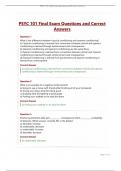
PSYC 101 Final Exam Questions and Correct Answers
PSYC 101 Final Exam Questions and Correct
Answers
Question 1
What is the difference between classical conditioning and operant conditioning?
a) Classical conditioning is learned from connections between stimuli and operant
conditioning is learned through reinforcement and consequences
b) Classical conditioning and operant conditioning are the same thing
c) Operant conditioning is learned from connections between stimuli and classical
conditioning is learned through reinforcement and consequences
d) Classical conditioning is learned from punishment and operant conditioning is
learned from reinforcement
Correct Answer
a) Classical conditioning is learned from connections between stimuli and operant
conditioning is learned through reinforcement and consequences
Question 2
What is an example of a negative reinforcement?
a) Going to see a movie with friends after finishing all of your homework
b) Giving your dog a treat for being good
c) Studying hard and getting a good grade
d) Putting your seatbelt on to stop the alarm
Correct Answer
d) Putting your seatbelt on to stop the alarm
Question 3
Positive punishment adds a(n) ___________ consequence which ___________ probability
of behavior. Which answer correctly fills in the blanks?
a) desirable, increase
b) undesirable, decrease
c) undesirable, increase
d) desirable, decrease
Correct Answer
b) undesirable, decrease
Page 1 of 72
, PSYC 101 Final Exam Questions and Correct Answers
Question 4
Which answer choice correctly describes sensory adaption?
a) There is a minimum amount of any given sensation that has to be present for us to
notice it
b) Smallest difference in amount of stimulus that a specific sense can detect
c) If a stimulus is unchanging, we become desensitized to it
d) Organizing sensations into meaningful patterns
Correct Answer
c) If a stimulus is unchanging, we become desensitized to it
Question 5
Which part of the eye converts light into nerve impulses?
a) Lens
b) Retina
c) Cornea
d) Pupil
Correct Answer
b) Retina
Question 6
What is the elimination of a learned response by removal of the unconditioned
stimulus or reinforcement?
a) Acquisition
b) Discrimination
c) Generalization
d) Extinction
Correct Answer
d) Extinction
Page 2 of 72
, PSYC 101 Final Exam Questions and Correct Answers
Question 7
What is the Arousal Theory?
a) People are motivated to behave in ways that produce a valued incentive
b) Gender differences in sexual activity, criticism and alternative explanations and
gender differences in male preferences
c) People are motivated to achieve and maintain an optimum level of bodily arousal
d) An inner state that energizes and directs us and keeps us moving towards our
goals
Correct Answer
c) People are motivated to achieve and maintain an optimum level of bodily arousal
Question 8
Which of the following is NOT a condition under which social norms exert the
greatest influence
a) Conditions are uncertain
b) Source is similar to us
c) Concerned about relationship with the source
d) Conditions are certain
Correct Answer
d) Conditions are certain
Question 9
When is it best to give a punishment?
a) Punishment is better to do right after the problem has occurred
b) Punishment is better to do a few hours after the problem has occurred
c) Punishment is better never to do after a problem has occurred
d) Punishment is better to do a long time after a problem has occurred
Correct Answer
a) Punishment is better to do right after the problem has occurred
Page 3 of 72
, PSYC 101 Final Exam Questions and Correct Answers
Question 10
What is the difference between REM Sleep and Non-REM Sleep?
a) REM sleep is marked by an absence of rapid eye movements, little dreaming and
varied EEG activity versus Non-REM sleep is deep stage sleep marked by rapid eye
movement, frequency in brain waves and dreaming
b) REM Sleep deals with a short duration of sleep versus Non-REM sleep deals with a
longer duration of sleep
c) REM sleep is marked by a deep stage of sleep marked by rapid eye movements,
frequency brain waves and dreaming versus Non-REM Sleep is marked by an absence
of rapid eye movements, little dreaming and varied EEG activity
d) None of the above
Correct Answer
c) REM sleep is marked by a deep stage of sleep marked by rapid eye movements,
frequency brain waves and dreaming versus Non-REM Sleep is marked by an
absence of rapid eye movements, little dreaming and varied EEG activity
Question 11
True or False: Selective Attention is the ability to distribute ones attention and
simultaneously engage in 2 or more activities
a) True
b) False
Correct Answer
b) False
Question 12
Which is Not one of the 4 types of Stress
a) Frustration
b) Sadness
c) Conflict
d) Change
e) Pressure
Correct Answer
b) Sadness
Page 4 of 72
PSYC 101 Final Exam Questions and Correct
Answers
Question 1
What is the difference between classical conditioning and operant conditioning?
a) Classical conditioning is learned from connections between stimuli and operant
conditioning is learned through reinforcement and consequences
b) Classical conditioning and operant conditioning are the same thing
c) Operant conditioning is learned from connections between stimuli and classical
conditioning is learned through reinforcement and consequences
d) Classical conditioning is learned from punishment and operant conditioning is
learned from reinforcement
Correct Answer
a) Classical conditioning is learned from connections between stimuli and operant
conditioning is learned through reinforcement and consequences
Question 2
What is an example of a negative reinforcement?
a) Going to see a movie with friends after finishing all of your homework
b) Giving your dog a treat for being good
c) Studying hard and getting a good grade
d) Putting your seatbelt on to stop the alarm
Correct Answer
d) Putting your seatbelt on to stop the alarm
Question 3
Positive punishment adds a(n) ___________ consequence which ___________ probability
of behavior. Which answer correctly fills in the blanks?
a) desirable, increase
b) undesirable, decrease
c) undesirable, increase
d) desirable, decrease
Correct Answer
b) undesirable, decrease
Page 1 of 72
, PSYC 101 Final Exam Questions and Correct Answers
Question 4
Which answer choice correctly describes sensory adaption?
a) There is a minimum amount of any given sensation that has to be present for us to
notice it
b) Smallest difference in amount of stimulus that a specific sense can detect
c) If a stimulus is unchanging, we become desensitized to it
d) Organizing sensations into meaningful patterns
Correct Answer
c) If a stimulus is unchanging, we become desensitized to it
Question 5
Which part of the eye converts light into nerve impulses?
a) Lens
b) Retina
c) Cornea
d) Pupil
Correct Answer
b) Retina
Question 6
What is the elimination of a learned response by removal of the unconditioned
stimulus or reinforcement?
a) Acquisition
b) Discrimination
c) Generalization
d) Extinction
Correct Answer
d) Extinction
Page 2 of 72
, PSYC 101 Final Exam Questions and Correct Answers
Question 7
What is the Arousal Theory?
a) People are motivated to behave in ways that produce a valued incentive
b) Gender differences in sexual activity, criticism and alternative explanations and
gender differences in male preferences
c) People are motivated to achieve and maintain an optimum level of bodily arousal
d) An inner state that energizes and directs us and keeps us moving towards our
goals
Correct Answer
c) People are motivated to achieve and maintain an optimum level of bodily arousal
Question 8
Which of the following is NOT a condition under which social norms exert the
greatest influence
a) Conditions are uncertain
b) Source is similar to us
c) Concerned about relationship with the source
d) Conditions are certain
Correct Answer
d) Conditions are certain
Question 9
When is it best to give a punishment?
a) Punishment is better to do right after the problem has occurred
b) Punishment is better to do a few hours after the problem has occurred
c) Punishment is better never to do after a problem has occurred
d) Punishment is better to do a long time after a problem has occurred
Correct Answer
a) Punishment is better to do right after the problem has occurred
Page 3 of 72
, PSYC 101 Final Exam Questions and Correct Answers
Question 10
What is the difference between REM Sleep and Non-REM Sleep?
a) REM sleep is marked by an absence of rapid eye movements, little dreaming and
varied EEG activity versus Non-REM sleep is deep stage sleep marked by rapid eye
movement, frequency in brain waves and dreaming
b) REM Sleep deals with a short duration of sleep versus Non-REM sleep deals with a
longer duration of sleep
c) REM sleep is marked by a deep stage of sleep marked by rapid eye movements,
frequency brain waves and dreaming versus Non-REM Sleep is marked by an absence
of rapid eye movements, little dreaming and varied EEG activity
d) None of the above
Correct Answer
c) REM sleep is marked by a deep stage of sleep marked by rapid eye movements,
frequency brain waves and dreaming versus Non-REM Sleep is marked by an
absence of rapid eye movements, little dreaming and varied EEG activity
Question 11
True or False: Selective Attention is the ability to distribute ones attention and
simultaneously engage in 2 or more activities
a) True
b) False
Correct Answer
b) False
Question 12
Which is Not one of the 4 types of Stress
a) Frustration
b) Sadness
c) Conflict
d) Change
e) Pressure
Correct Answer
b) Sadness
Page 4 of 72