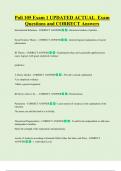
Poli 105 Exam 1 UPDATED ACTUAL Exam
Questions and CORRECT Answers
International Relations - CORRECT ANSWER - theoretical studies of politics
Social Science Theory - CORRECT ANSWER - General logical explanations of social
phenomena
IR Theory - CORRECT ANSWER - Explanations that can be generally applied across
cases: logical, with good, empirical evidence
predictive
A theory should: - CORRECT ANSWER - -Provide a casual explanation
-Use empirical evidence
-Make a general argument
IR theory seeks to be... - CORRECT ANSWER - Parsimonious
Parsimony - CORRECT ANSWER - Least amount of variance in the explanation of the
outcome.
The more you add the hard it is to falsify.
Theoretical Degeneration - CORRECT ANSWER - To add to the independent or add more
independent variables.
Hurts the strength of the explanation and parsimony.
Levels of Analysis according to Kenneth Waltz (Man, the State, and War) - CORRECT
ANSWER - 1. Individual Level
, 2. State Level
3. Systematic or Structural
Individual Level - CORRECT ANSWER - Great Man Theory
Great Man Theory - CORRECT ANSWER - Cause is found in individuals or small groups
based on their characteristics. THEY CAUSE
Hitler, Saddam, Bush
State Level - CORRECT ANSWER - Whatever goes on in the state or is attributed to the
state is casual. Considered unit level, not structure (but units within a structure)
Systematic or Structural Level - CORRECT ANSWER - Structure of any given stystem is
what matters as an independent variable
Goldstein's Third Level - CORRECT ANSWER - Divided into the interstate and global
levels
Joseph Lepgold's Policy/Theory Debate - CORRECT ANSWER - 1. IR is composed of
many groups
2.Institutions support integration
3. Shared goals of these groups make better policies based on good assumptions. (Help the
statesmen to help the state)
4. Some theories are more helpful
Paradigm - CORRECT ANSWER - Set of practices that define a scientific discipline at
any particular period
Realism and where it came from - CORRECT ANSWER - -Emphasizes military and
economic power over institutions or idea: differentiates states int he terms of powers, middle
powers, small powers.
Questions and CORRECT Answers
International Relations - CORRECT ANSWER - theoretical studies of politics
Social Science Theory - CORRECT ANSWER - General logical explanations of social
phenomena
IR Theory - CORRECT ANSWER - Explanations that can be generally applied across
cases: logical, with good, empirical evidence
predictive
A theory should: - CORRECT ANSWER - -Provide a casual explanation
-Use empirical evidence
-Make a general argument
IR theory seeks to be... - CORRECT ANSWER - Parsimonious
Parsimony - CORRECT ANSWER - Least amount of variance in the explanation of the
outcome.
The more you add the hard it is to falsify.
Theoretical Degeneration - CORRECT ANSWER - To add to the independent or add more
independent variables.
Hurts the strength of the explanation and parsimony.
Levels of Analysis according to Kenneth Waltz (Man, the State, and War) - CORRECT
ANSWER - 1. Individual Level
, 2. State Level
3. Systematic or Structural
Individual Level - CORRECT ANSWER - Great Man Theory
Great Man Theory - CORRECT ANSWER - Cause is found in individuals or small groups
based on their characteristics. THEY CAUSE
Hitler, Saddam, Bush
State Level - CORRECT ANSWER - Whatever goes on in the state or is attributed to the
state is casual. Considered unit level, not structure (but units within a structure)
Systematic or Structural Level - CORRECT ANSWER - Structure of any given stystem is
what matters as an independent variable
Goldstein's Third Level - CORRECT ANSWER - Divided into the interstate and global
levels
Joseph Lepgold's Policy/Theory Debate - CORRECT ANSWER - 1. IR is composed of
many groups
2.Institutions support integration
3. Shared goals of these groups make better policies based on good assumptions. (Help the
statesmen to help the state)
4. Some theories are more helpful
Paradigm - CORRECT ANSWER - Set of practices that define a scientific discipline at
any particular period
Realism and where it came from - CORRECT ANSWER - -Emphasizes military and
economic power over institutions or idea: differentiates states int he terms of powers, middle
powers, small powers.