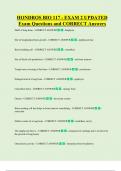
HONDROS BIO 117 - EXAM 2 UPDATED
Exam Questions and CORRECT Answers
Shaft of long bone - CORRECT ANSWER - diaphysis
Site of longitudinal bone growth - CORRECT ANSWER - epiphyseal disc
Bone-building cell - CORRECT ANSWER - osteoblast
Site of blood cell production - CORRECT ANSWER - red bone marrow
Tough outer covering of the bone - CORRECT ANSWER - periosteum
Enlarged end of a long bone - CORRECT ANSWER - epiphysis
Cancellous bone - CORRECT ANSWER - spongy bone
Osteon - CORRECT ANSWER - haversian system
Bone-eroding cell that helps in bone marrow remodeling - CORRECT ANSWER -
osteoclast
Hollow center of a long bone - CORRECT ANSWER - medullary cavity
The epiphyseal disc is - CORRECT ANSWER - composed of cartilage and is involved in
the growth of long bones
Osteoclastic activity - CORRECT ANSWER - stimulates bone breakdown
, Depression of the red bone marrow - CORRECT ANSWER - causes a life-threatening
decline in red blood cells
Osteoporosis affects the older population, with women being more affected. Other bone diseases
cause a decrease in bone density. Which hormone could possibly be contributing to this, what
cell is turning on and which cell is turning off? - CORRECT ANSWER - Parathyroid
Hormone, turning on osteoclasts, turning off osteoblasts
What are all the bones of the Pelvic and Pectoral Girdles? - CORRECT ANSWER - Pelvic
Girdle: Sacrum, Coccyx, Pelvic bone (ilium, ischium, pubis)
Pectoral Girdle: Scapula and Clavicle
If we needed less calcium in the bloodstream, what hormone would I want to use? What gland
does this hormone come from? What cell does it stimulate? What cell does it inhibit? -
CORRECT ANSWER - Calcitonin from the thyroid gland, osteoblasts, and osteoclasts
What are the bones of the arm? What bone does each articulate with? What special cartilage can
we see at the ends of these articulating bones? Is this appendicular skeleton or axial skeleton? -
CORRECT ANSWER - Humerus (articulates with scapula, radius, ulna), radius
(articulates with humerus, ulna, carpals), ulna (articulates with radius, humerus, carpals)
Special Cartilage = articular cartilage
Appendicular skeleton
What are the bones of the leg? What bone does each articulate? Where would I see synovial
fluid? - CORRECT ANSWER - Femur (articulates with pelvic bone, tibia, patella), Tibia
(articulates with fibula, patella, talus), Fibula (articulates with tibia, talus)
Synovial fluid is in the knee joint
Exam Questions and CORRECT Answers
Shaft of long bone - CORRECT ANSWER - diaphysis
Site of longitudinal bone growth - CORRECT ANSWER - epiphyseal disc
Bone-building cell - CORRECT ANSWER - osteoblast
Site of blood cell production - CORRECT ANSWER - red bone marrow
Tough outer covering of the bone - CORRECT ANSWER - periosteum
Enlarged end of a long bone - CORRECT ANSWER - epiphysis
Cancellous bone - CORRECT ANSWER - spongy bone
Osteon - CORRECT ANSWER - haversian system
Bone-eroding cell that helps in bone marrow remodeling - CORRECT ANSWER -
osteoclast
Hollow center of a long bone - CORRECT ANSWER - medullary cavity
The epiphyseal disc is - CORRECT ANSWER - composed of cartilage and is involved in
the growth of long bones
Osteoclastic activity - CORRECT ANSWER - stimulates bone breakdown
, Depression of the red bone marrow - CORRECT ANSWER - causes a life-threatening
decline in red blood cells
Osteoporosis affects the older population, with women being more affected. Other bone diseases
cause a decrease in bone density. Which hormone could possibly be contributing to this, what
cell is turning on and which cell is turning off? - CORRECT ANSWER - Parathyroid
Hormone, turning on osteoclasts, turning off osteoblasts
What are all the bones of the Pelvic and Pectoral Girdles? - CORRECT ANSWER - Pelvic
Girdle: Sacrum, Coccyx, Pelvic bone (ilium, ischium, pubis)
Pectoral Girdle: Scapula and Clavicle
If we needed less calcium in the bloodstream, what hormone would I want to use? What gland
does this hormone come from? What cell does it stimulate? What cell does it inhibit? -
CORRECT ANSWER - Calcitonin from the thyroid gland, osteoblasts, and osteoclasts
What are the bones of the arm? What bone does each articulate with? What special cartilage can
we see at the ends of these articulating bones? Is this appendicular skeleton or axial skeleton? -
CORRECT ANSWER - Humerus (articulates with scapula, radius, ulna), radius
(articulates with humerus, ulna, carpals), ulna (articulates with radius, humerus, carpals)
Special Cartilage = articular cartilage
Appendicular skeleton
What are the bones of the leg? What bone does each articulate? Where would I see synovial
fluid? - CORRECT ANSWER - Femur (articulates with pelvic bone, tibia, patella), Tibia
(articulates with fibula, patella, talus), Fibula (articulates with tibia, talus)
Synovial fluid is in the knee joint