lOMoAR cPSD| 47061011
NR 507 Week 5 Edapt GERD questions and
answers with solutions
NR 507 Week 5: Edapt: GERD: Alterations in the Gastrointestinal System
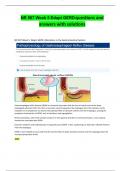
Gastroesophageal reflux disease (GERD) is commonly associated with the loss of muscle tone at the lower
esophageal sphincter (LES). The LES is a muscular ring that separates the esophagus from the stomach, and its
relaxation or incompetence can lead to the backward flow of stomach contents into the esophagus, causing the
symptoms characteristic of GERD, such as heartburn and regurgitation.
Reverse peristalsis, where the stomach contracts in the opposite direction of normal peristalsis, is not a typical
mechanism associated with GERD.
Excessive salivation and swallowing do not typically cause GERD. In fact, swallowing can help clear refluxed material
from the esophagus.
GERD is more related to issues with the LES and the reflux of acidic stomach contents into the esophagus than the
increased production of bile.
?????
, lOMoAR cPSD| 47061011
1)When an individual consumes a very large meal, the nurse practitioner (NP) knows the gastric emptying rate will
be increased .
2) When an individual receives a hypertonic gastric tube feeding solution, the NP knows the gastric emptying rate
will be delayed .
1. Stomach secretes gastrin into bloodstream in response to meal.
2. Gastrin returns to stomach and stimulates muscle contraction and acid production.
3. Partially digested food (chyme) moves into small intestine and stimulates secretion of CCK and secretin
into the blood.
4. CCK and secretin stimulate the secretion of digestive enzymes and bicarbonate ions f rom the pancreas
into the small intestines.
5. CCK also stimulates contraction of the gallbladder, which then releases bile into the s mall intestine.
The digestive system is responsible for breaking down ingested food, facilitating nutrient abs orption, maintaining
body water, and eliminating waste. Hormones and the autonomic nervo us system regulate most digestive
.
NR 507 Week 5 Edapt GERD questions and
answers with solutions
NR 507 Week 5: Edapt: GERD: Alterations in the Gastrointestinal System
Gastroesophageal reflux disease (GERD) is commonly associated with the loss of muscle tone at the lower
esophageal sphincter (LES). The LES is a muscular ring that separates the esophagus from the stomach, and its
relaxation or incompetence can lead to the backward flow of stomach contents into the esophagus, causing the
symptoms characteristic of GERD, such as heartburn and regurgitation.
Reverse peristalsis, where the stomach contracts in the opposite direction of normal peristalsis, is not a typical
mechanism associated with GERD.
Excessive salivation and swallowing do not typically cause GERD. In fact, swallowing can help clear refluxed material
from the esophagus.
GERD is more related to issues with the LES and the reflux of acidic stomach contents into the esophagus than the
increased production of bile.
?????
, lOMoAR cPSD| 47061011
1)When an individual consumes a very large meal, the nurse practitioner (NP) knows the gastric emptying rate will
be increased .
2) When an individual receives a hypertonic gastric tube feeding solution, the NP knows the gastric emptying rate
will be delayed .
1. Stomach secretes gastrin into bloodstream in response to meal.
2. Gastrin returns to stomach and stimulates muscle contraction and acid production.
3. Partially digested food (chyme) moves into small intestine and stimulates secretion of CCK and secretin
into the blood.
4. CCK and secretin stimulate the secretion of digestive enzymes and bicarbonate ions f rom the pancreas
into the small intestines.
5. CCK also stimulates contraction of the gallbladder, which then releases bile into the s mall intestine.
The digestive system is responsible for breaking down ingested food, facilitating nutrient abs orption, maintaining
body water, and eliminating waste. Hormones and the autonomic nervo us system regulate most digestive
.