NU170 EXAM 2 CORRECT QUESTIONS
& ANSWERS|| 2025 LATEST UPDATE!!
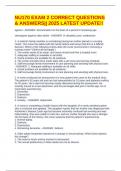
ageism - ANSWER discrimination on the basis of a person's increasing age
stereotypes against older adults - ANSWER ill, disabled, poor, unattractive
1. A patient's family member is considering having her mother placed in a nursing
center. The nurse has talked with the family before and knows that this is a difficult
decision. Which of the following criteria does the nurse recommend in choosing a
nursing center? (Select all that apply.)
1. The center needs to be clean, and rooms should look like a hospital room.
2. Adequate staffing is available on all shifts.
3. Social activities are available for all residents.
4. The center provides three meals daily with a set menu and serving schedule.
5. Staff encourage family involvement in care planning and assisting with physical care.
- ANSWER 2. Adequate staffing is available on all shifts.
3. Social activities are available for all residents.
5. Staff encourage family involvement in care planning and assisting with physical care.
2. A nurse conducted an assessment of a new patient who came to the medical clinic.
The patient is 82 years old and has had osteoarthritis for 10 years and diabetes mellitus
for 20 years. He is alert but becomes easily distracted during the assessment. He
recently moved to a new apartment, and his pet beagle died just 2 months ago. He is
most likely experiencing:
1. Dementia.
2. Depression.
3. Delirium.
4. Anxiety. - ANSWER depression
3. A nurse is completing a health history with the daughter of a newly admitted patient
who is confused and agitated. The daughter reports that her mother was diagnosed with
Alzheimer's disease 1year ago but became extremely confused last evening and was
hallucinating. She was unable to calm her, and her mother thought she was a stranger.
On the basis of this history, the nurse suspects that the patient is experiencing:
1. Normal aging.
2. Delirium.
3. Depression.
4. Worsening dementia. - ANSWER delirium
4. Older adults frequently experience a change in sexual activity. Which best explains
this change?
1. The need to touch and be touched is decreased.
2. The sexual preferences of older adults are not as diverse.
, 3. Medication side effects often impact sexual functioning.
4. Frequency and opportunities for sexual activity may decline. - ANSWER Frequency
and opportunities for sexual activity may decline.
10. A 71-year-old patient enters the emergency department after falling down stairs at
church. The nurse is conducting a fall history with the patient and his wife. They live in a
one-level ranch home. He has had diabetes for over 15 years and experiences some
numbness in his feet. He wears bifocal glasses. His blood pressure is stable at 130/70.
The patient does not exercise regularly and states that he experiences weakness in his
legs when climbing stairs. He is alert, oriented, and able to answer questions clearly.
What are the fall risk factors for this patient? (Select all that apply.)
1. Impaired vision
2. Residence design
3. Blood pressure
4. Leg weakness
5. Exercise history - ANSWER Impaired vision
Leg weakness
Exercise history
psychosocial changes occurring during aging - ANSWER life transitions and loss
(retirement and the associated financial changes, changes in roles and relationships,
alterations in health and functional ability, changes in one's social network, and
relocation)
True or False- Depression is a normal part of aging - ANSWER False
generalized impairment of intellectual functioning that interferes with social and
occupational functioning. characterized by a gradual, progressive, and irreversible
decline in cerebral function. - ANSWER dementia
respiratory physiological changes with aging - ANSWER Decreased cough reflex and
ciliary activity; increased anterior-posterior chest diameter; increased chest wall rigidity;
fewer alveoli, increased airway resistance
cardiac physiological changes with aging - ANSWER Thickening of blood vessel walls,
narrowing of vessel lumen, loss of vessel elasticity, lower cardiac output, decreased
number of heart muscle fibers, decreased elasticity and calcification of heart valves,
decreased baroreceptor sensitivity, decreased efficiency of venous valves, increased
pulmonary vascular tension, increased systolic blood pressure, decreased peripheral
circulation
musculoskeletal physiological changes with aging - ANSWER Decreased muscle mass
and strength, decalcification of bones, degenerative joint changes, dehydration of
intervertebral disks, fat tissue increases
& ANSWERS|| 2025 LATEST UPDATE!!
ageism - ANSWER discrimination on the basis of a person's increasing age
stereotypes against older adults - ANSWER ill, disabled, poor, unattractive
1. A patient's family member is considering having her mother placed in a nursing
center. The nurse has talked with the family before and knows that this is a difficult
decision. Which of the following criteria does the nurse recommend in choosing a
nursing center? (Select all that apply.)
1. The center needs to be clean, and rooms should look like a hospital room.
2. Adequate staffing is available on all shifts.
3. Social activities are available for all residents.
4. The center provides three meals daily with a set menu and serving schedule.
5. Staff encourage family involvement in care planning and assisting with physical care.
- ANSWER 2. Adequate staffing is available on all shifts.
3. Social activities are available for all residents.
5. Staff encourage family involvement in care planning and assisting with physical care.
2. A nurse conducted an assessment of a new patient who came to the medical clinic.
The patient is 82 years old and has had osteoarthritis for 10 years and diabetes mellitus
for 20 years. He is alert but becomes easily distracted during the assessment. He
recently moved to a new apartment, and his pet beagle died just 2 months ago. He is
most likely experiencing:
1. Dementia.
2. Depression.
3. Delirium.
4. Anxiety. - ANSWER depression
3. A nurse is completing a health history with the daughter of a newly admitted patient
who is confused and agitated. The daughter reports that her mother was diagnosed with
Alzheimer's disease 1year ago but became extremely confused last evening and was
hallucinating. She was unable to calm her, and her mother thought she was a stranger.
On the basis of this history, the nurse suspects that the patient is experiencing:
1. Normal aging.
2. Delirium.
3. Depression.
4. Worsening dementia. - ANSWER delirium
4. Older adults frequently experience a change in sexual activity. Which best explains
this change?
1. The need to touch and be touched is decreased.
2. The sexual preferences of older adults are not as diverse.
, 3. Medication side effects often impact sexual functioning.
4. Frequency and opportunities for sexual activity may decline. - ANSWER Frequency
and opportunities for sexual activity may decline.
10. A 71-year-old patient enters the emergency department after falling down stairs at
church. The nurse is conducting a fall history with the patient and his wife. They live in a
one-level ranch home. He has had diabetes for over 15 years and experiences some
numbness in his feet. He wears bifocal glasses. His blood pressure is stable at 130/70.
The patient does not exercise regularly and states that he experiences weakness in his
legs when climbing stairs. He is alert, oriented, and able to answer questions clearly.
What are the fall risk factors for this patient? (Select all that apply.)
1. Impaired vision
2. Residence design
3. Blood pressure
4. Leg weakness
5. Exercise history - ANSWER Impaired vision
Leg weakness
Exercise history
psychosocial changes occurring during aging - ANSWER life transitions and loss
(retirement and the associated financial changes, changes in roles and relationships,
alterations in health and functional ability, changes in one's social network, and
relocation)
True or False- Depression is a normal part of aging - ANSWER False
generalized impairment of intellectual functioning that interferes with social and
occupational functioning. characterized by a gradual, progressive, and irreversible
decline in cerebral function. - ANSWER dementia
respiratory physiological changes with aging - ANSWER Decreased cough reflex and
ciliary activity; increased anterior-posterior chest diameter; increased chest wall rigidity;
fewer alveoli, increased airway resistance
cardiac physiological changes with aging - ANSWER Thickening of blood vessel walls,
narrowing of vessel lumen, loss of vessel elasticity, lower cardiac output, decreased
number of heart muscle fibers, decreased elasticity and calcification of heart valves,
decreased baroreceptor sensitivity, decreased efficiency of venous valves, increased
pulmonary vascular tension, increased systolic blood pressure, decreased peripheral
circulation
musculoskeletal physiological changes with aging - ANSWER Decreased muscle mass
and strength, decalcification of bones, degenerative joint changes, dehydration of
intervertebral disks, fat tissue increases