
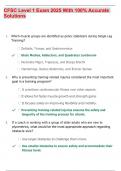
CFSC Level 1 Exam 2025 With 100% Accurate
Solutions
1. Which muscle groups are identified as pelvic stabilizers during Single Leg
Training?
Deltoids, Triceps, and Gastrocnemius
Glute Medius, Adductors, and Quadratus Lumborum
Pectoralis Major, Trapezius, and Biceps Brachii
Hamstrings, Rectus Abdominis, and Erector Spinae
2. Why is preventing training-related injuries considered the most important
goal in a training program?
It prioritizes cardiovascular fitness over other aspects.
It allows for faster muscle growth and strength gains.
It focuses solely on improving flexibility and mobility.
Preventing training-related injuries ensures the safety and
longevity of the training process for clients.
3. If a coach is working with a group of older adults who are new to
plyometrics, what would be the most appropriate approach regarding
obstacle size?
Use larger obstacles to challenge them more.
Use smaller obstacles to ensure safety and accommodate their
fitness level.
,Use the same size obstacles as younger athletes.
Avoid using obstacles altogether.
,4. Spinal stability and support should be provided primarily by:
passive role of ligaments and other inert structures
active work of the trunk musculature
5. If an older adult is unable to perform a standard push-up, what would be an
appropriate regression to ensure safety and effectiveness?
Add resistance bands to their arms
Perform push-ups on their knees
Perform push-ups with feet elevated
Incline their hand position
6. If a coach wants to improve the striking ability of a tennis player, which
training tool would be most effective and why?
Medicine balls, because they develop torso power essential for
striking.
Resistance bands, because they improve overall flexibility.
Dumbbells, because they increase leg strength for better footwork.
Kettlebells, because they enhance grip strength for racket control.
7. Why is it important to follow the principle of progression?
To gradually increase the intensity of the training program to
reduce the chance of injury.
To impress all of your friends with the amount of weight you can lift.
To make sure you exercise the right body part for improvement to
occur.
, To know how to cross-train thereby obtaining a total body workout.
8. If a client is experiencing discomfort during spinal flexion exercises, what
should be the next step in their training program?
Increase the load to strengthen the spine.
Switch to a completely different exercise without assessment.
Continue with the same exercise to build tolerance.
Modify the exercise to reduce spinal flexion or provide support to
the spine.
9. What position is used to eliminate ankle and knee joint movements during
strength training?
Lying down
Sitting
Standing
Kneeling
10. What is the most demanding load position that requires caution during
strength training?
Spinal Flexion
Hip Flexion
Shoulder Abduction
Knee Extension
11. What physiological factors contribute to older clients needing more time
for a warm-up?
Solutions
1. Which muscle groups are identified as pelvic stabilizers during Single Leg
Training?
Deltoids, Triceps, and Gastrocnemius
Glute Medius, Adductors, and Quadratus Lumborum
Pectoralis Major, Trapezius, and Biceps Brachii
Hamstrings, Rectus Abdominis, and Erector Spinae
2. Why is preventing training-related injuries considered the most important
goal in a training program?
It prioritizes cardiovascular fitness over other aspects.
It allows for faster muscle growth and strength gains.
It focuses solely on improving flexibility and mobility.
Preventing training-related injuries ensures the safety and
longevity of the training process for clients.
3. If a coach is working with a group of older adults who are new to
plyometrics, what would be the most appropriate approach regarding
obstacle size?
Use larger obstacles to challenge them more.
Use smaller obstacles to ensure safety and accommodate their
fitness level.
,Use the same size obstacles as younger athletes.
Avoid using obstacles altogether.
,4. Spinal stability and support should be provided primarily by:
passive role of ligaments and other inert structures
active work of the trunk musculature
5. If an older adult is unable to perform a standard push-up, what would be an
appropriate regression to ensure safety and effectiveness?
Add resistance bands to their arms
Perform push-ups on their knees
Perform push-ups with feet elevated
Incline their hand position
6. If a coach wants to improve the striking ability of a tennis player, which
training tool would be most effective and why?
Medicine balls, because they develop torso power essential for
striking.
Resistance bands, because they improve overall flexibility.
Dumbbells, because they increase leg strength for better footwork.
Kettlebells, because they enhance grip strength for racket control.
7. Why is it important to follow the principle of progression?
To gradually increase the intensity of the training program to
reduce the chance of injury.
To impress all of your friends with the amount of weight you can lift.
To make sure you exercise the right body part for improvement to
occur.
, To know how to cross-train thereby obtaining a total body workout.
8. If a client is experiencing discomfort during spinal flexion exercises, what
should be the next step in their training program?
Increase the load to strengthen the spine.
Switch to a completely different exercise without assessment.
Continue with the same exercise to build tolerance.
Modify the exercise to reduce spinal flexion or provide support to
the spine.
9. What position is used to eliminate ankle and knee joint movements during
strength training?
Lying down
Sitting
Standing
Kneeling
10. What is the most demanding load position that requires caution during
strength training?
Spinal Flexion
Hip Flexion
Shoulder Abduction
Knee Extension
11. What physiological factors contribute to older clients needing more time
for a warm-up?


