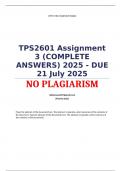
LCP4809 Assignment 1
(COMPLETE ANSWERS)
Semester 2 2025 - DUE 13
August 2025
NO PLAGIARISM
[Pick the date]
[Type the company name]
, Exam (elaborations)
LCP4809 Assignment 1 (COMPLETE
ANSWERS) Semester 2 2025 - DUE 13
August 2025
Course
Education Law (LCP4809)
Institution
University Of South Africa (Unisa)
Book
Foundations of Law and Education Law
LCP4809 Assignment 1 (COMPLETE ANSWERS) Semester 2 2025 - DUE 13
August 2025; 100% TRUSTED Complete, trusted solutions and explanations.
Ensure your success with us....
Question: Chapter 3 of the Constitution deals with co-operative government
and inter-governmental relations. This Chapter of the Constitution defines
the character of the three spheres of government, creates a framework for
co-operation between the spheres of government and organs of state within
each sphere, and prescribes methods to resolve uncertainties and possible
conflict among the spheres of government. Write an essay of approximately
300 words in which you discuss the role of co-operative government in the
South African education system. Please refer to relevant legislation and case
law to substantiate your argument.
The Role of Co-operative Government in the
South African Education System
The Constitution of the Republic of South Africa, 1996, establishes a unique and foundational
principle of governance in Chapter 3: co-operative government and inter-governmental relations.
This chapter mandates a framework where the three spheres of government—national,
provincial, and local—must work collaboratively to ensure the effective functioning of the state
and the provision of public services. This principle is not merely a political ideal but a
constitutional imperative, binding all organs of state to foster mutual trust and good faith, and to
assist and support one another. Within the South African context, where historical inequalities
and disparities persist, the principle of co-operative government is particularly crucial for the
education system. The system must navigate the dual challenges of setting uniform national
standards while also addressing the diverse and often starkly different needs of communities
across the country. This essay will discuss the multifaceted role of co-operative government in
the South African education system, examining how the three spheres of government interact,
(COMPLETE ANSWERS)
Semester 2 2025 - DUE 13
August 2025
NO PLAGIARISM
[Pick the date]
[Type the company name]
, Exam (elaborations)
LCP4809 Assignment 1 (COMPLETE
ANSWERS) Semester 2 2025 - DUE 13
August 2025
Course
Education Law (LCP4809)
Institution
University Of South Africa (Unisa)
Book
Foundations of Law and Education Law
LCP4809 Assignment 1 (COMPLETE ANSWERS) Semester 2 2025 - DUE 13
August 2025; 100% TRUSTED Complete, trusted solutions and explanations.
Ensure your success with us....
Question: Chapter 3 of the Constitution deals with co-operative government
and inter-governmental relations. This Chapter of the Constitution defines
the character of the three spheres of government, creates a framework for
co-operation between the spheres of government and organs of state within
each sphere, and prescribes methods to resolve uncertainties and possible
conflict among the spheres of government. Write an essay of approximately
300 words in which you discuss the role of co-operative government in the
South African education system. Please refer to relevant legislation and case
law to substantiate your argument.
The Role of Co-operative Government in the
South African Education System
The Constitution of the Republic of South Africa, 1996, establishes a unique and foundational
principle of governance in Chapter 3: co-operative government and inter-governmental relations.
This chapter mandates a framework where the three spheres of government—national,
provincial, and local—must work collaboratively to ensure the effective functioning of the state
and the provision of public services. This principle is not merely a political ideal but a
constitutional imperative, binding all organs of state to foster mutual trust and good faith, and to
assist and support one another. Within the South African context, where historical inequalities
and disparities persist, the principle of co-operative government is particularly crucial for the
education system. The system must navigate the dual challenges of setting uniform national
standards while also addressing the diverse and often starkly different needs of communities
across the country. This essay will discuss the multifaceted role of co-operative government in
the South African education system, examining how the three spheres of government interact,