1
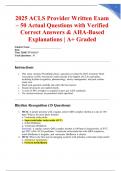
2025 ACLS Provider Written Exam
– 50 Actual Questions with Verified
Correct Answers & AHA-Based
Explanations | A+ Graded
Student Name: _________________________
Date: _______________
Time Limit: 60 minutes
Total Questions: 50
Instructions
• This exam contains 50 multiple-choice questions covering the 2025 American Heart
Association (AHA) Advanced Cardiovascular Life Support (ACLS) curriculum,
including rhythm recognition, pharmacology, airway management, and post-cardiac
arrest care.
• Read each question carefully and select the best answer.
• Ensure all answers are marked clearly.
• A score of 84% or higher is required to pass, per AHA standards.
• No external resources are permitted unless specified.
Rhythm Recognition (15 Questions)
1. MCQ: A patient presents with a regular, narrow QRS complex rhythm at a rate of 180
bpm. What is the most likely rhythm?
a. Ventricular tachycardia
b. Supraventricular tachycardia (SVT)
c. Atrial fibrillation
d. Ventricular fibrillation
Rationale: A regular, narrow QRS complex rhythm at 180 bpm is characteristic of SVT,
per 2025 AHA ACLS guidelines. Ventricular tachycardia has wide QRS complexes,
atrial fibrillation is irregular, and ventricular fibrillation is chaotic.
2. MCQ: What is the first step in managing a patient with pulseless ventricular tachycardia?
a. Administer amiodarone
b. Perform defibrillation
, 2
c. Give epinephrine
d. Start chest compressions
Rationale: Pulseless ventricular tachycardia is a shockable rhythm requiring immediate
defibrillation, per 2025 AHA ACLS guidelines.
3. MCQ: A patient’s ECG shows an irregular rhythm with no discernible P waves and a
variable ventricular rate. What is this rhythm?
a. Atrial fibrillation
b. Atrial flutter
c. Multifocal atrial tachycardia
d. Sinus tachycardia
Rationale: Atrial fibrillation is characterized by irregular rhythm and absent P waves, per
2025 AHA ACLS guidelines.
4. MCQ: A patient with a wide QRS complex tachycardia is hemodynamically stable. What
is the initial management?
a. Immediate defibrillation
b. Administer amiodarone
c. Perform synchronized cardioversion
d. Give adenosine
Rationale: For stable wide QRS tachycardia, amiodarone is recommended as the initial
antiarrhythmic, per 2025 AHA ACLS guidelines.
5. MCQ: What rhythm is characterized by a “sawtooth” pattern of P waves?
a. Atrial fibrillation
b. Atrial flutter
c. Supraventricular tachycardia
d. Sinus rhythm
Rationale: Atrial flutter shows a “sawtooth” pattern of flutter waves, per 2025 AHA
ACLS guidelines.
6. MCQ: A patient’s monitor shows ventricular fibrillation. What is the immediate action?
a. Administer epinephrine
b. Defibrillate
c. Start chest compressions
d. Give amiodarone
Rationale: Ventricular fibrillation is a shockable rhythm requiring immediate
defibrillation, per 2025 AHA ACLS guidelines.
7. MCQ: A patient in asystole is receiving CPR. What is the next step?
a. Defibrillate
b. Administer epinephrine
c. Give amiodarone
d. Perform synchronized cardioversion
Rationale: Asystole is a non-shockable rhythm; epinephrine is given after CPR, per 2025
AHA ACLS guidelines.
8. MCQ: What is the hallmark of pulseless electrical activity (PEA)?
a. Organized rhythm with a pulse
b. Organized rhythm without a pulse
c. Chaotic rhythm without a pulse
d. Flatline rhythm
2025 ACLS Provider Written Exam
– 50 Actual Questions with Verified
Correct Answers & AHA-Based
Explanations | A+ Graded
Student Name: _________________________
Date: _______________
Time Limit: 60 minutes
Total Questions: 50
Instructions
• This exam contains 50 multiple-choice questions covering the 2025 American Heart
Association (AHA) Advanced Cardiovascular Life Support (ACLS) curriculum,
including rhythm recognition, pharmacology, airway management, and post-cardiac
arrest care.
• Read each question carefully and select the best answer.
• Ensure all answers are marked clearly.
• A score of 84% or higher is required to pass, per AHA standards.
• No external resources are permitted unless specified.
Rhythm Recognition (15 Questions)
1. MCQ: A patient presents with a regular, narrow QRS complex rhythm at a rate of 180
bpm. What is the most likely rhythm?
a. Ventricular tachycardia
b. Supraventricular tachycardia (SVT)
c. Atrial fibrillation
d. Ventricular fibrillation
Rationale: A regular, narrow QRS complex rhythm at 180 bpm is characteristic of SVT,
per 2025 AHA ACLS guidelines. Ventricular tachycardia has wide QRS complexes,
atrial fibrillation is irregular, and ventricular fibrillation is chaotic.
2. MCQ: What is the first step in managing a patient with pulseless ventricular tachycardia?
a. Administer amiodarone
b. Perform defibrillation
, 2
c. Give epinephrine
d. Start chest compressions
Rationale: Pulseless ventricular tachycardia is a shockable rhythm requiring immediate
defibrillation, per 2025 AHA ACLS guidelines.
3. MCQ: A patient’s ECG shows an irregular rhythm with no discernible P waves and a
variable ventricular rate. What is this rhythm?
a. Atrial fibrillation
b. Atrial flutter
c. Multifocal atrial tachycardia
d. Sinus tachycardia
Rationale: Atrial fibrillation is characterized by irregular rhythm and absent P waves, per
2025 AHA ACLS guidelines.
4. MCQ: A patient with a wide QRS complex tachycardia is hemodynamically stable. What
is the initial management?
a. Immediate defibrillation
b. Administer amiodarone
c. Perform synchronized cardioversion
d. Give adenosine
Rationale: For stable wide QRS tachycardia, amiodarone is recommended as the initial
antiarrhythmic, per 2025 AHA ACLS guidelines.
5. MCQ: What rhythm is characterized by a “sawtooth” pattern of P waves?
a. Atrial fibrillation
b. Atrial flutter
c. Supraventricular tachycardia
d. Sinus rhythm
Rationale: Atrial flutter shows a “sawtooth” pattern of flutter waves, per 2025 AHA
ACLS guidelines.
6. MCQ: A patient’s monitor shows ventricular fibrillation. What is the immediate action?
a. Administer epinephrine
b. Defibrillate
c. Start chest compressions
d. Give amiodarone
Rationale: Ventricular fibrillation is a shockable rhythm requiring immediate
defibrillation, per 2025 AHA ACLS guidelines.
7. MCQ: A patient in asystole is receiving CPR. What is the next step?
a. Defibrillate
b. Administer epinephrine
c. Give amiodarone
d. Perform synchronized cardioversion
Rationale: Asystole is a non-shockable rhythm; epinephrine is given after CPR, per 2025
AHA ACLS guidelines.
8. MCQ: What is the hallmark of pulseless electrical activity (PEA)?
a. Organized rhythm with a pulse
b. Organized rhythm without a pulse
c. Chaotic rhythm without a pulse
d. Flatline rhythm