Thinking and deciding
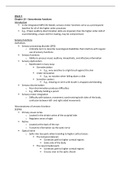
Chapter 1: introduction
“How do people make decisions and which information do they use?”
Personal decisions= choices that are essentially under our own control
Yversky and Kahnman (1974) used cognitive illusions as evidence for how
judgements and decisions are made; to show where people occasionally
go wrong under particular conditions
Cognitive illusions= systematic ways in which people make errors in
subjective judgement
People are strongly influenced by affect (= negative or positive emotion)
in making a choice
Fast-and-frugal approach= mental shortcuts are adaptive, because
they lead to the best balance between minimalizing the costs of cognitive
processing and time and maximizing the accuracy of decisions
Core question; How do people make complex decisions under conditions of
uncertainty, with time -and cognitive limitations?
Computational capacity= there is a limited amount of information we
can process at a time
Dual-process models= judgements and decisions are generally carried
out via two distinct kinds of mental processes;
1. System 1= fast, intuitive, automatic, emotion driven and not always
consciously accessible
2. System 2= slow, deliberate, controlled, reason driven and
consciously accessible
System 2 is tied to the working memory, and is therefore disrupted under
cognitive load
Model Sloman;
1. Associative system= reasoning is based on similarity and
statistical information
You quickly classify a given bird as a robin, because it is visually similar to
our memories of other robins, and it is statistically quite likely
2. Rule-based system= relying on logical rules
You classify a bird as a robin because it meets a six-point rule: bird, small,
dark body, red breast, robin genes, alive
,People have both systems for reasoning, and they can operate
simultaneously
- Descriptive models= attempt to describe how people actually
judge and decide, without saying what we do is good or bad (real-
life)
- Normative models= reflect optimal or ideal decision-making
(optimal)
- Prescriptive models= recommend a particular way in which
people ought to judge and decide
Exam question:
Let's dive into the section on "Understanding judgment and decision-
making." Why do you think understanding personal decisions is important
in the context of health and wellbeing?
, Chapter 2: Availability and representiveness
Heuristics= quick and easy rules of thumb, that we use to make
judgements under conditions of uncertainty (mental shortcut)
Definition Kahneman: “A simple procedure that helps find adequate
answers to difficult questions.”
Bias= systematic error in thinking in a specific direction that can result
from reliance on heuristics (error)
1) Availability heuristic= we (over-)estimate the frequency or
probability of something based on the ease with which something
comes to mind (Accessibility of exemplars)
Availability= memory traces existing in the mind
Accessibility= how easily one can retrieve these memory traces to
conscious awareness
Studies Tversky and Kahneman:
- Set-size judgment; estimating how many individuals belong to a
group or category
People’s frequency judgements appear to be based on the ease or
frequency with which they could call names to mind
- Relative frequency-of-occurrence judgement; estimate how
often an event or item occurs relative to another event or item
- Availability-by-number hypothesis= we esitmate how many
examples we are able to recall before making a frequency
judgement
- Availability-by-speed hypothesis= we estimate how easily
and/or quickly we are able to recall examples
People generally tend to underestimate the probability of high-frequency
occurrences and overestimate that of low-frequency occurrences, although
they are pretty accurate at rank-ordering different occurrences by
frequency.
People’s estimates of both high- and low frequency occurrences tend to
regress to the mean
2) Representativeness heuristic= we judge the probability that
something belongs to a category based on how strongly members of
that category resemble that something
, If X looks like a prototypical Y, then X probably is Y
Prototype or averaged representation of that class
- Law of small numbers= people's tendency to believe that small
samples closely represent the broader population, leading them to
overgeneralize from insufficient data
- Law of large numbers= randomness and fluctuations are more
pronounced in small samples, but as the sample size grows, these
random deviations diminish, and the sample becomes more
representative of the population as a whole
The Tom W. problem
Tom W. is intelligent, lacking creativity, need for clarity, tidy and does not
like interaction with others. What does Tom study?
a. Medicine
b. Social work
c. Computer science
People think Tom W. studies computer science, even though the base rate
(= statistical probability or frequency of an event or characteristic
occurring within a given population) of people studying computer science
is low. More people study social work, so statistically the probability of tom
studying social work is larger
There is a strong negative correlation between base rate and likelihood
judgements. People don’t take into account statistical probabilities
The Linda problem (conjunction fallacy)
Linda is outspoken and bright. She majored philosophy and is deeply
concerned about discrimination.
a. Linda is a bank teller > not likely
b. Linda is a bank teller and active in the feminist movement >
somewhat likely (probability average)
Conjunction rule= the probability of two things in conjunction cannot be
higher than the probability of either thing alone
3) Negativity bias= the tendency to pay more attention to the
negative information
Reason; negative is salient and evolutionary purpose
Interacts with the availability heuristic by making the world look grimmer
than it actually is
Chapter 1: introduction
“How do people make decisions and which information do they use?”
Personal decisions= choices that are essentially under our own control
Yversky and Kahnman (1974) used cognitive illusions as evidence for how
judgements and decisions are made; to show where people occasionally
go wrong under particular conditions
Cognitive illusions= systematic ways in which people make errors in
subjective judgement
People are strongly influenced by affect (= negative or positive emotion)
in making a choice
Fast-and-frugal approach= mental shortcuts are adaptive, because
they lead to the best balance between minimalizing the costs of cognitive
processing and time and maximizing the accuracy of decisions
Core question; How do people make complex decisions under conditions of
uncertainty, with time -and cognitive limitations?
Computational capacity= there is a limited amount of information we
can process at a time
Dual-process models= judgements and decisions are generally carried
out via two distinct kinds of mental processes;
1. System 1= fast, intuitive, automatic, emotion driven and not always
consciously accessible
2. System 2= slow, deliberate, controlled, reason driven and
consciously accessible
System 2 is tied to the working memory, and is therefore disrupted under
cognitive load
Model Sloman;
1. Associative system= reasoning is based on similarity and
statistical information
You quickly classify a given bird as a robin, because it is visually similar to
our memories of other robins, and it is statistically quite likely
2. Rule-based system= relying on logical rules
You classify a bird as a robin because it meets a six-point rule: bird, small,
dark body, red breast, robin genes, alive
,People have both systems for reasoning, and they can operate
simultaneously
- Descriptive models= attempt to describe how people actually
judge and decide, without saying what we do is good or bad (real-
life)
- Normative models= reflect optimal or ideal decision-making
(optimal)
- Prescriptive models= recommend a particular way in which
people ought to judge and decide
Exam question:
Let's dive into the section on "Understanding judgment and decision-
making." Why do you think understanding personal decisions is important
in the context of health and wellbeing?
, Chapter 2: Availability and representiveness
Heuristics= quick and easy rules of thumb, that we use to make
judgements under conditions of uncertainty (mental shortcut)
Definition Kahneman: “A simple procedure that helps find adequate
answers to difficult questions.”
Bias= systematic error in thinking in a specific direction that can result
from reliance on heuristics (error)
1) Availability heuristic= we (over-)estimate the frequency or
probability of something based on the ease with which something
comes to mind (Accessibility of exemplars)
Availability= memory traces existing in the mind
Accessibility= how easily one can retrieve these memory traces to
conscious awareness
Studies Tversky and Kahneman:
- Set-size judgment; estimating how many individuals belong to a
group or category
People’s frequency judgements appear to be based on the ease or
frequency with which they could call names to mind
- Relative frequency-of-occurrence judgement; estimate how
often an event or item occurs relative to another event or item
- Availability-by-number hypothesis= we esitmate how many
examples we are able to recall before making a frequency
judgement
- Availability-by-speed hypothesis= we estimate how easily
and/or quickly we are able to recall examples
People generally tend to underestimate the probability of high-frequency
occurrences and overestimate that of low-frequency occurrences, although
they are pretty accurate at rank-ordering different occurrences by
frequency.
People’s estimates of both high- and low frequency occurrences tend to
regress to the mean
2) Representativeness heuristic= we judge the probability that
something belongs to a category based on how strongly members of
that category resemble that something
, If X looks like a prototypical Y, then X probably is Y
Prototype or averaged representation of that class
- Law of small numbers= people's tendency to believe that small
samples closely represent the broader population, leading them to
overgeneralize from insufficient data
- Law of large numbers= randomness and fluctuations are more
pronounced in small samples, but as the sample size grows, these
random deviations diminish, and the sample becomes more
representative of the population as a whole
The Tom W. problem
Tom W. is intelligent, lacking creativity, need for clarity, tidy and does not
like interaction with others. What does Tom study?
a. Medicine
b. Social work
c. Computer science
People think Tom W. studies computer science, even though the base rate
(= statistical probability or frequency of an event or characteristic
occurring within a given population) of people studying computer science
is low. More people study social work, so statistically the probability of tom
studying social work is larger
There is a strong negative correlation between base rate and likelihood
judgements. People don’t take into account statistical probabilities
The Linda problem (conjunction fallacy)
Linda is outspoken and bright. She majored philosophy and is deeply
concerned about discrimination.
a. Linda is a bank teller > not likely
b. Linda is a bank teller and active in the feminist movement >
somewhat likely (probability average)
Conjunction rule= the probability of two things in conjunction cannot be
higher than the probability of either thing alone
3) Negativity bias= the tendency to pay more attention to the
negative information
Reason; negative is salient and evolutionary purpose
Interacts with the availability heuristic by making the world look grimmer
than it actually is