Pub 210 Midterm review Exam with
solved questions & answers
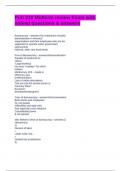
Bureaucracy - answers"the institutions of public
administration in America"
organizations and their employees who are tax
supported or operate under government
sponsorship
national, state, and local levels
Pros of Bureaucracy - answersDemocratization
Equality of treatment for
clients
"Legal leveling"
No more "royalties" for office-
holders
Meritocracy of B -- leads to
efficiency and
professionalism
Lack of viable alternatives
Can we trust the private sector or
honorary titles?
Economic
development/progress
Cons of Bureaucracy - answersDehumanization
Both clients and employees
#s, not people
Inflexibility and rigid rules
Red tape/rules over solutions
Consolidated power
B not elected
Max Weber's views of bureaucracy - answers1)
Hierarchical
2)
Division of labor
•
Large scale, but...
•
Divided into jurisdictions
3)
, Formal (legal) rules
•
Arbitrariness/favoritism prohibited
4)
Written files
•
Keeps
track of B's actions to ensure rules followed
5)
Paid, full-time, trained/professional employees
6)
Specialization (highly technical issues)
•
Power imbalance w/ politicians and
citizens
Stillman's 5 types of bureaucrats - answersPolitical appointees
Professional careerists
Civil service generalists
Unions/collective bargaining
Contract employees
political appointees - answerspeople selected by an elected leader, such as the
president, to hold a government position. The president is not one, but his cabinet is.
Professional careerists - answersA mix of political appointees and civil servants. A
General in the military for example. Someone who has worked their way up in
government and in some cases been appointed.
Civil servants are employees of the federal government who: - answersBased on
credentials and a merit system. Police officers, firefighters, sanitation workers, etc.
The Pendleton act requires exams and pay scale.
contract employee - answersAn employee who works under an agreement that defines
when the employee begins employment and when the employment ends. Cheaper, but
without direct control.
Unions and Collective Bargaining - answers- Collective bargaining is a process of
negotiation between employers and a group of employees (usually within a union)
aimed at agreeing to regulate salaries, working conditions, etc.
- If these unions are not able to be formed, these negotiations can become very one-
sided in favor of the employers, leading to poor wages, working conditions, etc.
Those involved in Kristen's Story - answersBoston Police
Probation Officers (county/state)
Courts (County and state)
solved questions & answers
Bureaucracy - answers"the institutions of public
administration in America"
organizations and their employees who are tax
supported or operate under government
sponsorship
national, state, and local levels
Pros of Bureaucracy - answersDemocratization
Equality of treatment for
clients
"Legal leveling"
No more "royalties" for office-
holders
Meritocracy of B -- leads to
efficiency and
professionalism
Lack of viable alternatives
Can we trust the private sector or
honorary titles?
Economic
development/progress
Cons of Bureaucracy - answersDehumanization
Both clients and employees
#s, not people
Inflexibility and rigid rules
Red tape/rules over solutions
Consolidated power
B not elected
Max Weber's views of bureaucracy - answers1)
Hierarchical
2)
Division of labor
•
Large scale, but...
•
Divided into jurisdictions
3)
, Formal (legal) rules
•
Arbitrariness/favoritism prohibited
4)
Written files
•
Keeps
track of B's actions to ensure rules followed
5)
Paid, full-time, trained/professional employees
6)
Specialization (highly technical issues)
•
Power imbalance w/ politicians and
citizens
Stillman's 5 types of bureaucrats - answersPolitical appointees
Professional careerists
Civil service generalists
Unions/collective bargaining
Contract employees
political appointees - answerspeople selected by an elected leader, such as the
president, to hold a government position. The president is not one, but his cabinet is.
Professional careerists - answersA mix of political appointees and civil servants. A
General in the military for example. Someone who has worked their way up in
government and in some cases been appointed.
Civil servants are employees of the federal government who: - answersBased on
credentials and a merit system. Police officers, firefighters, sanitation workers, etc.
The Pendleton act requires exams and pay scale.
contract employee - answersAn employee who works under an agreement that defines
when the employee begins employment and when the employment ends. Cheaper, but
without direct control.
Unions and Collective Bargaining - answers- Collective bargaining is a process of
negotiation between employers and a group of employees (usually within a union)
aimed at agreeing to regulate salaries, working conditions, etc.
- If these unions are not able to be formed, these negotiations can become very one-
sided in favor of the employers, leading to poor wages, working conditions, etc.
Those involved in Kristen's Story - answersBoston Police
Probation Officers (county/state)
Courts (County and state)