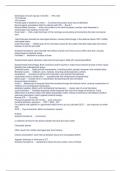
NUR 511 EXAM 1 STUDY GUIDE
S/S Heart failure - Answer -Fatigue, angina, anxiety, oliguria, decreased GI motility,
pale cool skin, weight gain (2 lb in a day 3-5 lb in a week), restlessness, edema
Left HF - Answer -Backs up to lungs, pulmonary edema. Pleural effusion. Crackles in
lungs. More common than right. DOE, SOB, PND, nonproductive cough, pink frothy
sputum, orthopnea, pulmonary crackles, fa IgE, weakness, activity intolerance, dry
cough, nocturnal cough, S3 and S4, dizziness syncope, palpitations/ tachycardia,
nocturia, pale/cyanosis, displaced PMI, anxiety, depression.
Right HF or Cor pulmonale - Answer -Result of either left ventricular failure or CoPD
and pulmonary hypertension. Peripheral edema. Ascites. JVD. Anorexia, nausea,
abdominal distinction, RUQ pain (liver distention), murmurs, anasarca, tachycardia,
hepatomegaly, splenomegaly, anxiety, depression.
Stroke volume - Answer -Made up of preload, contractility, afterload.
Compensatory mechanisms - Answer -SNS activation- catacholamine release
(increase HR, BP, vasoconstriction in periphery, workload on heart)
RAAS- hold onto water and salt, increase volume and vasoconstriction
ADH- hold onto water and salt
Natriuretic peptide- diuretic and vasodilation properties= BNP= specific marker for HF.
Hypertrophic- can't fill
Dilation- can't squeeze
HF classifications - Answer -Low numbers good, high bad. A is good, D is bad.
HF diagnosis - Answer -BNP elevated, BUN and creatinine elevated,
Ejection fraction - Answer -Greater than 60 is normal
40-60 moderate HF
20-40 mod to severe HF
Less than 20 severe HF
Serum BUN - Answer -Kidney function
Normal is 10-20 mg/dL
Serum creatinine - Answer -Kidney function
Normal is 0.5-1.2
Hyperkalemia - Answer -Potassium greater than 5.1
Causes: renal failure, excessive KCl, excessive use of salt substitutes.
Hyponatremia - Answer -Sodium level 135 mEq/L or less
, Causes: inadequate sodium intake, potent diuretics, retention of fluids (heart or kidney
failure).
Hypernatremia - Answer -Sodium level greater than 145 mEq/L
Causes: decreased water intake or excessive loss of water.
BNP - Answer -Levels over 700pg/mL indicate decompensated HF.
LFTs - Answer -AST, ALT, LDH, Alkaline phosphatase, Gamma GT.
SPO2 - Answer -Should be 90% or greater. Less than 85 is serious. Less than 70 is
deadly.
Edema scale - Answer -+1 is slight: rapidly returns to normal
+2 : normal in 10-15 sec
+3: normal in 1-2 min
+4: normal in 2-5 min
ACEs - Answer -End in "pril". Used to prevent kidney damage, prevent remodeling of
heart, and reduce BP.
Beta blockers for HF - Answer -Carvedilol, metoprolol XL, zebeta. Block
catacholamines.
Natrecor - Answer -Synthetic BNP. Profound vasodilator. Used for decompensated HF,
watch BP, IV infusion only, BNP will be elevated obviously...
Digoxin toxicity - Answer -Nausea, vomiting, anorexia, dysrhythmias, bradycardia,
tachycardia, headache, fatigue, blurred vision, colored vision.
Primary cardiomyopathy - Answer -Idiopathic cardiomyopathy
Secondary cardiomyopathy - Answer -Cardiomyopathy caused by another disease.
Dilated cardiomyopathy - Answer -Can't squeeze, most common type, cause of sudden
cardiac death, big boggy heart.
Caused by cardiotoxic agents (alcohol), infections, diseases, pregnancy.
HF symptoms, S3 and S4, at risk for blood clots!
Blood clot right side- pulmonary embolism
Blood clot left side- brain (stroke), legs, kidneys
Treat by stopping alcohol/drugs, same mess as HF, anticoagulants
Avoid alcohol, infections/crowds, family should learn CPR.
S/S Heart failure - Answer -Fatigue, angina, anxiety, oliguria, decreased GI motility,
pale cool skin, weight gain (2 lb in a day 3-5 lb in a week), restlessness, edema
Left HF - Answer -Backs up to lungs, pulmonary edema. Pleural effusion. Crackles in
lungs. More common than right. DOE, SOB, PND, nonproductive cough, pink frothy
sputum, orthopnea, pulmonary crackles, fa IgE, weakness, activity intolerance, dry
cough, nocturnal cough, S3 and S4, dizziness syncope, palpitations/ tachycardia,
nocturia, pale/cyanosis, displaced PMI, anxiety, depression.
Right HF or Cor pulmonale - Answer -Result of either left ventricular failure or CoPD
and pulmonary hypertension. Peripheral edema. Ascites. JVD. Anorexia, nausea,
abdominal distinction, RUQ pain (liver distention), murmurs, anasarca, tachycardia,
hepatomegaly, splenomegaly, anxiety, depression.
Stroke volume - Answer -Made up of preload, contractility, afterload.
Compensatory mechanisms - Answer -SNS activation- catacholamine release
(increase HR, BP, vasoconstriction in periphery, workload on heart)
RAAS- hold onto water and salt, increase volume and vasoconstriction
ADH- hold onto water and salt
Natriuretic peptide- diuretic and vasodilation properties= BNP= specific marker for HF.
Hypertrophic- can't fill
Dilation- can't squeeze
HF classifications - Answer -Low numbers good, high bad. A is good, D is bad.
HF diagnosis - Answer -BNP elevated, BUN and creatinine elevated,
Ejection fraction - Answer -Greater than 60 is normal
40-60 moderate HF
20-40 mod to severe HF
Less than 20 severe HF
Serum BUN - Answer -Kidney function
Normal is 10-20 mg/dL
Serum creatinine - Answer -Kidney function
Normal is 0.5-1.2
Hyperkalemia - Answer -Potassium greater than 5.1
Causes: renal failure, excessive KCl, excessive use of salt substitutes.
Hyponatremia - Answer -Sodium level 135 mEq/L or less
, Causes: inadequate sodium intake, potent diuretics, retention of fluids (heart or kidney
failure).
Hypernatremia - Answer -Sodium level greater than 145 mEq/L
Causes: decreased water intake or excessive loss of water.
BNP - Answer -Levels over 700pg/mL indicate decompensated HF.
LFTs - Answer -AST, ALT, LDH, Alkaline phosphatase, Gamma GT.
SPO2 - Answer -Should be 90% or greater. Less than 85 is serious. Less than 70 is
deadly.
Edema scale - Answer -+1 is slight: rapidly returns to normal
+2 : normal in 10-15 sec
+3: normal in 1-2 min
+4: normal in 2-5 min
ACEs - Answer -End in "pril". Used to prevent kidney damage, prevent remodeling of
heart, and reduce BP.
Beta blockers for HF - Answer -Carvedilol, metoprolol XL, zebeta. Block
catacholamines.
Natrecor - Answer -Synthetic BNP. Profound vasodilator. Used for decompensated HF,
watch BP, IV infusion only, BNP will be elevated obviously...
Digoxin toxicity - Answer -Nausea, vomiting, anorexia, dysrhythmias, bradycardia,
tachycardia, headache, fatigue, blurred vision, colored vision.
Primary cardiomyopathy - Answer -Idiopathic cardiomyopathy
Secondary cardiomyopathy - Answer -Cardiomyopathy caused by another disease.
Dilated cardiomyopathy - Answer -Can't squeeze, most common type, cause of sudden
cardiac death, big boggy heart.
Caused by cardiotoxic agents (alcohol), infections, diseases, pregnancy.
HF symptoms, S3 and S4, at risk for blood clots!
Blood clot right side- pulmonary embolism
Blood clot left side- brain (stroke), legs, kidneys
Treat by stopping alcohol/drugs, same mess as HF, anticoagulants
Avoid alcohol, infections/crowds, family should learn CPR.