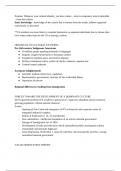
Premise: Whatever your cultural identity, you have values – what is competent, what is desirable
– from that culture
Emic knowledge - knowledge of the culture that is learned from the inside, seldom organized
consciously or discussed
**US residents are more likely to consider themselves as separate individuals free to choose their
own values rather than see the US as having a culture.
ORIGINS OF US CULTURAL PATTERNS
Pre 16th century Indigenous Americans
● 10 million people speaking hundreds of languages
● Iroquois League formed prior to European contact
● Founded to maintain peace and resolve disputes
● Written constitution with a system of checks, balances, supreme law
● Limited central authority
European Enlightenment
● Scientific method, democracy, capitalism
● Representative government, structure of law, individual liberty
● Separation of powers
Regional differences resulting from immigration
FORCES TOWARD THE DEVELOPMENT OF A DOMINANT CULTURE
De Tocqueville predicted US would be a great power - large size, abundant natural resources,
growing population, vibrant national character
Events:
- Opening of Erie Canal and emergence of NY as financial and corporate center of
integrated industrial complex
- Defeat of South and 13, 14, 15 amendments
- New nationalism - intellectual foundation of an activist national government
- Passage of Immigration Act of 1924
- Development of radio and television which nationalized politics and popular culture
- Automobile and interstate highways
- Great Depression, World War 1, onset of Cold War: all increased the need for a strong
centralized national government
VALUE ORIENTATION THEORY
– from that culture
Emic knowledge - knowledge of the culture that is learned from the inside, seldom organized
consciously or discussed
**US residents are more likely to consider themselves as separate individuals free to choose their
own values rather than see the US as having a culture.
ORIGINS OF US CULTURAL PATTERNS
Pre 16th century Indigenous Americans
● 10 million people speaking hundreds of languages
● Iroquois League formed prior to European contact
● Founded to maintain peace and resolve disputes
● Written constitution with a system of checks, balances, supreme law
● Limited central authority
European Enlightenment
● Scientific method, democracy, capitalism
● Representative government, structure of law, individual liberty
● Separation of powers
Regional differences resulting from immigration
FORCES TOWARD THE DEVELOPMENT OF A DOMINANT CULTURE
De Tocqueville predicted US would be a great power - large size, abundant natural resources,
growing population, vibrant national character
Events:
- Opening of Erie Canal and emergence of NY as financial and corporate center of
integrated industrial complex
- Defeat of South and 13, 14, 15 amendments
- New nationalism - intellectual foundation of an activist national government
- Passage of Immigration Act of 1924
- Development of radio and television which nationalized politics and popular culture
- Automobile and interstate highways
- Great Depression, World War 1, onset of Cold War: all increased the need for a strong
centralized national government
VALUE ORIENTATION THEORY