PEN2608
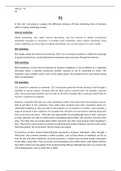
Assignment 1 Semester 2 2025
2 2025
Unique Number:
Due date: 29 August 2025
QUESTION 1
Rule 12 in the Nelson Mandela Rules deals with accommodation for offenders during the
night. It states that, where possible, each prisoner should have their own cell or room at
night. If communal cells are used, the offenders must be carefully chosen to ensure that they
are suitable to be housed together. This selection is aimed at preventing conflict, ensuring
safety, and promoting positive association among prisoners. The rule also requires that
there must be regular night supervision, in line with the security needs of the prison, to
protect offenders’ well-being and maintain order.
Rule 22 focuses on the provision of health care in correctional facilities. It requires that each
prison should have a resident medical officer with psychiatric knowledge and that offenders
who need specialised treatment must be transferred to a hospital capable of providing it.
Offenders must have access to qualified dental care, and where mothers are allowed to
keep their infants with them, nurseries staffed with qualified personnel must be provided.
DISCLAIMER & TERMS OF USE
Educational Aid: These study notes are intended to be used as educational resources and should not be seen as a
replacement for individual research, critical analysis, or professional consultation. Students are encouraged to perform
their own research and seek advice from their instructors or academic advisors for specific assignment guidelines.
Personal Responsibility: While every effort has been made to ensure the accuracy and reliability of the information in
these study notes, the seller does not guarantee the completeness or correctness of all content. The buyer is
responsible for verifying the accuracy of the information and exercising their own judgment when applying it to their
assignments.
Academic Integrity: It is essential for students to maintain academic integrity and follow their institution's policies
regarding plagiarism, citation, and referencing. These study notes should be used as learning tools and sources of
inspiration. Any direct reproduction of the content without proper citation and acknowledgment may be considered
academic misconduct.
Limited Liability: The seller shall not be liable for any direct or indirect damages, losses, or consequences arising from
the use of these notes. This includes, but is not limited to, poor academic performance, penalties, or any other negative
consequences resulting from the application or misuse of the information provided.
, For additional support +27 81 278 3372
QUESTION 1
Rule 12 in the Nelson Mandela Rules deals with accommodation for offenders
during the night. It states that, where possible, each prisoner should have their own
cell or room at night. If communal cells are used, the offenders must be carefully
chosen to ensure that they are suitable to be housed together. This selection is
aimed at preventing conflict, ensuring safety, and promoting positive association
among prisoners. The rule also requires that there must be regular night supervision,
in line with the security needs of the prison, to protect offenders’ well-being and
maintain order.
Rule 22 focuses on the provision of health care in correctional facilities. It requires
that each prison should have a resident medical officer with psychiatric knowledge
and that offenders who need specialised treatment must be transferred to a hospital
capable of providing it. Offenders must have access to qualified dental care, and
where mothers are allowed to keep their infants with them, nurseries staffed with
qualified personnel must be provided. Upon admission, every offender must be
examined by a medical practitioner to identify any illnesses, including infectious
diseases, and such cases must be managed to avoid the spread of infection.
Offenders should be seen daily by the medical practitioner, and any deterioration in
their health due to imprisonment must be reported to the prison director. The medical
officer must also monitor and report on food quality, hygiene, bedding, clothing, and
the general physical condition of the offenders.
QUESTION 2
The Positive Impact of Offender M Furthering His Education
If offender M decides to continue his education and complete grade 12, it could bring
several positive changes to his life during and after his incarceration. Education in a
correctional setting is not only about gaining academic knowledge; it is also a way of
equipping an offender with skills, values, and confidence that can help reduce the
chances of reoffending. By completing grade 12, offender M will improve his reading,
writing, and numerical skills, which are essential for everyday tasks and for most
forms of employment in society. These skills can also make him more capable of
Assignment 1 Semester 2 2025
2 2025
Unique Number:
Due date: 29 August 2025
QUESTION 1
Rule 12 in the Nelson Mandela Rules deals with accommodation for offenders during the
night. It states that, where possible, each prisoner should have their own cell or room at
night. If communal cells are used, the offenders must be carefully chosen to ensure that they
are suitable to be housed together. This selection is aimed at preventing conflict, ensuring
safety, and promoting positive association among prisoners. The rule also requires that
there must be regular night supervision, in line with the security needs of the prison, to
protect offenders’ well-being and maintain order.
Rule 22 focuses on the provision of health care in correctional facilities. It requires that each
prison should have a resident medical officer with psychiatric knowledge and that offenders
who need specialised treatment must be transferred to a hospital capable of providing it.
Offenders must have access to qualified dental care, and where mothers are allowed to
keep their infants with them, nurseries staffed with qualified personnel must be provided.
DISCLAIMER & TERMS OF USE
Educational Aid: These study notes are intended to be used as educational resources and should not be seen as a
replacement for individual research, critical analysis, or professional consultation. Students are encouraged to perform
their own research and seek advice from their instructors or academic advisors for specific assignment guidelines.
Personal Responsibility: While every effort has been made to ensure the accuracy and reliability of the information in
these study notes, the seller does not guarantee the completeness or correctness of all content. The buyer is
responsible for verifying the accuracy of the information and exercising their own judgment when applying it to their
assignments.
Academic Integrity: It is essential for students to maintain academic integrity and follow their institution's policies
regarding plagiarism, citation, and referencing. These study notes should be used as learning tools and sources of
inspiration. Any direct reproduction of the content without proper citation and acknowledgment may be considered
academic misconduct.
Limited Liability: The seller shall not be liable for any direct or indirect damages, losses, or consequences arising from
the use of these notes. This includes, but is not limited to, poor academic performance, penalties, or any other negative
consequences resulting from the application or misuse of the information provided.
, For additional support +27 81 278 3372
QUESTION 1
Rule 12 in the Nelson Mandela Rules deals with accommodation for offenders
during the night. It states that, where possible, each prisoner should have their own
cell or room at night. If communal cells are used, the offenders must be carefully
chosen to ensure that they are suitable to be housed together. This selection is
aimed at preventing conflict, ensuring safety, and promoting positive association
among prisoners. The rule also requires that there must be regular night supervision,
in line with the security needs of the prison, to protect offenders’ well-being and
maintain order.
Rule 22 focuses on the provision of health care in correctional facilities. It requires
that each prison should have a resident medical officer with psychiatric knowledge
and that offenders who need specialised treatment must be transferred to a hospital
capable of providing it. Offenders must have access to qualified dental care, and
where mothers are allowed to keep their infants with them, nurseries staffed with
qualified personnel must be provided. Upon admission, every offender must be
examined by a medical practitioner to identify any illnesses, including infectious
diseases, and such cases must be managed to avoid the spread of infection.
Offenders should be seen daily by the medical practitioner, and any deterioration in
their health due to imprisonment must be reported to the prison director. The medical
officer must also monitor and report on food quality, hygiene, bedding, clothing, and
the general physical condition of the offenders.
QUESTION 2
The Positive Impact of Offender M Furthering His Education
If offender M decides to continue his education and complete grade 12, it could bring
several positive changes to his life during and after his incarceration. Education in a
correctional setting is not only about gaining academic knowledge; it is also a way of
equipping an offender with skills, values, and confidence that can help reduce the
chances of reoffending. By completing grade 12, offender M will improve his reading,
writing, and numerical skills, which are essential for everyday tasks and for most
forms of employment in society. These skills can also make him more capable of