

PALS Updated FINAL EXAM
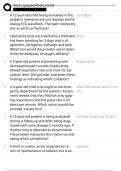
1. A 12-year-old child being evaluated in the second degree
pediatric intensive care unit displays the fol-
lowing ECG waveform. The team interprets
this as which arrhythmia?
2. Laboratory tests are ordered for a child who Lactate
has been vomiting for 3 days and is di-
aphoretic, tachypneic, lethargic and pale.
Which test would the provider use to deter-
mine the adequacy of oxygen delivery?
3. A 9-year-old patient is presenting with Respiratory failure
decreased breath sounds, bradycardia,
slowed respiratory rate and a low O2 sat-
uration level. The provider interprets these
findings as indicating which condition?
4. A 4-year-old child is brought to the emer- Deliver 1 BVM ventilation every 3 to 5 sec-
gency department by the parents. Assess- onds.
ment reveals that the child has only gasp-
ing respirations and the pulse rate is 65
beats per minute. Which action would the
provider initiate first?
5. A 15-year-old patient is being evaluated First-degree atrioventricular (AV) block
during a follow-up visit after being diag-
nosed with Lyme disease 2 months ago. A
rhythm strip is obtained as shown below.
The provider interprets this rhythm as indi-
cating which arrhythmia?
6. A child in cardiac arrest experiences re- Hypotension
turn of spontaneous circulation but is ex-
, PALS Updated FINAL EXAM
hibiting signs of post-cardiac arrest syn- Fever
drome (PCAS). The PALS resuscitation team
determines that the child is experiencing Hyperglycemia
a systemic response to ischemia/reperfu-
sion. The team bases this determination on
which finding(s)?
7. A 2-year-old child arrives at the emer- Allowing the chest to recoil fully after each
gency department with the parents. The compression
child is unresponsive, is not breathing and
has no pulse. Two emergency department Providing ventilations that last about 1 sec-
providers begin high-quality CPR. Which ond each
action(s) by the providers demonstrates
Compressing the chest about 2 inches
high-quality CPR?
Giving 2 ventilations to every 15 compres-
sions
8. A PALS resuscitation team is preparing to VF and pVT are shockable cardiac arrest
defibrillate a child experiencing cardiac ar- rhythms.
rest. For which rhythm(s) would this action
be appropriate?
9. A provider is assessing a child with suspect- Hypotension is not a consistent feature of
ed shock. Which statement correctly de- shock;
scribes hypotension and shock?
10. A provider is caring for a 4-year-old child in Supplemental oxygen should be adminis-
the urgent care clinic. Primary assessment tered as needed to maintain an oxygen sat-
reveals difficulty breathing and an oxygen uration above 94%.
saturation of 91%. The provider adminis-
ters oxygen by nasal cannula with the goal
1. A 12-year-old child being evaluated in the second degree
pediatric intensive care unit displays the fol-
lowing ECG waveform. The team interprets
this as which arrhythmia?
2. Laboratory tests are ordered for a child who Lactate
has been vomiting for 3 days and is di-
aphoretic, tachypneic, lethargic and pale.
Which test would the provider use to deter-
mine the adequacy of oxygen delivery?
3. A 9-year-old patient is presenting with Respiratory failure
decreased breath sounds, bradycardia,
slowed respiratory rate and a low O2 sat-
uration level. The provider interprets these
findings as indicating which condition?
4. A 4-year-old child is brought to the emer- Deliver 1 BVM ventilation every 3 to 5 sec-
gency department by the parents. Assess- onds.
ment reveals that the child has only gasp-
ing respirations and the pulse rate is 65
beats per minute. Which action would the
provider initiate first?
5. A 15-year-old patient is being evaluated First-degree atrioventricular (AV) block
during a follow-up visit after being diag-
nosed with Lyme disease 2 months ago. A
rhythm strip is obtained as shown below.
The provider interprets this rhythm as indi-
cating which arrhythmia?
6. A child in cardiac arrest experiences re- Hypotension
turn of spontaneous circulation but is ex-
, PALS Updated FINAL EXAM
hibiting signs of post-cardiac arrest syn- Fever
drome (PCAS). The PALS resuscitation team
determines that the child is experiencing Hyperglycemia
a systemic response to ischemia/reperfu-
sion. The team bases this determination on
which finding(s)?
7. A 2-year-old child arrives at the emer- Allowing the chest to recoil fully after each
gency department with the parents. The compression
child is unresponsive, is not breathing and
has no pulse. Two emergency department Providing ventilations that last about 1 sec-
providers begin high-quality CPR. Which ond each
action(s) by the providers demonstrates
Compressing the chest about 2 inches
high-quality CPR?
Giving 2 ventilations to every 15 compres-
sions
8. A PALS resuscitation team is preparing to VF and pVT are shockable cardiac arrest
defibrillate a child experiencing cardiac ar- rhythms.
rest. For which rhythm(s) would this action
be appropriate?
9. A provider is assessing a child with suspect- Hypotension is not a consistent feature of
ed shock. Which statement correctly de- shock;
scribes hypotension and shock?
10. A provider is caring for a 4-year-old child in Supplemental oxygen should be adminis-
the urgent care clinic. Primary assessment tered as needed to maintain an oxygen sat-
reveals difficulty breathing and an oxygen uration above 94%.
saturation of 91%. The provider adminis-
ters oxygen by nasal cannula with the goal


