Lecture 1 Overall Framework + Topic 1: Short-Term Financial Management
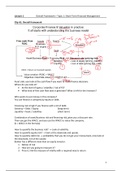
Clip A1: Overall framework
(ROIC = Return on Invested Capital)
Asset side: you look at the cash flow if you want to make finance decisions.
Where do you look at?
• At the level of sigma / volatility / risk of FCF
• What kind of free cash flow does it generate? What is left for the investors?
Who wants to put money in this company?
You can finance a company by equity or debt.
Financing risk is high if you finance with a lot of debt.
Solvency = Debt / Equity (long term)
Liquidity = Asset / Liabilities (short term)
Combination of asset/business risk and financing risk, gives you a discount rate.
Then you get the WACC, and you use the WACC to value the company.
(k = WACC in the formula)
How to quantify the business risk? → Look at volatility
How to quantify equity risk? → look at the downside and upside.
How to quantity debt risk → probability that you do not get your money back, only look at
the downside, not at the upside.
Banker has a different view than an equity investor.
1. Notion of risk
2. How are you going to measure it?
3. Price it, link the measure of vitality with a required way to return
1
,Corporate finance at different levels
1. Long term finance
Long term investments, capital structure, equity versus debt
2. Short term finance
- Working capital management (total funding need for WC assets)
- Liquidity management (liquidity assets, maturity funding)
3. Cash management
Organization of all transactions/payments in a company
Corporate finance:
- Managing the balance sheet
- Matching assets with funding
Clip A2: Market versus Book Balance Sheet
Book balance sheet
Cash + liquid assets Short term liabilities
- Short term debt
- - accounts payable
Accounts receivable Long term liabilities
(Long term debt)
Inventory Book equity
Long term assets (doesn’t have anything to do with the
- Fixed market value of the company, depends too
- Non-fixed much on accounting rules)
- Financial
(433 – 403 = EBIT + Depreciation = EBITDA)
2
,Total equity becomes positive – strange:
3
, HEMA case: Market balance sheet
Senior Secured Floating Rate Notes – first ones to get their money back (most of the time
the bank). After them, the Senior Secured Fixed Rate notes, and then the Super Senior
Revolving Credit Facility.
On the asset side
• Cash flow engine
• EBITDA = 88 million (transfer into FCF and put a PV on the FCF to make it a valuation)
• 10.75 and 38% are determined by supply and demand
On the liability side
• 800 million in debt – convert into market value:
o Market value senior debt: 268 million (market is willing to give you 268 mio)
o Equity value = about zero
On the asset side: Enterprise value about 268 million
NOPAT: free cash flow estimate FCF
Turnover
– Costs
EBITDA 88
– Depreciation – 36
EBIT 52
– Tax (100% equity financed) – (52 x 0.30)
NOPAT 35 million
268 = 35 / WACC →→ WACC is implied 14% (high but makes sense because of risk)
Risk is high →→ WACC goes up.
4
Clip A1: Overall framework
(ROIC = Return on Invested Capital)
Asset side: you look at the cash flow if you want to make finance decisions.
Where do you look at?
• At the level of sigma / volatility / risk of FCF
• What kind of free cash flow does it generate? What is left for the investors?
Who wants to put money in this company?
You can finance a company by equity or debt.
Financing risk is high if you finance with a lot of debt.
Solvency = Debt / Equity (long term)
Liquidity = Asset / Liabilities (short term)
Combination of asset/business risk and financing risk, gives you a discount rate.
Then you get the WACC, and you use the WACC to value the company.
(k = WACC in the formula)
How to quantify the business risk? → Look at volatility
How to quantify equity risk? → look at the downside and upside.
How to quantity debt risk → probability that you do not get your money back, only look at
the downside, not at the upside.
Banker has a different view than an equity investor.
1. Notion of risk
2. How are you going to measure it?
3. Price it, link the measure of vitality with a required way to return
1
,Corporate finance at different levels
1. Long term finance
Long term investments, capital structure, equity versus debt
2. Short term finance
- Working capital management (total funding need for WC assets)
- Liquidity management (liquidity assets, maturity funding)
3. Cash management
Organization of all transactions/payments in a company
Corporate finance:
- Managing the balance sheet
- Matching assets with funding
Clip A2: Market versus Book Balance Sheet
Book balance sheet
Cash + liquid assets Short term liabilities
- Short term debt
- - accounts payable
Accounts receivable Long term liabilities
(Long term debt)
Inventory Book equity
Long term assets (doesn’t have anything to do with the
- Fixed market value of the company, depends too
- Non-fixed much on accounting rules)
- Financial
(433 – 403 = EBIT + Depreciation = EBITDA)
2
,Total equity becomes positive – strange:
3
, HEMA case: Market balance sheet
Senior Secured Floating Rate Notes – first ones to get their money back (most of the time
the bank). After them, the Senior Secured Fixed Rate notes, and then the Super Senior
Revolving Credit Facility.
On the asset side
• Cash flow engine
• EBITDA = 88 million (transfer into FCF and put a PV on the FCF to make it a valuation)
• 10.75 and 38% are determined by supply and demand
On the liability side
• 800 million in debt – convert into market value:
o Market value senior debt: 268 million (market is willing to give you 268 mio)
o Equity value = about zero
On the asset side: Enterprise value about 268 million
NOPAT: free cash flow estimate FCF
Turnover
– Costs
EBITDA 88
– Depreciation – 36
EBIT 52
– Tax (100% equity financed) – (52 x 0.30)
NOPAT 35 million
268 = 35 / WACC →→ WACC is implied 14% (high but makes sense because of risk)
Risk is high →→ WACC goes up.
4