100% satisfaction guarantee Immediately available after payment Both online and in PDF No strings attached 4.2 TrustPilot
logo-home
Exam (elaborations)

Essentials exam #3 Oxygenation, Skin Integrity, Wound Care and Nutrition Final Exam Latest Updated Questions With Complete Solutions.

Rating
-
Sold
-
Pages
9
Grade
A+
Uploaded on
03-08-2025
Written in
2025/2026

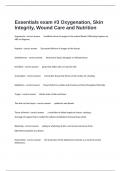
Hypoxemia - correct answer insufficient level of oxygen in the arterial blood (<80mmHg) requires an ABG to diagnose. Hypoxia - correct answer Decreased delivery of oxygen to the tissues Debridement: - correct answer Removal of dead, damaged, or infected tissue Emollient - correct answer gents that soften skin or treat dry skin Granulation - correct answer Connective tissue that forms on the surface of a healing Epithelium - correct answer Tissue that lines cavities and structure surfaces throughout the body Turgor - correct answer Elastic state of skin and tissue The skin has two layers - correct answer epidermis and dermis Tissue ischemia - correct answer a restriction in blood supply to tissues, causing a shortage of oxygen that is needed for cellular metabolism (to keep tissue alive). Blanching - correct answer paling or whitening of skin, and normal red tones of the light-skinned patient are absent. Evisceration - correct answer the protrusion of the abdominal contents as a result of wound dehiscence. Serous - correct answer thin, clear/off white, watery secretion. Purulent - correct answer Containing pus, thick, yellow/ brown/beige, smells foul (malodorous). Incision - correct answer Open cut made with a knife/scalpel. Sanguineous - correct answer Containing RBCs/bright red. Laceration - correct answer Irregular wound tear; jagged edges. Serosanguineous - correct answer Red watery secretion. Dehiscence - correct answer Previously closed wound. Partial or total separation of wound tissues, an opening of the surgical incision. Contusion - correct answer closed wound with pain and swelling Abrasion - correct answer scraping away at the skin surface Penetrating - correct answer entering into the tissues/body cavity Primary intention - correct answer The skin edges are approximated, or closed, and the risk of infection is low. Secondary intention - correct answer A wound involving loss of tissue such as a burn, stage II pressure injury, or severe laceration. The wound is left open until it becomes filled by scar tissue Tertiary intention - correct answer The wound is purposely left open due to heavy infection or contamination initially cleaned, debrided and observed (Tissue Graft, Stage 4 Pressure ulcer with necrotic tissue and infection) Three phases of healing - correct answer inflammatory, proliferative, maturation inflammatory phase of healing - correct answer First phase of the healing process Hemostasis develops; macrophages remove debris. proliferative phase of healing - correct answer New blood vessels and tissue are formed. Bring blood supply to a healing area. Maturation phase of healing - correct answer Final stage of wound healing, Lasts for months. Collagen fiber is remodeled; scar formation and contraction occur. Hemorrhage - correct answer excessive bleeding Hematoma - correct answer Blood to collecting and pooling under the skin; bad bruise. Braden Scale - correct answer Pressure ulcers lower the number, higher the risk 4-23 less than 17 = risk for pressure ulcers wound stages - correct answer Stage 1: Redness, non-blanchable INTACT skin Stage 2: Partial-thickness loss of skin, exposed dermis Stage 3: Full-thickness skin loss, adipose tissue is visible (looks like chicken fat), rounded/ epibole edges. Slough and eschar may be visable Stage 4: Full-thickness SKIN AND TISSUE LOSS, with EXPOSED muscle, tendon, bone, cartilage. Unstageable: Full thickness skin and tissue loss and is obscured by slough or eschar. Deep Tissue Injury: Intact skin with PURPLE discoloration or blood filled blister Undermining - correct answer tissue destruction underlying intact skin along wound margins tunneling - correct answer are narrow areas that extend beyond the depth or edge of the wound, channeling away from the wound through soft tissue or muscle. Usual Bony Prominences - correct answer Occiput Ear Scapula Spinous Process Shoulder Elbow Iliac Crest Sacrum/Coccyx Ischial Tuberosity Trochanter Knee Malleolus Heel Toe Basal Metabolic Rate - correct answer the body's resting rate of energy output Resting Enegry Expenditure - correct answer Amount of energy needed to consume over 24-hour period for the body to maintain internal working activities while at rest. Metabolism - correct answer All biochemical reactions within the cells of the body Anabolism - correct answer Building muscle: Building of more complex biochemical substances by synthesis of nutrients Catabolism - correct answer Break down of muscles: Breakdown of biochemical substances into simpler substances; occurs during physiological states of negative nitrogen balance Absorption - correct answer The , lined with fingerlike projections called villi, is the primary absorption site for nutrients: carbohydrates, protein, minerals, and water-soluble vitamins. Chyme - correct answer Partially digested, semiliquid food mixed with digestive enzymes and acids in the stomach. Anthropometry - correct answer the scientific study of the measurements and proportions of the human body. dysphagia - correct answer difficulty swallowing Enteral nutrition (EN) - correct answer Provision of nutrients through the gastrointestinal tract when the client cannot ingest, chew, or swallow food but can digest and absorb nutrients. central parenteral nutrition - correct answer specialized for of nutritional support used when adequate nutrition cannot be delivered to or absorbed by the gastrointestinal (GI) tract. Fat soluble vitamins - correct answer Vitamins A, D, E, K water soluble vitamins - correct answer Vitamins B and C, Easily absorbed through GI tract in the small intestine, body does NOT store these Minerals - correct answer A solid inorganic substance of natural occurrence. Hypervitaminosis - correct answer Condition caused by excessive intake of a vitamin; less likely to occur with water-soluble vitamins. Clear Liquid - correct answer Clear fat-free broth, bouillon, coffee, tea, carbonated beverages, clear fruit juices, gelatin, fruit ices, popsicles Full Liquid - correct answer As for clear liquid, with addition of smooth-textured dairy products (e.g., ice cream), strained or blended cream soups, custards, refined cooked cereals, vegetable juice, pureed vegetables, all fruit juices, sherbets, puddings, frozen yogurt Dysphagia Stages, Thickened Liquids, Pureed - correct answer As for clear and full liquid, with addition of scrambled eggs; pureed meats, vegetables, and fruits; mashed potatoes and gravy mechanical soft diet - correct answer As for clear and full liquid and pureed, with addition of all cream soups, ground or finely diced meats, flaked fish, cottage cheese, cheese, rice, potatoes, pancakes, light breads, cooked vegetables, cooked or canned fruits, bananas, soups, peanut butter, eggs (not fried) soft/low residue diet - correct answer Addition of low-fiber, easily digested foods such as pastas, casseroles, moist tender meats, and canned cooked fruits and vegetables; desserts, cakes, and cookies without nuts or coconut most common methods for providing enteral nutrition - correct answer Naso, gastro and jejunostomy Exudate - correct answer fluid that accumulates in a wound; may contain serum, cellular debris, bacteria, and white blood cells macerate - correct answer soften or break up by soaking; weaken Periwound - correct answer Area of skin around a wound bed NPWT - correct answer Negative-pressure wound therapy: activity that promotes wound healing and wound closure through the application of uniform negative pressure on the wound bed, reduction in bacteria in the wound, and the removal of excess wound fluid necrosis - correct answer death of tissue Excoriation - correct answer Skin sore or abrasion produced by scratching or scraping Types of wound dressings - correct answer transparent film, impregnated nonadherent, hydrocolloids, clear absorbent acrylic, hydrogel, polyurethane foam, alginate Where is oxygen on Maslow's Hierarchy of Maslow's Hierarchy of Needs? - correct answer Physiological Needs Know the purpose, patient, and performance - correct answer Amount of oxygen to be delivered Physical condition and developmental age of the patient Oxygen concentration delivered by device Nasal Cannula - correct answer -6 L/min Every liter/minute of oxygen increases the percentage of O2 the patient breathes by 3 - 4 %. Room air is 21% O2. So if a patient is on 4 L/min O2 flow, then he or she is breathing air that is about 33 - 37% O2 Flow rates >4 L/min may produce drying membranes How should nasal cannula prongs should be inserted - correct answer Nasal cannula prongs should be curved downward when inserted. Nasal Cannula:Nursing Considerations - correct answer

Show more Read less
Institution
SKIN INTEGRITY
Course
SKIN INTEGRITY


Whoops! We can’t load your doc right now. Try again or contact support.

Written for

Institution
SKIN INTEGRITY
Course
SKIN INTEGRITY

Document information

Uploaded on
August 3, 2025
Number of pages
9
Written in
2025/2026
Type
Exam (elaborations)
Contains
Questions & answers

Subjects

Content preview

Essentials exam #3 Oxygenation, Skin
Integrity, Wound Care and Nutrition
Hypoxemia - correct answer insufficient level of oxygen in the arterial blood (<80mmHg) requires an
ABG to diagnose.


Hypoxia - correct answer Decreased delivery of oxygen to the tissues


Debridement: - correct answer Removal of dead, damaged, or infected tissue


Emollient - correct answer gents that soften skin or treat dry skin


Granulation - correct answer Connective tissue that forms on the surface of a healing


Epithelium - correct answer Tissue that lines cavities and structure surfaces throughout the body


Turgor - correct answer Elastic state of skin and tissue


The skin has two layers - correct answer epidermis and dermis


Tissue ischemia - correct answer a restriction in blood supply to tissues, causing a

shortage of oxygen that is needed for cellular metabolism (to keep tissue alive).


Blanching - correct answer paling or whitening of skin, and normal red tones of the

light-skinned patient are absent.


Evisceration - correct answer the protrusion of the abdominal contents as a result of wound
dehiscence.

, Serous - correct answer thin, clear/off white, watery secretion.


Purulent - correct answer Containing pus, thick, yellow/ brown/beige, smells foul

(malodorous).


Incision - correct answer Open cut made with a knife/scalpel.


Sanguineous - correct answer Containing RBCs/bright red.


Laceration - correct answer Irregular wound tear; jagged edges.


Serosanguineous - correct answer Red watery secretion.


Dehiscence - correct answer Previously closed wound. Partial or total separation of wound tissues, an
opening of the surgical incision.


Contusion - correct answer closed wound with pain and swelling


Abrasion - correct answer scraping away at the skin surface


Penetrating - correct answer entering into the tissues/body cavity


Primary intention - correct answer The skin edges are approximated, or closed, and the risk of
infection is low.


Secondary intention - correct answer A wound involving loss of tissue such as a burn, stage II
pressure injury, or severe laceration. The wound is left open until it becomes filled by scar tissue

Get to know the seller

Seller avatar
Reputation scores are based on the amount of documents a seller has sold for a fee and the reviews they have received for those documents. There are three levels: Bronze, Silver and Gold. The better the reputation, the more your can rely on the quality of the sellers work.
Rechga Nursing
View profile
Follow You need to be logged in order to follow users or courses
Sold
14
Member since
1 year
Number of followers
2
Documents
2232
Last sold
1 month ago

5.0

10 reviews

5
10
4
0
3
0
2
0
1
0

Recently viewed by you

Why students choose Stuvia

Created by fellow students, verified by reviews

Quality you can trust: written by students who passed their tests and reviewed by others who've used these notes.

Didn't get what you expected? Choose another document

No worries! You can instantly pick a different document that better fits what you're looking for.

Pay as you like, start learning right away

No subscription, no commitments. Pay the way you're used to via credit card and download your PDF document instantly.

Student with book image

“Bought, downloaded, and aced it. It really can be that simple.”

Alisha Student

Frequently asked questions