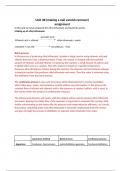
Unit 4B (making a nail varnish remover)
assignment
In this unit we have produced the ethyl ethanoate and tested its purity.
Making up of ethyl ethanoate
SULFURIC ACID
Ethanoic acid + ethanol ethyl ethanoate + water
CH3COOH + C2H5 OH CH3COOC2H5 + H2O
Batch process
In this process of producing ethyl ethanoate, includes a single reactor using ethanoic acid and
ethanol that turns into a desired product. Firstly, the reactor is charged with the essential
amount of ethanoic acid and ethanol. To speed up the reaction, a small amount of sulfuric acid
is added which acts as a catalyst. Then this mixture is heated at a specific temperature
(between 60 to 80 degrees Celsius) during this reaction, the ethanoic acid and ethanol undergo
a chemical reaction that produces ethyl ethanoate and water. Then the water is removed using
the distillation from the batch process.
The continuous process is also used to produce ethyl ethanoate but in massive quantities,
which takes days, weeks, and sometime months without any interruption. In this process the
constant flow of ethanol and ethanoic acid in the presence of catalyst (sulfuric acid) is used, in
the reactor where the product is continuously removed.
The ethanol and ethanoic acid reacts with the catalyst sulfuric acid to produce ethyl ethanoate
and water. Keeping the stable flow of the reactants is important to maintain this running. With
totally concentrating on the factors like the pressure and temperature for efficiency. As a result,
the product containing water and ethyl ethanoate is extracted continuously from the reactor
and goes through the process of distillation to separate ethyl ethanoate from water.
Laboratory method Batch process Continuous process
Apparatus Condenser, thermometer, metal distillation apparatus Fractional distillation
, used separation funnel, water and single reaction/ reaction column
bath, flask, beakers. vessel
Used Catalyst (concentrated Sulfuric acid), ethanoic acid and ethanol
substances
Method/ Drying Fill the reaction vessel with Continuous streamed
process distillation/separation, the reactants (ethanol and reactants are mixed,
neutralization, and reflux. ethanoic acid) in the and products
presence of a catalyst removed by boiling
(sulfuric acid), then heat the point.
vessel. After reflux, distill
and remove them at parallel
boiling points.
Scale of Milliliters (ml) Cubic meters (cm3)/ Tonnes, Cubic meters /
operation one batch at a time. Tonnes, can run
continuously for
weeks
Fischer esterification is often used for the chemical production of alcohols and carboxylic acids
in the presence of most reactive catalysts. In this process of producing ethyl ethanoate, the
ethanoic acid and ethanol are used as a reactant. Then the catalyst like HCl or sulfuric acid is
added to speed up the reaction in the reaction. Which makes the estimated 95% yield of ethyl
ethanoate at room temperature. In this reaction, the alcohol has nucleic attack on carboxylic
acid, it is heated at a specific temperature and pressure, then the water is removed that gives a
proper ester as a product.
The Tishchenko method used a different process for producing ethyl ethanoate, in which same
reactants ethanoic acid reacts with ethanol. It uses the temperature of 0 – 5 degrees Celsius in
which a different catalyst (aluminum alcoholate) is used. This process has the highest
percentage of yield of ethyl ethanoate which is about 98%.
Fischer method Tishchenko method
assignment
In this unit we have produced the ethyl ethanoate and tested its purity.
Making up of ethyl ethanoate
SULFURIC ACID
Ethanoic acid + ethanol ethyl ethanoate + water
CH3COOH + C2H5 OH CH3COOC2H5 + H2O
Batch process
In this process of producing ethyl ethanoate, includes a single reactor using ethanoic acid and
ethanol that turns into a desired product. Firstly, the reactor is charged with the essential
amount of ethanoic acid and ethanol. To speed up the reaction, a small amount of sulfuric acid
is added which acts as a catalyst. Then this mixture is heated at a specific temperature
(between 60 to 80 degrees Celsius) during this reaction, the ethanoic acid and ethanol undergo
a chemical reaction that produces ethyl ethanoate and water. Then the water is removed using
the distillation from the batch process.
The continuous process is also used to produce ethyl ethanoate but in massive quantities,
which takes days, weeks, and sometime months without any interruption. In this process the
constant flow of ethanol and ethanoic acid in the presence of catalyst (sulfuric acid) is used, in
the reactor where the product is continuously removed.
The ethanol and ethanoic acid reacts with the catalyst sulfuric acid to produce ethyl ethanoate
and water. Keeping the stable flow of the reactants is important to maintain this running. With
totally concentrating on the factors like the pressure and temperature for efficiency. As a result,
the product containing water and ethyl ethanoate is extracted continuously from the reactor
and goes through the process of distillation to separate ethyl ethanoate from water.
Laboratory method Batch process Continuous process
Apparatus Condenser, thermometer, metal distillation apparatus Fractional distillation
, used separation funnel, water and single reaction/ reaction column
bath, flask, beakers. vessel
Used Catalyst (concentrated Sulfuric acid), ethanoic acid and ethanol
substances
Method/ Drying Fill the reaction vessel with Continuous streamed
process distillation/separation, the reactants (ethanol and reactants are mixed,
neutralization, and reflux. ethanoic acid) in the and products
presence of a catalyst removed by boiling
(sulfuric acid), then heat the point.
vessel. After reflux, distill
and remove them at parallel
boiling points.
Scale of Milliliters (ml) Cubic meters (cm3)/ Tonnes, Cubic meters /
operation one batch at a time. Tonnes, can run
continuously for
weeks
Fischer esterification is often used for the chemical production of alcohols and carboxylic acids
in the presence of most reactive catalysts. In this process of producing ethyl ethanoate, the
ethanoic acid and ethanol are used as a reactant. Then the catalyst like HCl or sulfuric acid is
added to speed up the reaction in the reaction. Which makes the estimated 95% yield of ethyl
ethanoate at room temperature. In this reaction, the alcohol has nucleic attack on carboxylic
acid, it is heated at a specific temperature and pressure, then the water is removed that gives a
proper ester as a product.
The Tishchenko method used a different process for producing ethyl ethanoate, in which same
reactants ethanoic acid reacts with ethanol. It uses the temperature of 0 – 5 degrees Celsius in
which a different catalyst (aluminum alcoholate) is used. This process has the highest
percentage of yield of ethyl ethanoate which is about 98%.
Fischer method Tishchenko method