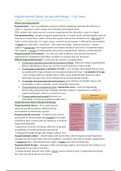
Organizational theory, design and change - G.R. Jones
Chapter 1: Organizations and organizational effectiveness
What is an organization?
Organization = way to coordinate actions to obtain something someone else desires or
values → response to and a means of satisfying some human need.
FEX: people who value security create an organization like the police, army or a bank.
Entrepreneurship = people recognize opportunities to satisfy needs and then gather and use
resources to meet those needs → these days goods and services related to new i nfo tech (IT).
Value creation takes place in 3 stages: input, conversion and output → affected by environment.
→ i nputs: raw materials - machinery - info and knowledge - human resources - money -
capital → c onversion: way organizations use human resources and tech to transform inputs
into outputs → output: finished goods and services organization releases to environment.
Organizational environment = set of forces and conditions that operate beyond an
organization’s boundaries and affect its ability to acquire and use resources.
Why do organizations exist? 5 reasons for the existence of organizations:
1. To increase specialization and the division of labour: collective nature organizations
allows individuals to focus on a narrow area of expertise → more skills.
2. To use large-scale tech: e conomies of scale = cost savings when goods and services
are produced in large volumes on automated production lines → e conomies of scope
= cost savings when an organization is able to use underutilized resources more
effectively because they can be shared across several products/tasks.
3. To manage the organizational environment: environment of valuable inputs and
marketplace → also economic, social and political pressure.
4. To economize on transaction costs: t ransaction costs = costs of negotiating,
monitoring and governing exchanges between people → organization’s ability to
control exchanges, reduces transaction costs.
5. To exert power and control: pressure on
individuals to increase production efficiency.
Organizational theory, design and change
Organizational theory = how organizations
function and affect and are affected by the
environment in which they operate.
Organizational structure = formal system of task
and authority relationships that c ontrol how people
coordinate their actions and use resources to achieve
organizational goals.
→a ppropriate structure: facilitates effective responses
to problems of coordination and motivation.
→ managed through design and change (culture too).
Organizational culture = shared values and norms that control organizational members’
interactions with each other and with suppliers, customers and others outside organization.
→ s haped by ethics and employment rights → s hapes and controls behaviour.
Organizational design = managers select and manage aspects of structure and culture so an
organization can control activities.
→ organizational structure and c ulture: m eans used to achieve goals → organizational d
esign:
how and why those means are chosen.
,Organizational change = organizations redesign their structures and cultures to move from
their present state to a desired future state to increase effectiveness.
→ g oal: find new/improved ways of using resources and capabilities to increase performance.
→ interrelated to design → change = organizational redesign and transformation.
Organizational design and change important for: company’s (1) abilities to deal with
contingencies, (2) achieve a competitive advantage, (3) manage d iversity effectively and (4)
increase efficiency and the ability to innovate.
Contingency = event that might occur and must be planned for → FEX. new competitor.
Organizational design, change and redesign as a source of competitive advantage = ability
to outperform, because managers can create more value from the available resources.
→ arises from c ore competences = managers’ skills and abilities in value-creating activities.
Strategy = specific pattern of decisions and actions managers take to use core competences
to achieve a competitive advantage and outperform competitors.
How do managers measure organizational effectiveness? 3 processes:
1. Control: over the external environment → ability to attract resources and customers.
2. Innovation: developing skills and capabilities to discover new products and processes
→ designing and creating new structures and cultures to change → adaption.
3. Efficiency: developing modern production facilities using new info tech that can
produce and distribute products in a timely and cost-effective manner.
An organization is effective if it can:
1. Secure scarce/valued skills and resources from
outside the organization (external resource approach) → how
effectively an organization manages and controls its external
environment → using indicators (stock price, profitability).
2. Coordinate resources with employee skills to
innovate products and adapt to changing customer needs
(internal systems approach) → evaluate how effectively an
organization functions and resources operate.
3. Convert skills and resources efficiently into finished
goods and services (technical approach) → measured by ratio of outputs to inputs.
2 types of goals to evaluate effectiveness:
1. Official goals = guiding principles that organization formally states in its annual
report and other public documents → legitimize the organization and its activities, to
obtain resources and the support of its stakeholders.
→ lay out the m ission = why the organization exists and what it should be doing.
2. Operative goals = specific long-term and short-term goals that guide managers and
employees → measure how well managers manage the environment → compare
competitors’ cost and achievements.
Chapter 2: Stakeholders, managers and ethics
Organizational stakeholders
Organizations exist because of s takeholders =
people who have
an interest, claim or stake in an organization, in what it does
and how well it performs → o wners of organization.
Inducement = reward like money, power and organizational
status → motivates stakeholders.
, Contribution = skills, knowledge and expertise that organizations require of their members.
→ i nside stakeholders (closest to organization and strongest claim on resources): s hareholders
(invest money for inducements) - m anagers (employees responsible for coordinating
resources and ensuring goals are met) - workforce (all nonmanagerial employees).
→o utside stakeholders (people who don’t own the organization and are not employed by it):
customers (largest outside stakeholder group) - s uppliers (provide raw materials) -
government (compete in a fair manner and obey rules) - trade unions (conflict or cooperation)
- local communities (stake in performance, because employment, housing etc are affected by
success/failure of local businesses) - g eneral public (happy when successful competition
against overseas rivals in a socially responsible way).
Organizational effectiveness: satisfying stakeholders’ goals and interests
Organization must minimally satisfy the interest of all stakeholder
groups in the organization.
→p roblems with winning stakeholders’ approval: choosing which
stakeholder goals to satisfy - how to allocate rewards - balancing
short-term and long-term goals.
Authority = power to hold people accountable for their actions and
to make decisions about the use of resources.
Inside directors are in a company’s formal hierarchy → full-time
employees of the corporation.
Outside directors are not employees, but professional directors → to
bring objectivity to the decision making.
Chain of command = system of hierarchical reporting
relationships of a large corporation.
Hierarchy = classification of people according to their authority and rank.
CEO (chief executive officer) = responsible for setting strategy and policy → often someone
who is also chair of the board of directors.
CEO influence effectiveness and decision making in 5 ways: (1) responsible for setting goals and
designing structure. (2) selects key executives for top levels of managerial hierarchy. (3)
determines top management’s rewards and incentives. (4) controls allocation of scarce
resources (money, decision making power). (5) actions and reputation have major impact on
inside and outside stakeholders’ view and affect ability to get resources from environment.
After chair and CEO comes C OO (chief operating officer) = next in line for CEO’s job →
managing internal operations so they suit to organization’s strategic objectives.
→ after COO comes e xecutive vice presidents → overseeing staff responsibilities.
Line role = managers who have direct responsibility for production of goods and services.
Staff role = managers who are in charge of specific organizational (sales/R&D).
Top-management team (TMT) = group of managers who report to CEO and COO and help
CEO set the strategy and long-term goals.
Corporate managers = TMT members with the responsibility to set the strategy for the
corporation as a whole → are all the members of the TMT.
Divisional managers = managers who set policy only for the division they lead.
Functional managers = managers who are responsible for developing the functional skills
and capabilities that provide core competencies that give an advantage.
An agency theory perspective
Chapter 1: Organizations and organizational effectiveness
What is an organization?
Organization = way to coordinate actions to obtain something someone else desires or
values → response to and a means of satisfying some human need.
FEX: people who value security create an organization like the police, army or a bank.
Entrepreneurship = people recognize opportunities to satisfy needs and then gather and use
resources to meet those needs → these days goods and services related to new i nfo tech (IT).
Value creation takes place in 3 stages: input, conversion and output → affected by environment.
→ i nputs: raw materials - machinery - info and knowledge - human resources - money -
capital → c onversion: way organizations use human resources and tech to transform inputs
into outputs → output: finished goods and services organization releases to environment.
Organizational environment = set of forces and conditions that operate beyond an
organization’s boundaries and affect its ability to acquire and use resources.
Why do organizations exist? 5 reasons for the existence of organizations:
1. To increase specialization and the division of labour: collective nature organizations
allows individuals to focus on a narrow area of expertise → more skills.
2. To use large-scale tech: e conomies of scale = cost savings when goods and services
are produced in large volumes on automated production lines → e conomies of scope
= cost savings when an organization is able to use underutilized resources more
effectively because they can be shared across several products/tasks.
3. To manage the organizational environment: environment of valuable inputs and
marketplace → also economic, social and political pressure.
4. To economize on transaction costs: t ransaction costs = costs of negotiating,
monitoring and governing exchanges between people → organization’s ability to
control exchanges, reduces transaction costs.
5. To exert power and control: pressure on
individuals to increase production efficiency.
Organizational theory, design and change
Organizational theory = how organizations
function and affect and are affected by the
environment in which they operate.
Organizational structure = formal system of task
and authority relationships that c ontrol how people
coordinate their actions and use resources to achieve
organizational goals.
→a ppropriate structure: facilitates effective responses
to problems of coordination and motivation.
→ managed through design and change (culture too).
Organizational culture = shared values and norms that control organizational members’
interactions with each other and with suppliers, customers and others outside organization.
→ s haped by ethics and employment rights → s hapes and controls behaviour.
Organizational design = managers select and manage aspects of structure and culture so an
organization can control activities.
→ organizational structure and c ulture: m eans used to achieve goals → organizational d
esign:
how and why those means are chosen.
,Organizational change = organizations redesign their structures and cultures to move from
their present state to a desired future state to increase effectiveness.
→ g oal: find new/improved ways of using resources and capabilities to increase performance.
→ interrelated to design → change = organizational redesign and transformation.
Organizational design and change important for: company’s (1) abilities to deal with
contingencies, (2) achieve a competitive advantage, (3) manage d iversity effectively and (4)
increase efficiency and the ability to innovate.
Contingency = event that might occur and must be planned for → FEX. new competitor.
Organizational design, change and redesign as a source of competitive advantage = ability
to outperform, because managers can create more value from the available resources.
→ arises from c ore competences = managers’ skills and abilities in value-creating activities.
Strategy = specific pattern of decisions and actions managers take to use core competences
to achieve a competitive advantage and outperform competitors.
How do managers measure organizational effectiveness? 3 processes:
1. Control: over the external environment → ability to attract resources and customers.
2. Innovation: developing skills and capabilities to discover new products and processes
→ designing and creating new structures and cultures to change → adaption.
3. Efficiency: developing modern production facilities using new info tech that can
produce and distribute products in a timely and cost-effective manner.
An organization is effective if it can:
1. Secure scarce/valued skills and resources from
outside the organization (external resource approach) → how
effectively an organization manages and controls its external
environment → using indicators (stock price, profitability).
2. Coordinate resources with employee skills to
innovate products and adapt to changing customer needs
(internal systems approach) → evaluate how effectively an
organization functions and resources operate.
3. Convert skills and resources efficiently into finished
goods and services (technical approach) → measured by ratio of outputs to inputs.
2 types of goals to evaluate effectiveness:
1. Official goals = guiding principles that organization formally states in its annual
report and other public documents → legitimize the organization and its activities, to
obtain resources and the support of its stakeholders.
→ lay out the m ission = why the organization exists and what it should be doing.
2. Operative goals = specific long-term and short-term goals that guide managers and
employees → measure how well managers manage the environment → compare
competitors’ cost and achievements.
Chapter 2: Stakeholders, managers and ethics
Organizational stakeholders
Organizations exist because of s takeholders =
people who have
an interest, claim or stake in an organization, in what it does
and how well it performs → o wners of organization.
Inducement = reward like money, power and organizational
status → motivates stakeholders.
, Contribution = skills, knowledge and expertise that organizations require of their members.
→ i nside stakeholders (closest to organization and strongest claim on resources): s hareholders
(invest money for inducements) - m anagers (employees responsible for coordinating
resources and ensuring goals are met) - workforce (all nonmanagerial employees).
→o utside stakeholders (people who don’t own the organization and are not employed by it):
customers (largest outside stakeholder group) - s uppliers (provide raw materials) -
government (compete in a fair manner and obey rules) - trade unions (conflict or cooperation)
- local communities (stake in performance, because employment, housing etc are affected by
success/failure of local businesses) - g eneral public (happy when successful competition
against overseas rivals in a socially responsible way).
Organizational effectiveness: satisfying stakeholders’ goals and interests
Organization must minimally satisfy the interest of all stakeholder
groups in the organization.
→p roblems with winning stakeholders’ approval: choosing which
stakeholder goals to satisfy - how to allocate rewards - balancing
short-term and long-term goals.
Authority = power to hold people accountable for their actions and
to make decisions about the use of resources.
Inside directors are in a company’s formal hierarchy → full-time
employees of the corporation.
Outside directors are not employees, but professional directors → to
bring objectivity to the decision making.
Chain of command = system of hierarchical reporting
relationships of a large corporation.
Hierarchy = classification of people according to their authority and rank.
CEO (chief executive officer) = responsible for setting strategy and policy → often someone
who is also chair of the board of directors.
CEO influence effectiveness and decision making in 5 ways: (1) responsible for setting goals and
designing structure. (2) selects key executives for top levels of managerial hierarchy. (3)
determines top management’s rewards and incentives. (4) controls allocation of scarce
resources (money, decision making power). (5) actions and reputation have major impact on
inside and outside stakeholders’ view and affect ability to get resources from environment.
After chair and CEO comes C OO (chief operating officer) = next in line for CEO’s job →
managing internal operations so they suit to organization’s strategic objectives.
→ after COO comes e xecutive vice presidents → overseeing staff responsibilities.
Line role = managers who have direct responsibility for production of goods and services.
Staff role = managers who are in charge of specific organizational (sales/R&D).
Top-management team (TMT) = group of managers who report to CEO and COO and help
CEO set the strategy and long-term goals.
Corporate managers = TMT members with the responsibility to set the strategy for the
corporation as a whole → are all the members of the TMT.
Divisional managers = managers who set policy only for the division they lead.
Functional managers = managers who are responsible for developing the functional skills
and capabilities that provide core competencies that give an advantage.
An agency theory perspective