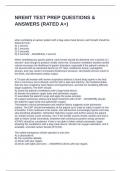
NREMT TEST PREP QUESTIONS &
ANSWERS (RATED A+)
when ventilating an apneic patient with a bag-valve-mask device, each breath should be
delivered over:
A) 1 second.
B) 2 seconds.
C) 3 seconds.
D) 4 seconds. - ANSWERA) 1 second.
When ventilating any apneic patient, each breath should be delivered over a period of 1
second—just enough to produce visible chest rise. Excessive ventilation duration and/or
volume increases the likelihood of gastric distention, especially if the patient's airway is
not secured with an advanced device (ie, ET tube, multilumen airway, supraglottic
airway), and may result in increased intrathoracic pressure, decreased venous return to
the heart, and decreased cardiac output.
A 70-year-old woman with severe respiratory distress is found lying supine in her bed.
She is conscious, but confused, and her skin is pale and clammy. Her husband states
that she has congestive heart failure and hypertension, and that her breathing difficulty
began suddenly. The EMT should:
A) assist the patient's ventilations with a bag-mask device.
B) elevate the patient's upper body and administer oxygen.
C) auscultate the patient's lungs and apply the pulse oximeter.
D) suspect pulmonary edema and begin treatment with CPAP. - ANSWERB) elevate
the patient's upper body and administer oxygen.
The patient's clinical presentation and medical history suggests acute pulmonary
edema. The EMT should immediately sit the patient up in order to make it easier for her
to breathe. If she continues to lie supine, she will become increasingly hypoxic and may
stop breathing altogether. Administer high-flow oxygen and further assess the patient
(ie, breath sounds, pulse oximetry, etc). If her breath sounds reveal crackles and she is
able to follow verbal commands, treatment with continuous positive airway pressure
(CPAP) should be considered. If she is not able to follow verbal commands, begin
assisting her ventilations with a bag-mask device. Monitor her oxygen saturation, and if
available, end-tidal carbon dioxide (ETCO2).
The safest emergency vehicle operator is one who:
A) is physically fit.
B) has a positive attitude.
C) drives with due regard.
D) drives with lights and siren. - ANSWERC) drives with due regard.
,When driving in emergency mode on a multilane highway, the emergency vehicle
operator should keep to the:
A) right shoulder so that traffic flow is not disrupted.
B) extreme left lane so motorists can yield to the right.
C) extreme right lane so motorists can yield to the left.
D) center lane so the traffic can flow around the ambulance. - ANSWERB) extreme left
lane so motorists can yield to the right.
When arriving at a chemical plant fire, the incident commander should expect a plant
representative to present a/an:
A) bill of lading (freight bill).
B) material safety data sheet.
C) company policy handbook.
D) emergency response guidebook. - ANSWERB) material safety data sheet.
Assessment of an older man with respiratory distress reveals that his chest has a
barrel-shaped appearance and he is exhaling through pursed lips. What is the
pathophysiology of these findings?
A) Decreased tidal volume
B) Increased residual volume
C) Increased vital capacity
D) Widespread bronchodilation - ANSWERB) Increased residual volume
Pursed-lip breathing and a barrel-shaped chest are classic signs of emphysema, a type
of chronic obstructive pulmonary disease (COPD). Emphysema is caused by
destruction of the alveolar walls and a loss of pulmonary surfactant. As a result, the
alveoli cannot easily expand and recoil and the process of pulmonary gas exchange is
impaired. The patient with emphysema has chronic air trapping in the lungs due
secondary to incomplete alveolar emptying; as a result, residual volume increases.
Residual volume is the amount of air remaining in the lungs following a complete
exhalation. Decreased tidal volume would manifest with shallow breathing; it would not
explain the pursed-lip breathing and barrel-shaped chest. Vital capacity is the maximum
amount of air one can exhale after a completion inhalation; in patients with emphysema,
vital capacity would decrease, not increase. Widespread bronchospasm, such as what
is seen in patients with asthma, would result in wheezing; it would not explain the
pursed-lip breathing and barrel-shaped chest.
Which of the following would MOST likely cause a reduction in tidal volume?
A) Flaring of the nostrils
B) Accessory muscle use
C) Unequal chest expansion
D) Increased minute volume - ANSWERC) Unequal chest expansion
Unequal (asymmetrical) or minimal expansion of the chest results in a decrease in the
amount of air inhaled per breath (tidal volume). Accessory muscle use and nasal flaring
are signs of increased work of breathing, which represents an attempt to maintain
adequate tidal volume (and therefore, minute volume). An increase in tidal volume,
respiratory rate, or both would result in an increase in minute volume. It should be
,noted, however, that a markedly fast respiratory rate would cause a natural decrease in
tidal volume. For example, a patient breathing at a rate of 45 breaths/min would likely
only inhale air into the anatomic dead space before promptly exhaling it.
Assuming a dead space volume of 150 mL, which of the following would yield the lowest
minute alveolar ventilation?
A) Respiratory rate, 10 breaths/min; tidal volume, 500 mL
B) Respiratory rate, 16 breaths/min; tidal volume, 300 mL
C) Respiratory rate, 12 breaths/min; tidal volume, 400 mL
D) Respiratory rate, 14 breaths/min; tidal volume, 350 mL - ANSWERB) Respiratory
rate, 16 breaths/min; tidal volume, 300 mL
Minute alveolar ventilation is the amount of air that moves in and out of the alveoli each
minute. In calculating minute alveolar ventilation, you must subtract the dead space
volume from the tidal volume first, and then multiply that number by the respiratory rate.
Of the options listed, a tidal volume of 300 mL and a respiratory rate of 16 breaths/min
yields the lowest value (2,400 mL [2.4 L]).
Medications such as albuterol (Ventolin) relieve respiratory distress by:
A) constricting the bronchioles in the lungs.
B) contracting the smaller airways in the lungs.
C) relaxing the smooth muscle of the bronchioles.
D) dilating the large mainstem bronchi of the airway. - ANSWERC) relaxing the smooth
muscle of the bronchioles.
Medications such as albuterol (Ventolin), metaproterenol (Alupent), and levalbuterol
(Xopenex) are in a class of drugs called bronchodilators. They relax the smooth muscle
found within the bronchioles in the lungs, which causes them to dilate. This effect opens
the air passages and improves the patient's ability to breathe.
Tidal volume is defined as the:
A) volume of air inhaled or exhaled per breath.
B) volume of air that remains in the upper airway.
C) total volume of air that the lungs are capable of holding.
D) volume of air moved in and out of the lungs each minute. - ANSWERA) volume of air
inhaled or exhaled per breath.
Tidal volume (VT) is the amount of air that is inhaled or exhaled per breath; it is
normally about 500 mL in an average adult male. Tidal volume is assessed by noting
the depth of a patient's breathing. Shallow breathing, for example, indicates a reduced
tidal volume. The volume of air that remains in the upper respiratory tract (eg, larger
bronchi, trachea) is called dead space volume (VD); it is approximately 30% of the adult
male's tidal volume and does not participate in pulmonary gas exchange.
A patient with slow shallow breathing has a large volume of blood and secretions in his
oropharnx. What should you do?
A) Suction his airway until it is clear and ventilate with a bag-mask device.
B) Insert a nasopharyngeal airway and suction the airway for 30 seconds.
C) Turn the patient onto his side and provide immediate transport.
, D) Insert an oropharyngeal airway and suction for 10 to 15 seconds. - ANSWERA)
Suction his airway until it is clear and ventilate with a bag-mask device.
Slow, shallow breathing should be treated with assisted ventilation. However, if the
patient has blood, vomitus, or other secretions in the airway, they must be removed first.
Suction the oropharynx until it is clear, and then begin ventilation assistance. Fifteen or
30 seconds of suction may not be enough time to remove all of the secretions.
Ventilating a patient with secretions in the airway virtually assures aspiration, and
mortality dramatically increases if aspiration occurs. Insert the appropriate airway
adjunct after the airway is clear of secretions, continue to ventilate, and monitor the
airway for ongoing secretions; provide additional suctioning as needed.
An elderly man is found lying unresponsive in his garage. The patient's wife did not
witness the event that led to his unresponsiveness. You should:
A) assess the patient's respirations.
B) apply supplemental oxygen.
C) thoroughly suction his oropharynx.
D) grasp the angles of the lower jaw and lift. - ANSWERD) grasp the angles of the lower
jaw and lift.
Because this patient was found unresponsive and his wife did not witness the event,
you should assume that he fell from a standing position and potentially injured his spine.
Because of the potential trauma, the jaw-thrust maneuver should be used, which
involves grasping the angles of the lower jaw and lifting forward without manipulating
the head. After manually opening his airway, use suction to clear secretions from his
oropharynx if indicated. Assess the patient's breathing and then begin appropriate
treatment (ie, bag-mask ventilation, passive supplemental oxygen).
Assessment of a 40-year-old patient reveals respiratory distress, tachycardia, audible
expiratory wheezing, and an oxygen saturation of 88%. The EMT should suspect:
A) fluid in the lower airways.
B) diffuse bronchoconstriction.
C) swelling in the laryngeal area.
D) infection of the lower airway. - ANSWERB) diffuse bronchoconstriction.
Wheezing is a whistling sound that indicates constriction of the bronchioles in the lungs.
It is commonly heard on exhalation, but may also occur during inhalation and
exhalation. Wheezing occurs with asthma or bronchiolitis. Fluid in the lower airways
produces breath sounds such as rales (crackles) or rhonchi. Laryngeal swelling would
produce stridor, a high-pitched sound heard during inhalation. Infection of the lower
airway, such as pneumonia, would be expected to present with a fever, productive
cough, and diminished breath sounds over an isolated lung field.
At the peak of the inspiratory phase, the alveoli in the lungs contain:
A) large quantities of carbon dioxide.
B) minimal levels of oxygen and carbon dioxide.
C) equal levels of oxygen and carbon dioxide.
D) more oxygen than carbon dioxide. - ANSWERD) more oxygen than carbon dioxide.
ANSWERS (RATED A+)
when ventilating an apneic patient with a bag-valve-mask device, each breath should be
delivered over:
A) 1 second.
B) 2 seconds.
C) 3 seconds.
D) 4 seconds. - ANSWERA) 1 second.
When ventilating any apneic patient, each breath should be delivered over a period of 1
second—just enough to produce visible chest rise. Excessive ventilation duration and/or
volume increases the likelihood of gastric distention, especially if the patient's airway is
not secured with an advanced device (ie, ET tube, multilumen airway, supraglottic
airway), and may result in increased intrathoracic pressure, decreased venous return to
the heart, and decreased cardiac output.
A 70-year-old woman with severe respiratory distress is found lying supine in her bed.
She is conscious, but confused, and her skin is pale and clammy. Her husband states
that she has congestive heart failure and hypertension, and that her breathing difficulty
began suddenly. The EMT should:
A) assist the patient's ventilations with a bag-mask device.
B) elevate the patient's upper body and administer oxygen.
C) auscultate the patient's lungs and apply the pulse oximeter.
D) suspect pulmonary edema and begin treatment with CPAP. - ANSWERB) elevate
the patient's upper body and administer oxygen.
The patient's clinical presentation and medical history suggests acute pulmonary
edema. The EMT should immediately sit the patient up in order to make it easier for her
to breathe. If she continues to lie supine, she will become increasingly hypoxic and may
stop breathing altogether. Administer high-flow oxygen and further assess the patient
(ie, breath sounds, pulse oximetry, etc). If her breath sounds reveal crackles and she is
able to follow verbal commands, treatment with continuous positive airway pressure
(CPAP) should be considered. If she is not able to follow verbal commands, begin
assisting her ventilations with a bag-mask device. Monitor her oxygen saturation, and if
available, end-tidal carbon dioxide (ETCO2).
The safest emergency vehicle operator is one who:
A) is physically fit.
B) has a positive attitude.
C) drives with due regard.
D) drives with lights and siren. - ANSWERC) drives with due regard.
,When driving in emergency mode on a multilane highway, the emergency vehicle
operator should keep to the:
A) right shoulder so that traffic flow is not disrupted.
B) extreme left lane so motorists can yield to the right.
C) extreme right lane so motorists can yield to the left.
D) center lane so the traffic can flow around the ambulance. - ANSWERB) extreme left
lane so motorists can yield to the right.
When arriving at a chemical plant fire, the incident commander should expect a plant
representative to present a/an:
A) bill of lading (freight bill).
B) material safety data sheet.
C) company policy handbook.
D) emergency response guidebook. - ANSWERB) material safety data sheet.
Assessment of an older man with respiratory distress reveals that his chest has a
barrel-shaped appearance and he is exhaling through pursed lips. What is the
pathophysiology of these findings?
A) Decreased tidal volume
B) Increased residual volume
C) Increased vital capacity
D) Widespread bronchodilation - ANSWERB) Increased residual volume
Pursed-lip breathing and a barrel-shaped chest are classic signs of emphysema, a type
of chronic obstructive pulmonary disease (COPD). Emphysema is caused by
destruction of the alveolar walls and a loss of pulmonary surfactant. As a result, the
alveoli cannot easily expand and recoil and the process of pulmonary gas exchange is
impaired. The patient with emphysema has chronic air trapping in the lungs due
secondary to incomplete alveolar emptying; as a result, residual volume increases.
Residual volume is the amount of air remaining in the lungs following a complete
exhalation. Decreased tidal volume would manifest with shallow breathing; it would not
explain the pursed-lip breathing and barrel-shaped chest. Vital capacity is the maximum
amount of air one can exhale after a completion inhalation; in patients with emphysema,
vital capacity would decrease, not increase. Widespread bronchospasm, such as what
is seen in patients with asthma, would result in wheezing; it would not explain the
pursed-lip breathing and barrel-shaped chest.
Which of the following would MOST likely cause a reduction in tidal volume?
A) Flaring of the nostrils
B) Accessory muscle use
C) Unequal chest expansion
D) Increased minute volume - ANSWERC) Unequal chest expansion
Unequal (asymmetrical) or minimal expansion of the chest results in a decrease in the
amount of air inhaled per breath (tidal volume). Accessory muscle use and nasal flaring
are signs of increased work of breathing, which represents an attempt to maintain
adequate tidal volume (and therefore, minute volume). An increase in tidal volume,
respiratory rate, or both would result in an increase in minute volume. It should be
,noted, however, that a markedly fast respiratory rate would cause a natural decrease in
tidal volume. For example, a patient breathing at a rate of 45 breaths/min would likely
only inhale air into the anatomic dead space before promptly exhaling it.
Assuming a dead space volume of 150 mL, which of the following would yield the lowest
minute alveolar ventilation?
A) Respiratory rate, 10 breaths/min; tidal volume, 500 mL
B) Respiratory rate, 16 breaths/min; tidal volume, 300 mL
C) Respiratory rate, 12 breaths/min; tidal volume, 400 mL
D) Respiratory rate, 14 breaths/min; tidal volume, 350 mL - ANSWERB) Respiratory
rate, 16 breaths/min; tidal volume, 300 mL
Minute alveolar ventilation is the amount of air that moves in and out of the alveoli each
minute. In calculating minute alveolar ventilation, you must subtract the dead space
volume from the tidal volume first, and then multiply that number by the respiratory rate.
Of the options listed, a tidal volume of 300 mL and a respiratory rate of 16 breaths/min
yields the lowest value (2,400 mL [2.4 L]).
Medications such as albuterol (Ventolin) relieve respiratory distress by:
A) constricting the bronchioles in the lungs.
B) contracting the smaller airways in the lungs.
C) relaxing the smooth muscle of the bronchioles.
D) dilating the large mainstem bronchi of the airway. - ANSWERC) relaxing the smooth
muscle of the bronchioles.
Medications such as albuterol (Ventolin), metaproterenol (Alupent), and levalbuterol
(Xopenex) are in a class of drugs called bronchodilators. They relax the smooth muscle
found within the bronchioles in the lungs, which causes them to dilate. This effect opens
the air passages and improves the patient's ability to breathe.
Tidal volume is defined as the:
A) volume of air inhaled or exhaled per breath.
B) volume of air that remains in the upper airway.
C) total volume of air that the lungs are capable of holding.
D) volume of air moved in and out of the lungs each minute. - ANSWERA) volume of air
inhaled or exhaled per breath.
Tidal volume (VT) is the amount of air that is inhaled or exhaled per breath; it is
normally about 500 mL in an average adult male. Tidal volume is assessed by noting
the depth of a patient's breathing. Shallow breathing, for example, indicates a reduced
tidal volume. The volume of air that remains in the upper respiratory tract (eg, larger
bronchi, trachea) is called dead space volume (VD); it is approximately 30% of the adult
male's tidal volume and does not participate in pulmonary gas exchange.
A patient with slow shallow breathing has a large volume of blood and secretions in his
oropharnx. What should you do?
A) Suction his airway until it is clear and ventilate with a bag-mask device.
B) Insert a nasopharyngeal airway and suction the airway for 30 seconds.
C) Turn the patient onto his side and provide immediate transport.
, D) Insert an oropharyngeal airway and suction for 10 to 15 seconds. - ANSWERA)
Suction his airway until it is clear and ventilate with a bag-mask device.
Slow, shallow breathing should be treated with assisted ventilation. However, if the
patient has blood, vomitus, or other secretions in the airway, they must be removed first.
Suction the oropharynx until it is clear, and then begin ventilation assistance. Fifteen or
30 seconds of suction may not be enough time to remove all of the secretions.
Ventilating a patient with secretions in the airway virtually assures aspiration, and
mortality dramatically increases if aspiration occurs. Insert the appropriate airway
adjunct after the airway is clear of secretions, continue to ventilate, and monitor the
airway for ongoing secretions; provide additional suctioning as needed.
An elderly man is found lying unresponsive in his garage. The patient's wife did not
witness the event that led to his unresponsiveness. You should:
A) assess the patient's respirations.
B) apply supplemental oxygen.
C) thoroughly suction his oropharynx.
D) grasp the angles of the lower jaw and lift. - ANSWERD) grasp the angles of the lower
jaw and lift.
Because this patient was found unresponsive and his wife did not witness the event,
you should assume that he fell from a standing position and potentially injured his spine.
Because of the potential trauma, the jaw-thrust maneuver should be used, which
involves grasping the angles of the lower jaw and lifting forward without manipulating
the head. After manually opening his airway, use suction to clear secretions from his
oropharynx if indicated. Assess the patient's breathing and then begin appropriate
treatment (ie, bag-mask ventilation, passive supplemental oxygen).
Assessment of a 40-year-old patient reveals respiratory distress, tachycardia, audible
expiratory wheezing, and an oxygen saturation of 88%. The EMT should suspect:
A) fluid in the lower airways.
B) diffuse bronchoconstriction.
C) swelling in the laryngeal area.
D) infection of the lower airway. - ANSWERB) diffuse bronchoconstriction.
Wheezing is a whistling sound that indicates constriction of the bronchioles in the lungs.
It is commonly heard on exhalation, but may also occur during inhalation and
exhalation. Wheezing occurs with asthma or bronchiolitis. Fluid in the lower airways
produces breath sounds such as rales (crackles) or rhonchi. Laryngeal swelling would
produce stridor, a high-pitched sound heard during inhalation. Infection of the lower
airway, such as pneumonia, would be expected to present with a fever, productive
cough, and diminished breath sounds over an isolated lung field.
At the peak of the inspiratory phase, the alveoli in the lungs contain:
A) large quantities of carbon dioxide.
B) minimal levels of oxygen and carbon dioxide.
C) equal levels of oxygen and carbon dioxide.
D) more oxygen than carbon dioxide. - ANSWERD) more oxygen than carbon dioxide.