lOMoARcPSD|18747600
Adult Health Exam 3 Review
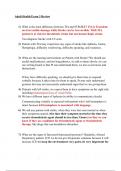
1) What is the main difference between TIA and STROKE? TIA is Transient,
no irreversible damage while Stroke can be irreversible. With TIA
patient is at risk for thrombotic stroke but not hemorrhagic stroke.
You diagnose Stroke with CT-scan.
2) Patient with TIA may experience any signs of stroke like Aphasia, Ataxia,
Hemiplegia, difficulty swallowing, difficulty speaking, and weakness.
3) What are the nursing interventions on Patient with Stroke? We should use
useful small phrases, and not long phrases, we talk to them slowly, we can
use writing board so that Pt can understand them, we also avoid noise and
distractions.
If they have difficulty speaking, we should give them time to respond
verbally because it takes time for them to speak, Pt may only understand
gestures but may not necessarily understand signs that we are giving them.
4) Patients with left stroke, we expect them to have symptoms on the right side
including hemianopsia (loss of visual field).
5) We have different types of Aphasia (in ability to communicate clearly)
Communicating verbally is expected with patient who’s left hemisphere is
intact because left hemisphere is associated with language.
6) We ask any patient with stroke, when they were last seen normal or when
their symptoms started, (the time their symptom started to the time they
receive thrombolytic agent should be less than 3 hours) so that we can
know if they are candidate for thrombolytic agent or thrombolytic
therapy like drugs that can breakdown thrombus.
7) What are the signs of Increased Intracranial pressure? Headache, Altered
Respiratory pattern. ICP, we do not give Hypotonic solutions because it will
increase ICP, we keep the environment very quiet, its very important for
tFee ofdfeedee
E_e_edTaEfo
Downloaded by Arianna Hernandez ()
, lOMoARcPSD|18747600
the Pt to be in a quiet room, because any type of stimulation will
increase ICP especially with Pt who have Hemorrhagic stroke.
8) We should understand what type of food to give Pt with stroke, Solid food
can be dangerous especially if they are having difficulty swallowing, we
should also have them in semi fowler position after we feed them, we should
give them passive range of motion exercises especially to their weak side so
that they don’t develop Atrophy (passive Physical therapy is encouraged)
9) The most important thing to do for Pt with seizure is to (a) prevent them
from falling (b) Maintain ABC (c) we remove any sharp or dangerous object,
we let the seizure take its place and we ASSESS their BREATHING
(ABC) AFTER SEIZURES.
10) With Grand mal Seizure or Tonic-clonic seizures we expect Pt to be
drowsy for few hours, Pt may or may not remember what is going on. We
remove their eyeglasses, loosen their clothing’s, we remove their dentures if
they have one but do not put anything or your finger into their mouth.
11)There are certain drugs we give to Pt’s who have seizures, one of them is
Phenytoin to be in the therapeutic range, and in other for the
medication to, and we want Phenytoin to be in the therapeutic range, we
ask Pt to take medication exactly as it was prescribed, we ask them not to
miss any dose because if they miss any dose it will affect the therapeutic
range ( this is true with any medication with therapeutic window
especially antiepileptic medications)
12) What is Status Epilepticus? It is life threatening seizures or
convulsion lasting more than 5 minutes and Pt cannot breathe, Pt must be
given anticonvulsive drug to relax the muscles because muscles become
rigid and tensed and the lungs, chest and diaphragm cannot expand, and so
first line medication for Status Epilepticus Lorazepam(Ativan) should be
given immediately.
13) In Parkinson Disease, Pt lack what? Dopamine. What are the
signs/symptoms of Parkinson?
soSes
_eeoeiIe______
Downloaded by Arianna Hernandez ()
Adult Health Exam 3 Review
1) What is the main difference between TIA and STROKE? TIA is Transient,
no irreversible damage while Stroke can be irreversible. With TIA
patient is at risk for thrombotic stroke but not hemorrhagic stroke.
You diagnose Stroke with CT-scan.
2) Patient with TIA may experience any signs of stroke like Aphasia, Ataxia,
Hemiplegia, difficulty swallowing, difficulty speaking, and weakness.
3) What are the nursing interventions on Patient with Stroke? We should use
useful small phrases, and not long phrases, we talk to them slowly, we can
use writing board so that Pt can understand them, we also avoid noise and
distractions.
If they have difficulty speaking, we should give them time to respond
verbally because it takes time for them to speak, Pt may only understand
gestures but may not necessarily understand signs that we are giving them.
4) Patients with left stroke, we expect them to have symptoms on the right side
including hemianopsia (loss of visual field).
5) We have different types of Aphasia (in ability to communicate clearly)
Communicating verbally is expected with patient who’s left hemisphere is
intact because left hemisphere is associated with language.
6) We ask any patient with stroke, when they were last seen normal or when
their symptoms started, (the time their symptom started to the time they
receive thrombolytic agent should be less than 3 hours) so that we can
know if they are candidate for thrombolytic agent or thrombolytic
therapy like drugs that can breakdown thrombus.
7) What are the signs of Increased Intracranial pressure? Headache, Altered
Respiratory pattern. ICP, we do not give Hypotonic solutions because it will
increase ICP, we keep the environment very quiet, its very important for
tFee ofdfeedee
E_e_edTaEfo
Downloaded by Arianna Hernandez ()
, lOMoARcPSD|18747600
the Pt to be in a quiet room, because any type of stimulation will
increase ICP especially with Pt who have Hemorrhagic stroke.
8) We should understand what type of food to give Pt with stroke, Solid food
can be dangerous especially if they are having difficulty swallowing, we
should also have them in semi fowler position after we feed them, we should
give them passive range of motion exercises especially to their weak side so
that they don’t develop Atrophy (passive Physical therapy is encouraged)
9) The most important thing to do for Pt with seizure is to (a) prevent them
from falling (b) Maintain ABC (c) we remove any sharp or dangerous object,
we let the seizure take its place and we ASSESS their BREATHING
(ABC) AFTER SEIZURES.
10) With Grand mal Seizure or Tonic-clonic seizures we expect Pt to be
drowsy for few hours, Pt may or may not remember what is going on. We
remove their eyeglasses, loosen their clothing’s, we remove their dentures if
they have one but do not put anything or your finger into their mouth.
11)There are certain drugs we give to Pt’s who have seizures, one of them is
Phenytoin to be in the therapeutic range, and in other for the
medication to, and we want Phenytoin to be in the therapeutic range, we
ask Pt to take medication exactly as it was prescribed, we ask them not to
miss any dose because if they miss any dose it will affect the therapeutic
range ( this is true with any medication with therapeutic window
especially antiepileptic medications)
12) What is Status Epilepticus? It is life threatening seizures or
convulsion lasting more than 5 minutes and Pt cannot breathe, Pt must be
given anticonvulsive drug to relax the muscles because muscles become
rigid and tensed and the lungs, chest and diaphragm cannot expand, and so
first line medication for Status Epilepticus Lorazepam(Ativan) should be
given immediately.
13) In Parkinson Disease, Pt lack what? Dopamine. What are the
signs/symptoms of Parkinson?
soSes
_eeoeiIe______
Downloaded by Arianna Hernandez ()