Solution Manual For
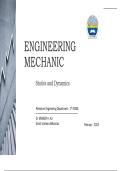
ENGINEERING MECHANICS
DYNAMICS
TWELFTH EDITION
R. C. HIBBELER
PRENTICE HALL
Upper Saddle River, NJ 07458
,•12–1. A car starts from rest and with constant
acceleration achieves a velocity of 15 m>s when it travels a
distance of 200 m. Determine the acceleration of the car
and the time required.
Kinematics:
v0 = 0, v = 15 m>s, s0 = 0, and s = 200 m.
A :+ B v2 = v0 2 + 2ac(s - s0)
152 = 02 + 2ac(200 - 0)
ac = 0.5625 m>s2 Ans.
A :+ B v = v0 + act
15 = 0 + 0.5625t
t = 26.7 s Ans.
12–2. A train starts from rest at a station and travels with
a constant acceleration of 1 m>s2. Determine the velocity of
the train when t = 30 s and the distance traveled during
this time.
Kinematics:
ac = 1 m>s2, v0 = 0, s0 = 0, and t = 30 s.
A :+ B v = v0 + act
= 0 + 1(30) = 30 m>s Ans.
1
A :+ B s = s0 + v0t + act2
2
1
= 0 + 0 + (1) A 302 B
2
= 450 m Ans.
,12–3. An elevator descends from rest with an acceleration
of 5 ft>s2 until it achieves a velocity of 15 ft>s. Determine the
time required and the distance traveled.
Kinematics:
ac = 5 ft>s2, v0 = 0, v = 15 ft>s, and s0 = 0.
A +T B v = v0 + act
15 = 0 + 5t
t = 3s Ans.
A +T B v2 = v0 2 + 2ac(s - s0)
152 = 02 + 2(5)(s - 0)
s = 22.5 ft Ans.
*12–4. A car is traveling at 15 m>s, when the traffic light
50 m ahead turns yellow. Determine the required constant
deceleration of the car and the time needed to stop the car
at the light.
Kinematics:
v0 = 0, s0 = 0, s = 50 m and v0 = 15 m>s.
A :+ B v2 = v0 2 + 2ac(s - s0)
0 = 152 + 2ac(50 - 0)
ac = - 2.25 m>s2 = 2.25 m>s2 ; Ans.
A :+ B v = v0 + act
0 = 15 + ( - 2.25)t
t = 6.67 s Ans.
2
, •12–5. A particle is moving along a straight line with the
acceleration a = (12t – 3t1/2) ft>s2, where t is in seconds.
Determine the velocity and the position of the particle as a
function of time. When t = 0, v = 0 and s = 15 ft.
Velocity:
A :+ B dv = a dt
v t
dv = A 12t - 3t1>2 B dt
L0 L0
v t
v = A 6t2 - 2t3>2 B 2
0
0
v = A 6t2 - 2t3>2 B ft>s Ans.
Position: Using this result and the initial condition s = 15 ft at t = 0 s,
A :+ B ds = v dt
s t
ds = A 6t2 - 2t3>2 B dt
L15 ft L0
t
= a 2t3 - 4 t5>2 b 2
s
s
15 ft 5 0
4
s = a 2t3 - t5>2 + 15 b ft Ans.
5
12–6. A ball is released from the bottom of an elevator
which is traveling upward with a velocity of 6 ft>s. If the ball
strikes the bottom of the elevator shaft in 3 s, determine the
height of the elevator from the bottom of the shaft at the
instant the ball is released. Also, find the velocity of the ball
when it strikes the bottom of the shaft.
Kinematics: When the ball is released, its velocity will be the same as the elevator at
the instant of release. Thus, v0 = 6 ft>s. Also, t = 3 s, s0 = 0, s = - h, and
ac = - 32.2 ft>s2.
1
A+cB s = s + vt + a t2
0 0
2 c
1
- h = 0 + 6(3) + ( - 32.2) A 32 B
2
h = 127 ft Ans.
A+cB v = v0 + act
v = 6 + (- 32.2)(3)
= - 90.6 ft>s = 90.6 ft>s T Ans.
3
ENGINEERING MECHANICS
DYNAMICS
TWELFTH EDITION
R. C. HIBBELER
PRENTICE HALL
Upper Saddle River, NJ 07458
,•12–1. A car starts from rest and with constant
acceleration achieves a velocity of 15 m>s when it travels a
distance of 200 m. Determine the acceleration of the car
and the time required.
Kinematics:
v0 = 0, v = 15 m>s, s0 = 0, and s = 200 m.
A :+ B v2 = v0 2 + 2ac(s - s0)
152 = 02 + 2ac(200 - 0)
ac = 0.5625 m>s2 Ans.
A :+ B v = v0 + act
15 = 0 + 0.5625t
t = 26.7 s Ans.
12–2. A train starts from rest at a station and travels with
a constant acceleration of 1 m>s2. Determine the velocity of
the train when t = 30 s and the distance traveled during
this time.
Kinematics:
ac = 1 m>s2, v0 = 0, s0 = 0, and t = 30 s.
A :+ B v = v0 + act
= 0 + 1(30) = 30 m>s Ans.
1
A :+ B s = s0 + v0t + act2
2
1
= 0 + 0 + (1) A 302 B
2
= 450 m Ans.
,12–3. An elevator descends from rest with an acceleration
of 5 ft>s2 until it achieves a velocity of 15 ft>s. Determine the
time required and the distance traveled.
Kinematics:
ac = 5 ft>s2, v0 = 0, v = 15 ft>s, and s0 = 0.
A +T B v = v0 + act
15 = 0 + 5t
t = 3s Ans.
A +T B v2 = v0 2 + 2ac(s - s0)
152 = 02 + 2(5)(s - 0)
s = 22.5 ft Ans.
*12–4. A car is traveling at 15 m>s, when the traffic light
50 m ahead turns yellow. Determine the required constant
deceleration of the car and the time needed to stop the car
at the light.
Kinematics:
v0 = 0, s0 = 0, s = 50 m and v0 = 15 m>s.
A :+ B v2 = v0 2 + 2ac(s - s0)
0 = 152 + 2ac(50 - 0)
ac = - 2.25 m>s2 = 2.25 m>s2 ; Ans.
A :+ B v = v0 + act
0 = 15 + ( - 2.25)t
t = 6.67 s Ans.
2
, •12–5. A particle is moving along a straight line with the
acceleration a = (12t – 3t1/2) ft>s2, where t is in seconds.
Determine the velocity and the position of the particle as a
function of time. When t = 0, v = 0 and s = 15 ft.
Velocity:
A :+ B dv = a dt
v t
dv = A 12t - 3t1>2 B dt
L0 L0
v t
v = A 6t2 - 2t3>2 B 2
0
0
v = A 6t2 - 2t3>2 B ft>s Ans.
Position: Using this result and the initial condition s = 15 ft at t = 0 s,
A :+ B ds = v dt
s t
ds = A 6t2 - 2t3>2 B dt
L15 ft L0
t
= a 2t3 - 4 t5>2 b 2
s
s
15 ft 5 0
4
s = a 2t3 - t5>2 + 15 b ft Ans.
5
12–6. A ball is released from the bottom of an elevator
which is traveling upward with a velocity of 6 ft>s. If the ball
strikes the bottom of the elevator shaft in 3 s, determine the
height of the elevator from the bottom of the shaft at the
instant the ball is released. Also, find the velocity of the ball
when it strikes the bottom of the shaft.
Kinematics: When the ball is released, its velocity will be the same as the elevator at
the instant of release. Thus, v0 = 6 ft>s. Also, t = 3 s, s0 = 0, s = - h, and
ac = - 32.2 ft>s2.
1
A+cB s = s + vt + a t2
0 0
2 c
1
- h = 0 + 6(3) + ( - 32.2) A 32 B
2
h = 127 ft Ans.
A+cB v = v0 + act
v = 6 + (- 32.2)(3)
= - 90.6 ft>s = 90.6 ft>s T Ans.
3