Lecture 1 – Neuroanatomy 1
31/08/20
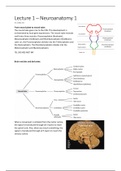
From neural plate to neural tube:
The neural tube gives rise to the CNS. This development is
orchestrated by local gene expressions. The neural tube encloses
and forms three vesicles: Prosencephalon (forebrain),
Mesencephalon (midbrain) and Rhombencephalon (hindbrain).
Later on, the Prosencephalon divides into the Telencephalon and
the Diencephalon. The Rhombencephalon divides into the
Metencephalon and Myelencephalon.
TEL DIE MES MET MY
Brain vesicles and derivates:
When a movement is initiated from the motor cortex,
the signal is transduced through all 5 layers to reach
the spinal cord. Also, when you touch something, the
signal is transduced through all 5 layers to reach the
sensory cortex.
,Ventricular system:
The ventricular system doesn’t look like a tube anymore
(only the cerebral aqueduct still looks like a tube). The
surrounding structures don’t grow at the same pace.
For instance, the Telencephalon with surrounding the
lateral ventricle starts to grow tremendously at a
certain point compared to the underlying structures like
the Diencephalon and the rest of the brainstem. This
gives rise to the characteristic C-shape.
There is a relation between the ventricular
system and the outlying vesicle. The walls of
the lateral ventricle are formed by the
Telencephalon, the third ventricle by the
Diencephalon etc.
Development of brain flexures:
Next to different pace of growth in the
different brain layers, there are certain
flexures which also give rise to specific shape
of the brain. There are three major brain
flexures during development:
1. Cephalic flexure
2. Cervical flexure
3. Pontine flexure
These flexures give rise to the position of the
brain in relation to the spinal cord and the
underlying brain stem structures.
The 5 brain regions are:
1. Frontal lobe
2. Parietal lobe
3. Occipital lobe
4. Temporal lobe
5. Insula (first cortex to appear during
development. From the insula, lots of
neurons are formed which causes the gyri
and sulci to form)
,Development in time:
In this figure, you can see that before
birth, neurogenesis takes place. When
this is completed, synaptogenesis can
take place (mostly after birth).
Interestingly, myelination occurs
completely after birth.
Discrete ages of onset:
At different ages, there is a higher
chance of different neurological
disabilities. For instance, autism
spectrum disorders occur very early
and Alzheimer’s disease appear
much later.
, Lecture 2 – M&M1 Yeast
31/08/2020
Complexity of an organism is not based on the amount of genes (50.000 in rice compared to 22.500
genes in humans), but on the regulation of these genes.
Randy Schekman won a Nobel price on his vesicle fusion research. He
compared a control with a sec1-1 mutant (which is a secretion KO) in yeast. As
you can see in this image: the vesicles are accumulating in the yeast. This
mutation is also common in humans which is called Ohtahara syndrome:
children with very low IQ-score, autistic features and epileptic features. As a
technique, Randy Schekman used random mutagenesis to induce random
mutations in yeast. He further examined this sec1-1 gene and observed it is
temperature-dependent.
Enzymatic assay:
The internal amount of the enzyme invertase increases a lot when
the temperature shifts from 25 to 37 degrees. This suggests that
the enzyme is not able to be secreted at a high temperature due
to conformational changes.
When looking externally: at a temperature of 25 degrees: the
enzyme is being secreted and you see a higher external invertase
concentration. When increasing the temperature to 37 degrees:
the external invertase concentration is lower, which confirms the
other experiment.
So he concluded he found a gene which is responsible for the
secretion of invertase, however he didn’t know which gene yet.
Complementation analysis:
Complementation analysis is performed to identify the genes that are responsible for the disability of
the vesicle secretion after random mutagenesis. A library of plasmids with small parts of the yeast
genome is collected: Isolate the whole genome → randomly cut the whole genome into fragments
using restriction enzymes → these fragments are
ligated into the plasmids
Randy took these different yeast cells sec1
mutants that are buoyant (they are buoyant
because it contains vesicles that are not able to
be secreted) at a high density → inserted
plasmids into these buoyant yeast cells → yeast
cells express the specific genes in the plasmids →
Yeast cells that now survive at a high density
happen to have the plasmids with the genes that
were knocked out (sec1-1 mutation)
31/08/20
From neural plate to neural tube:
The neural tube gives rise to the CNS. This development is
orchestrated by local gene expressions. The neural tube encloses
and forms three vesicles: Prosencephalon (forebrain),
Mesencephalon (midbrain) and Rhombencephalon (hindbrain).
Later on, the Prosencephalon divides into the Telencephalon and
the Diencephalon. The Rhombencephalon divides into the
Metencephalon and Myelencephalon.
TEL DIE MES MET MY
Brain vesicles and derivates:
When a movement is initiated from the motor cortex,
the signal is transduced through all 5 layers to reach
the spinal cord. Also, when you touch something, the
signal is transduced through all 5 layers to reach the
sensory cortex.
,Ventricular system:
The ventricular system doesn’t look like a tube anymore
(only the cerebral aqueduct still looks like a tube). The
surrounding structures don’t grow at the same pace.
For instance, the Telencephalon with surrounding the
lateral ventricle starts to grow tremendously at a
certain point compared to the underlying structures like
the Diencephalon and the rest of the brainstem. This
gives rise to the characteristic C-shape.
There is a relation between the ventricular
system and the outlying vesicle. The walls of
the lateral ventricle are formed by the
Telencephalon, the third ventricle by the
Diencephalon etc.
Development of brain flexures:
Next to different pace of growth in the
different brain layers, there are certain
flexures which also give rise to specific shape
of the brain. There are three major brain
flexures during development:
1. Cephalic flexure
2. Cervical flexure
3. Pontine flexure
These flexures give rise to the position of the
brain in relation to the spinal cord and the
underlying brain stem structures.
The 5 brain regions are:
1. Frontal lobe
2. Parietal lobe
3. Occipital lobe
4. Temporal lobe
5. Insula (first cortex to appear during
development. From the insula, lots of
neurons are formed which causes the gyri
and sulci to form)
,Development in time:
In this figure, you can see that before
birth, neurogenesis takes place. When
this is completed, synaptogenesis can
take place (mostly after birth).
Interestingly, myelination occurs
completely after birth.
Discrete ages of onset:
At different ages, there is a higher
chance of different neurological
disabilities. For instance, autism
spectrum disorders occur very early
and Alzheimer’s disease appear
much later.
, Lecture 2 – M&M1 Yeast
31/08/2020
Complexity of an organism is not based on the amount of genes (50.000 in rice compared to 22.500
genes in humans), but on the regulation of these genes.
Randy Schekman won a Nobel price on his vesicle fusion research. He
compared a control with a sec1-1 mutant (which is a secretion KO) in yeast. As
you can see in this image: the vesicles are accumulating in the yeast. This
mutation is also common in humans which is called Ohtahara syndrome:
children with very low IQ-score, autistic features and epileptic features. As a
technique, Randy Schekman used random mutagenesis to induce random
mutations in yeast. He further examined this sec1-1 gene and observed it is
temperature-dependent.
Enzymatic assay:
The internal amount of the enzyme invertase increases a lot when
the temperature shifts from 25 to 37 degrees. This suggests that
the enzyme is not able to be secreted at a high temperature due
to conformational changes.
When looking externally: at a temperature of 25 degrees: the
enzyme is being secreted and you see a higher external invertase
concentration. When increasing the temperature to 37 degrees:
the external invertase concentration is lower, which confirms the
other experiment.
So he concluded he found a gene which is responsible for the
secretion of invertase, however he didn’t know which gene yet.
Complementation analysis:
Complementation analysis is performed to identify the genes that are responsible for the disability of
the vesicle secretion after random mutagenesis. A library of plasmids with small parts of the yeast
genome is collected: Isolate the whole genome → randomly cut the whole genome into fragments
using restriction enzymes → these fragments are
ligated into the plasmids
Randy took these different yeast cells sec1
mutants that are buoyant (they are buoyant
because it contains vesicles that are not able to
be secreted) at a high density → inserted
plasmids into these buoyant yeast cells → yeast
cells express the specific genes in the plasmids →
Yeast cells that now survive at a high density
happen to have the plasmids with the genes that
were knocked out (sec1-1 mutation)