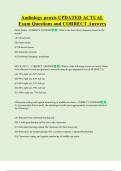
Audiology praxis UPDATED ACTUAL
Exam Questions and CORRECT Answers
Otitis Media - CORRECT ANSWER - What is the most likely diagnosis based on the
results?
(A) Otosclerosis
(B) Otitis media
(C) Bilateral atresia
(D) Impacted cerumen
(E) Perforated tympanic membrane
88% R, 90% L - CORRECT ANSWER - Which of the following scores are mostly likely
to be obtained if word recognition is assessed using an age-appropriate test at 40 dB SL?A)
(A) 70% right ear, 66% left ear
(B) 60% right ear, 80% left ear
(C) 80% right ear, 72% left ear
(D) 88% right ear, 90% left ear
(E) 100% right ear, 70% left ear
Classroom seating and regular monitoring of middle-ear status - CORRECT ANSWER -
To accommodate Kim's needs, the audiologist would most appropriately recommend which of
the following?
(A) Binaural bone-anchored hearing aids
(B) A mild gain hearing aid for use in the classroom
(C) Individual tutoring outside the classroom for three hours/day
(D) Referral to an otolaryngologist for a cochlear-implant evaluationPreferential
(E) Classroom seating and regular monitoring of middle-ear status
,Individualized Education Program - CORRECT ANSWER - According to IDEA, the
audiologist's recommendations for this child should be addressed in which of the following
documents?
(A) Individualized Family Service Plan
(B) Individualized Education Program
(C) Report card
(D) Behavioral Intervention Plan
(E) Cumulative academic record
investigate the use of a bone-conduction hearing aid until audiological test results can be
confirmed and surgery initiated when the child is older - CORRECT ANSWER - A six-
month-old child born with bilateral bony atresia is seen for an audiological evaluation and
treatment recommendation. Radiological evidence indicates the probable presence of an intact
middle ear and cochlea. ABR responses have been obtained at near-normal levels to bone-
conducted signals. Of the following, the most appropriate course of action for this child at this
time would be to
(A) defer treatment until growth of the external and middle ear is complete at about age six
(B) suggest that surgery be initiated on at least one ear to permit a normal air- conducted
pathway
(C) recommend an implanted bone-anchored hearing aid
(D) investigate the use of a bone-conduction hearing aid until audiological test results can be
confirmed and surgery initiated when the child is older
(E) counsel the parents concerning sign language and initiate a treatment program based on the
use of all visual cues
It suggests a left peripheral vestibular disorder of either the labyrinthine or the
VIIIth nerve - CORRECT ANSWER - Which of the following statements about a caloric
response yielding a left unilateral weakness in the interpretation of videonystagmography results
is most accurate?
(A) It suggests a right peripheral vestibular disorder of the labyrinth.
, (B) It is of no real value in the interpretation.
(C) It suggests a nonspecific (nonlocalizing) vestibular disorder.
(D) It suggests a left peripheral vestibular disorder of either the labyrinthine or the
VIIIth nerve.
(E) It suggests a central vestibular disorder.
Sensitivity - CORRECT ANSWER - The accuracy of a hearing screening test in correctly
identifying those individuals who actually have a hearing disorder is referred to as the screening
test's
(A) reliability
(B) validity
(C) precision
(D) specificity
(E) sensitivity
Reliability - CORRECT ANSWER - The ability of the test to show consistent results for
the same subject under different conditions is
(A) reliability
(B) validity
(C) precision
(D) specificity
(E) sensitivity
Validity - CORRECT ANSWER - The ability of a test to measure what it is designed to
measure;
(A) reliability
Exam Questions and CORRECT Answers
Otitis Media - CORRECT ANSWER - What is the most likely diagnosis based on the
results?
(A) Otosclerosis
(B) Otitis media
(C) Bilateral atresia
(D) Impacted cerumen
(E) Perforated tympanic membrane
88% R, 90% L - CORRECT ANSWER - Which of the following scores are mostly likely
to be obtained if word recognition is assessed using an age-appropriate test at 40 dB SL?A)
(A) 70% right ear, 66% left ear
(B) 60% right ear, 80% left ear
(C) 80% right ear, 72% left ear
(D) 88% right ear, 90% left ear
(E) 100% right ear, 70% left ear
Classroom seating and regular monitoring of middle-ear status - CORRECT ANSWER -
To accommodate Kim's needs, the audiologist would most appropriately recommend which of
the following?
(A) Binaural bone-anchored hearing aids
(B) A mild gain hearing aid for use in the classroom
(C) Individual tutoring outside the classroom for three hours/day
(D) Referral to an otolaryngologist for a cochlear-implant evaluationPreferential
(E) Classroom seating and regular monitoring of middle-ear status
,Individualized Education Program - CORRECT ANSWER - According to IDEA, the
audiologist's recommendations for this child should be addressed in which of the following
documents?
(A) Individualized Family Service Plan
(B) Individualized Education Program
(C) Report card
(D) Behavioral Intervention Plan
(E) Cumulative academic record
investigate the use of a bone-conduction hearing aid until audiological test results can be
confirmed and surgery initiated when the child is older - CORRECT ANSWER - A six-
month-old child born with bilateral bony atresia is seen for an audiological evaluation and
treatment recommendation. Radiological evidence indicates the probable presence of an intact
middle ear and cochlea. ABR responses have been obtained at near-normal levels to bone-
conducted signals. Of the following, the most appropriate course of action for this child at this
time would be to
(A) defer treatment until growth of the external and middle ear is complete at about age six
(B) suggest that surgery be initiated on at least one ear to permit a normal air- conducted
pathway
(C) recommend an implanted bone-anchored hearing aid
(D) investigate the use of a bone-conduction hearing aid until audiological test results can be
confirmed and surgery initiated when the child is older
(E) counsel the parents concerning sign language and initiate a treatment program based on the
use of all visual cues
It suggests a left peripheral vestibular disorder of either the labyrinthine or the
VIIIth nerve - CORRECT ANSWER - Which of the following statements about a caloric
response yielding a left unilateral weakness in the interpretation of videonystagmography results
is most accurate?
(A) It suggests a right peripheral vestibular disorder of the labyrinth.
, (B) It is of no real value in the interpretation.
(C) It suggests a nonspecific (nonlocalizing) vestibular disorder.
(D) It suggests a left peripheral vestibular disorder of either the labyrinthine or the
VIIIth nerve.
(E) It suggests a central vestibular disorder.
Sensitivity - CORRECT ANSWER - The accuracy of a hearing screening test in correctly
identifying those individuals who actually have a hearing disorder is referred to as the screening
test's
(A) reliability
(B) validity
(C) precision
(D) specificity
(E) sensitivity
Reliability - CORRECT ANSWER - The ability of the test to show consistent results for
the same subject under different conditions is
(A) reliability
(B) validity
(C) precision
(D) specificity
(E) sensitivity
Validity - CORRECT ANSWER - The ability of a test to measure what it is designed to
measure;
(A) reliability