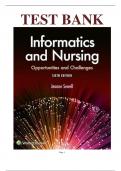
Informatics and Nursing Opportunities and Challenges Fifth Edition Jeanne Sewell Test Bank
Test Bank
Informatics and Nursing Opportunities and Challenges
5th Edition Jeanne Sewell
,Informatics and Nursing Opportunities and Challenges Fifth Edition Jeanne Sewell Test Bank
1. The nurse is developing a plan of care for a client, integrating information from the
client's history and physical examination, laboratory and diagnostic test results, and
medications using the new informatics system adopted by the facility. The nurse
understands that informatics facilitates the task because it focuses on:
A) using computers.
B) using information technology.
C) managing information.
D) accessing the Internet.
2. An nursing informatics specialist is working as part of group tasked with evaluating the
current health information technology system in the facility. As part of the evaluation
process, the nurse is reviewing the initial strategic plan developed for the nationwide
implementation of health information technology. Which result would lead the nurse to
determine that the system has met the initial goals?
A) The use of personal electronic health records was eliminated.
B) A collaborative governance was developed to support information use for
population health.
C) Statewide adoption of the electronic health record was fostered.
D) The use of telehealth systems became significantly limited.
3. Which action would a nurse identify as the current focus of today's practice informatics?
A) Capturing data at the point of care
B) Performing secondary data analysis
C) Using aggregated data
D) Making decisions based on data
4. A nurse interested in nursing informatics is reading a journal article about early
computerized clinical information systems. Which information would the nurse most
likely find as characteristic of these early systems?
A) Two or three functions could be performed at one time.
B) Information could be shared among several departments.
C) Different software systems were created for different areas.
D) Data entry needed to be done once.
5. A nursing informatics specialist is describing the benefits of informatics to a group of
agency staff. Which would the nurse identify as a primary benefit for healthcare in
general?
A) Increase in the usability of data
B) Promotion of cost saving
C) Promotion of time saving
D) Ability to identify patterns
,Informatics and Nursing Opportunities and Challenges Fifth Edition Jeanne Sewell Test Bank
6. A nursing informatics specialist is speaking to a group of colleagues about the benefits
of informatics for the nursing profession. Which benefits would the specialist most
likely include? Select all that apply.
A) Improvement in documentation
B) Use of data for quality control
C) Building of evidence-based knowledge
D) Increase in time needed for documentation
E) Separation of nursing information from other healthcare information
7. A nurse is presenting an in-service program on nursing informatics competencies. When
describing the need for computer fluency for nursing informatics competencies, which
would the nurse include as characterizing this concept?
A) Temporary state
B) Lifelong learning
C) Task oriented
D) Competency
8. A nursing informatics specialist is characterized by colleagues as an informatics
innovator. This nurse would demonstrate the ability to:
A) use basic desktop software.
B) generate informatics theory.
C) make judgments based on trends.
D) communicate via a computer.
9. For which is information literacy considered essential?
A) Critical thinking
B) Problem solving
C) Data evaluation
D) Evidence-based practice
10. A nursing informatics specialist is preparing an in-service program for staff on
healthcare informatics and information technology. The nurse would emphasize which
component as the focus?
A) Information
B) Computer
C) Access
D) Data storage
, Informatics and Nursing Opportunities and Challenges Fifth Edition Jeanne Sewell Test Bank
11. A client tells the nurse, “I'm not so sure that I like the computer as my chart. I've heard
so many horror stories of security problems on the computer.” Which response by the
nurse demonstrates understanding of the recent strategic planning goals aimed at
inspiring confidence and trust in health information technology?
A) “We are doing everything possible to protect the confidentiality of your health
information.”
B) “This technology will make it possible for everyone to have use of electronic
medical records.”
C) “It might sound strange, but we can exchange information with others so your care
will improve.”
D) “By using this technology, we can provide better care because we can actually
measure the care you receive.”
12. While reading a journal article on the evolution of nursing informatics, at which time
would the nurse expect to find a discussion about the shift in definition from a
technology orientation to more of an information orientation?
A) Early 1960s
B) Late 1970s
C) Mid-1980s
D) Early 1990s
13. When reviewing a client safety database, the nurse understands that which is used?
A) Aggregated data
B) Deidentified data
C) Genomics
D) Protocols
14. When describing how new systems for information are organized, which would the
nursing informatics specialist explain as being used?
A) Process
B) Data
C) Flow
D) Increments
15. A nurse asks the nursing informatics specialist, “What is the difference between
computer literacy and computer fluency?” Which information would the nursing
informatics specialist integrate into the response?
A) Computer fluency is a temporary state.
B) Computer literacy refers to the ability to perform tasks with a computer.
C) Computer fluency is static.
D) Computer literacy involves increasing one's ability to effectively use a computer.
Test Bank
Informatics and Nursing Opportunities and Challenges
5th Edition Jeanne Sewell
,Informatics and Nursing Opportunities and Challenges Fifth Edition Jeanne Sewell Test Bank
1. The nurse is developing a plan of care for a client, integrating information from the
client's history and physical examination, laboratory and diagnostic test results, and
medications using the new informatics system adopted by the facility. The nurse
understands that informatics facilitates the task because it focuses on:
A) using computers.
B) using information technology.
C) managing information.
D) accessing the Internet.
2. An nursing informatics specialist is working as part of group tasked with evaluating the
current health information technology system in the facility. As part of the evaluation
process, the nurse is reviewing the initial strategic plan developed for the nationwide
implementation of health information technology. Which result would lead the nurse to
determine that the system has met the initial goals?
A) The use of personal electronic health records was eliminated.
B) A collaborative governance was developed to support information use for
population health.
C) Statewide adoption of the electronic health record was fostered.
D) The use of telehealth systems became significantly limited.
3. Which action would a nurse identify as the current focus of today's practice informatics?
A) Capturing data at the point of care
B) Performing secondary data analysis
C) Using aggregated data
D) Making decisions based on data
4. A nurse interested in nursing informatics is reading a journal article about early
computerized clinical information systems. Which information would the nurse most
likely find as characteristic of these early systems?
A) Two or three functions could be performed at one time.
B) Information could be shared among several departments.
C) Different software systems were created for different areas.
D) Data entry needed to be done once.
5. A nursing informatics specialist is describing the benefits of informatics to a group of
agency staff. Which would the nurse identify as a primary benefit for healthcare in
general?
A) Increase in the usability of data
B) Promotion of cost saving
C) Promotion of time saving
D) Ability to identify patterns
,Informatics and Nursing Opportunities and Challenges Fifth Edition Jeanne Sewell Test Bank
6. A nursing informatics specialist is speaking to a group of colleagues about the benefits
of informatics for the nursing profession. Which benefits would the specialist most
likely include? Select all that apply.
A) Improvement in documentation
B) Use of data for quality control
C) Building of evidence-based knowledge
D) Increase in time needed for documentation
E) Separation of nursing information from other healthcare information
7. A nurse is presenting an in-service program on nursing informatics competencies. When
describing the need for computer fluency for nursing informatics competencies, which
would the nurse include as characterizing this concept?
A) Temporary state
B) Lifelong learning
C) Task oriented
D) Competency
8. A nursing informatics specialist is characterized by colleagues as an informatics
innovator. This nurse would demonstrate the ability to:
A) use basic desktop software.
B) generate informatics theory.
C) make judgments based on trends.
D) communicate via a computer.
9. For which is information literacy considered essential?
A) Critical thinking
B) Problem solving
C) Data evaluation
D) Evidence-based practice
10. A nursing informatics specialist is preparing an in-service program for staff on
healthcare informatics and information technology. The nurse would emphasize which
component as the focus?
A) Information
B) Computer
C) Access
D) Data storage
, Informatics and Nursing Opportunities and Challenges Fifth Edition Jeanne Sewell Test Bank
11. A client tells the nurse, “I'm not so sure that I like the computer as my chart. I've heard
so many horror stories of security problems on the computer.” Which response by the
nurse demonstrates understanding of the recent strategic planning goals aimed at
inspiring confidence and trust in health information technology?
A) “We are doing everything possible to protect the confidentiality of your health
information.”
B) “This technology will make it possible for everyone to have use of electronic
medical records.”
C) “It might sound strange, but we can exchange information with others so your care
will improve.”
D) “By using this technology, we can provide better care because we can actually
measure the care you receive.”
12. While reading a journal article on the evolution of nursing informatics, at which time
would the nurse expect to find a discussion about the shift in definition from a
technology orientation to more of an information orientation?
A) Early 1960s
B) Late 1970s
C) Mid-1980s
D) Early 1990s
13. When reviewing a client safety database, the nurse understands that which is used?
A) Aggregated data
B) Deidentified data
C) Genomics
D) Protocols
14. When describing how new systems for information are organized, which would the
nursing informatics specialist explain as being used?
A) Process
B) Data
C) Flow
D) Increments
15. A nurse asks the nursing informatics specialist, “What is the difference between
computer literacy and computer fluency?” Which information would the nursing
informatics specialist integrate into the response?
A) Computer fluency is a temporary state.
B) Computer literacy refers to the ability to perform tasks with a computer.
C) Computer fluency is static.
D) Computer literacy involves increasing one's ability to effectively use a computer.