100% satisfaction guarantee Immediately available after payment Both online and in PDF No strings attached 4.2 TrustPilot
logo-home
Exam (elaborations)

NUR 213 Module 5 questions and answers Updated 2025.

Rating
-
Sold
-
Pages
9
Grade
A+
Uploaded on
25-07-2025
Written in
2024/2025

NUR 213 Module 5 questions and answers Updated 2025. 1. Sort the following joints into the categories based on their degree of mobility. Synovial Fibrous Cartilaginous 2. Which of the following neurologic conditions may cause a problem with mobility? Select all that apply. A Parkinson’s disease B Huntington’s disease C Epilepsy D Ataxia E Adult attention deficit disorder 3. A nurse cares for an older adult client who has an alteration in mobility. Which of the following are physiological changes that commonly occur in older adults? Select all that apply. A Thinner and less resilient Cartilage B Increased range of motion C Rigid and brittle tendons D Loss of muscle mass E Fewer bursa sacs 4. The nurse is caring for clients at risk for immobility. Which of the following actions should the nurse include to prevent complications of immobility? Select all that apply. A Explain the importance of mobilization. B Demonstrate exercises with the client. C Assess the client’s cognitive status. D Provide a complete bed bath. E Determine if the client can mobilize independently. 5. A nurse is caring for a client who has lower back pain. The client asks about using a transcutaneous electrical nerve stimulator (TENS) unit. Which of the following would be a contraindication of use of a TENS unit? A Chronic low back pain B Small cell carcinoma C Fractured bone in the foot D Chronic bursitis 6. A client who has osteoporosis is prescribed bisphosphonate. Which of the following instructions is important for the nurse to include? A “Avoid calcium-rich foods while taking.” B “Notify the provider if you have pain in your hips or groin.” C “If you experience sudden pain in your calf, be sure to elevate your legs.” D “Be sure to have a dental exam before starting this medication.” 7. A nurse is caring for a client who is postoperative following a total hip arthroplasty. Which of the following actions should the nurse take? Select all that apply. A Monitor the client for compartment syndrome. B Maintain the client in the supine position. C Teach the client to avoid crossing their legs. D Perform neurovascular checks. E Obtain a raised toilet seat. 8. The nurse is assessing a client in the home for risks of soft tissue injuries related to falls. Which of the following factors increases the client's risk of falling? Select all that apply. A Throw rugs present throughout the home. B Having railings on each stairwell. C Taking sleeping medication before bed. D Good lighting in walkways. E Pets are present in the home. 9. A nurse is providing teaching to a client who experienced a soft tissue injury of their leg. Which of the following statements should indicate to the nurse that the client understands the teaching? Select all that apply. A “I should avoid applying a cold pack if I am in pain.” B “I should place a cold pack on my bare skin.” C “I should remove a cold pack after 20 minutes.” D “I should sit in a chair with my feet touching the floor.” E “I can use an elastic bandage to hold the cold pack in place.” 10. Which of the following are the most common causes of hip fractures? A Falls B Motor vehicle crashes C Sports injuries D Repetitive motion injuries 11. A nurse is caring for clients who have musculoskeletal conditions. Match the description in the right column with the correct condition in the left column. Drag the options on the left to the corresponding category on the right (or click the option on the left and then the corresponding category on the right). Compartment syndrome- Osteoarthritis- Osteoporosis- Complex regional pain syndrome- Stress fracture- 12. A nurse is caring for clients who are experiencing back pain. Which of the following should the nurse recognize as mechanical causes of back pain? Select all that apply. A Osteoarthritis B Herniated disk C Abdominal aneurysm D Meningitis E Cancer 13. A nurse is planning care for a client who is undergoing diagnostic studies for back pain. Which of the following should the nurse identify as a diagnostic test that measures the electrical activity of the nerves? A Nerve conduction velocity B Magnetic resonance imaging (MRI) C Computerized tomography (CT) D Transcutaneous electrical nerve stimulation (TENS) 14. A nurse is caring for a client after amputation of the right leg above the knee. The client begins to complain of pain in the right calf area. Which of the following responses by the nurse is appropriate at this time? A “I am not sure that you could be having pain there.” B “I will see what you have ordered to manage the pain.” C “Let me notify your provider about that.” D “Let me prop your leg up on a couple of pillows to see if that will help.” 15. A nurse is caring for a client after an amputation and notices gabapentin has been ordered. Which of the following is how this medication works in this client? A Slows the electrical conduction of the heart B Allows for improved movement with a prosthesis C Changes signals in the brain for those with nerve damage D Prevents seizure formation 16. A nurse is discharging a client after an amputation below the knee. Which of the following instructions are important for the nurse to include to care for the residual limb? Select all that apply. A “Be sure to monitor the incision daily for redness, warmth, or swelling.” B “You may need to use a mirror to fully examine the site.” C “Be sure to keep it elevated on two to three pillows when in bed.” D “If you notice an odor, use baby powder under the compression dressing.” E “You might consider attending a support group.” 17. Drag the characteristics below to match them with either rheumatoid arthritis or osteoporosis. Rheumatoid arthritis Osteoporosis 18. A client who has rheumatoid arthritis is taking methotrexate. Which of the following reduces toxicity from this medication? A Folic acid B Magnesium sulfate C Ferrous sulfate D Niacin (Vitamin B) 19. A client is about to start therapy with methotrexate for rheumatoid arthritis. Knowing the adverse effects of methotrexate, you advise the client to watch for which of the following? A Dysphagia B Sore throat C Edema D Paresthesia 20. A primary care provider prescribes etanercept to treat a client’s rheumatoid arthritis. Prior to beginning the treatment, the client requires testing for which of the following? A Pancreatitis B Hepatitis C Tuberculosis D Gastritis 21. A nurse is caring for a client taking etanercept. Which of the following adverse effects is most important to mention when educating this client? A Injection site reaction can occur. B Elevation of liver enzymes can occur. C Gastric perforation can occur. D Vision changes can occur. 22. Prior to starting alendronate, the nurse should assess which of the following in the client? Select all that apply. A Ability to swallow B Baseline vision C The client's ability to lay flat D Absence of nasal dryness 23. A primary care provider prescribes calcitonin salmon for a client who is post-menopause. When considering the adverse effects of calcitonin, which of the following actions should the nurse instruct the client to do? A Increase fluid intake. B Rise slowly from a reclining position. C Increase calcium and vitamin D intake. D Rest painful joints after exercise. 24. Which of the following medications are effective in disease prevention as well as treatment of osteoporosis? Select all that apply. A Raloxifene B Calcitonin salmon C Alendronate D NSAIDs 25. A client who is menopausal is taking a calcium supplement to prevent osteoporosis. The nurse should instruct the client to watch for which of the following indications of hypercalcemia? A Eye twitching B Bleeding gums C Tinnitus D Nausea 26. Match the medication used to treat osteoporosis with its expected pharmacologic action. Bosphosphonates- Selective estrogen receptor modulators- Calcium supplements- Calcitonin-

Show more Read less


Whoops! We can’t load your doc right now. Try again or contact support.

Document information

Uploaded on
July 25, 2025
Number of pages
9
Written in
2024/2025
Type
Exam (elaborations)
Contains
Questions & answers

Subjects

  • nur 213 module 5
  • nur213 2025

Content preview

NUR 213 Module 5 questions and answers Updated 2025.

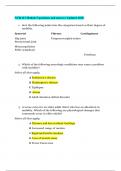
1. Sort the following joints into the categories based on their degree of
mobility.

Synovial Fibrous Cartilaginous

Hip joint Temporooccipital suture
Sternocostal joint

Metacarpal joint
Pubic symphysis

Vertebrae


2. Which of the following neurologic conditions may cause a problem
with mobility?

Select all that apply.

A Parkinson’s disease

B Huntington’s disease

C Epilepsy

D Ataxia

E Adult attention deficit disorder


3. A nurse cares for an older adult client who has an alteration in
mobility. Which of the following are physiological changes that
commonly occur in older adults?

Select all that apply.

A Thinner and less resilient Cartilage

B Increased range of motion

C Rigid and brittle tendons

D Loss of muscle mass

E Fewer bursa sacs

, 4. The nurse is caring for clients at risk for immobility. Which of the
following actions should the nurse include to prevent complications of
immobility?

Select all that apply.

A Explain the importance of mobilization.

B Demonstrate exercises with the client.

C Assess the client’s cognitive status.

D Provide a complete bed bath.

E Determine if the client can mobilize independently.


5. A nurse is caring for a client who has lower back pain. The client asks
about using a transcutaneous electrical nerve stimulator (TENS) unit.
Which of the following would be a contraindication of use of a TENS
unit?

A Chronic low back pain

B Small cell carcinoma

C Fractured bone in the foot

D Chronic bursitis


6. A client who has osteoporosis is prescribed bisphosphonate. Which of
the following instructions is important for the nurse to include?

A “Avoid calcium-rich foods while taking.”

B “Notify the provider if you have pain in your hips or groin.”

C “If you experience sudden pain in your calf, be sure to elevate
your legs.”

D “Be sure to have a dental exam before starting this
medication.”
$14.69
Get access to the full document:

100% satisfaction guarantee
Immediately available after payment
Both online and in PDF
No strings attached

Get to know the seller
Seller avatar
Empire25

Also available in package deal

Thumbnail
Package deal
NUR 213 Modules 1 to 5 Complete questions and answers, exam solution guide_Updated 2025/2026.
-
6 2025
$ 80.04 More info

Get to know the seller

Seller avatar
Empire25 Azusa Pacific University
View profile
Follow You need to be logged in order to follow users or courses
Sold
0
Member since
2 year
Number of followers
0
Documents
90
Last sold
-
COLLEGE EDUCATOR

I offer course materials, learning platforms, and resources catered to your subject area.

0.0

0 reviews

5
0
4
0
3
0
2
0
1
0

Recently viewed by you

Why students choose Stuvia

Created by fellow students, verified by reviews

Quality you can trust: written by students who passed their tests and reviewed by others who've used these notes.

Didn't get what you expected? Choose another document

No worries! You can instantly pick a different document that better fits what you're looking for.

Pay as you like, start learning right away

No subscription, no commitments. Pay the way you're used to via credit card and download your PDF document instantly.

Student with book image

“Bought, downloaded, and aced it. It really can be that simple.”

Alisha Student

Frequently asked questions