Page | 1
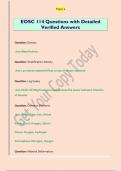
EOSC 114 Questions with Detailed
Verified Answers
Question: Density
Ans: Mass/Volume
Question: Stratification-Density
Ans: Less dense materials float on top of denser materials
Question: Log Scales
Ans: Order-Of-Magnitude concept because the power indicates intensity
of disaster
Question: Common Elements
Ans: Earths Core: Iron, Nickel
Earths Crust: Oxygen, Silicon
Ocean: Oxygen, hydrogen
Atmosphere: Nitrogen, Oxygen
Question: Material Deformation:
, Page | 2
Ans: Strain is the change in shape or size of a solid object.
Elastic: an object changes shape when forced by springs back to original
when force is released.
Plastic/Ductile (very plastic): the object permanently changes shape or
deform when forced.
Brittle: not plastic; fractures instead of bending.
Question: Types of energy
Ans: Work: W=FD
PE
KE
S. Heat
L. Heat.
When gases condense into liquids or when liquids freeze into solids, latent
heat is released into sensible heat.
Question: Linkages exist
Ans: Earthquakes -> landslides + tsunamis, hurricanes -> flooding + coastal
erosion.
, Page | 3
Question: Energy Conservation
Ans: Kinetic energy of an asteroid is converted into sensible and latent
heat when it strikes Earth.
Question: Carrying Capacity
Ans: The pop can be sustainably supported within a given domain, given
overall factors.
Question: 3 TYPES OF STRESS
Ans: 1) COMPRESSION
2) TENSION
3) TRANSVERSE.
Question: Strain
Ans: ..is the deformation in response to stress, objects change size, shape
or volume. Elastic is temp change, and reversible. Plastic is permanent
change is shape or size, irreversible. Brittle causes faults. Low temp and
low confining pressure, and at high strain rate.
Question: Earthquakes strain
Ans: Brittle deformation.
EOSC 114 Questions with Detailed
Verified Answers
Question: Density
Ans: Mass/Volume
Question: Stratification-Density
Ans: Less dense materials float on top of denser materials
Question: Log Scales
Ans: Order-Of-Magnitude concept because the power indicates intensity
of disaster
Question: Common Elements
Ans: Earths Core: Iron, Nickel
Earths Crust: Oxygen, Silicon
Ocean: Oxygen, hydrogen
Atmosphere: Nitrogen, Oxygen
Question: Material Deformation:
, Page | 2
Ans: Strain is the change in shape or size of a solid object.
Elastic: an object changes shape when forced by springs back to original
when force is released.
Plastic/Ductile (very plastic): the object permanently changes shape or
deform when forced.
Brittle: not plastic; fractures instead of bending.
Question: Types of energy
Ans: Work: W=FD
PE
KE
S. Heat
L. Heat.
When gases condense into liquids or when liquids freeze into solids, latent
heat is released into sensible heat.
Question: Linkages exist
Ans: Earthquakes -> landslides + tsunamis, hurricanes -> flooding + coastal
erosion.
, Page | 3
Question: Energy Conservation
Ans: Kinetic energy of an asteroid is converted into sensible and latent
heat when it strikes Earth.
Question: Carrying Capacity
Ans: The pop can be sustainably supported within a given domain, given
overall factors.
Question: 3 TYPES OF STRESS
Ans: 1) COMPRESSION
2) TENSION
3) TRANSVERSE.
Question: Strain
Ans: ..is the deformation in response to stress, objects change size, shape
or volume. Elastic is temp change, and reversible. Plastic is permanent
change is shape or size, irreversible. Brittle causes faults. Low temp and
low confining pressure, and at high strain rate.
Question: Earthquakes strain
Ans: Brittle deformation.