Thursday, 24 September 2020
BOM WEEK 3 NOTES
BOM
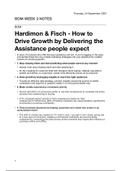
Hardimon & Fisch - How to
Drive Growth by Delivering the
Assistance people expect
- In short, the brands who offer the best assistance will win. If you’re lagging in this area,
incorporate these four key mobile marketing strategies into your playbook for a better
chance at unlocking growth.
- 1. Stop chasing intent and start predicting what people want at any moment
• brands must stop chasing intent and start predicting it
• Ex. By coupling its customer data with Google’s intent signals, Allstate was able to
predict and deliver on customers’ needs more efficiently across all touchpoints
- 2. Drive growth by leveraging insights to reach the right audiences
• To build an effective data strategy, connect insights across the journey to better
understand and respond to people’s needs in a more personalised way.
- 3. Make mobile experiences a business priority
• Almost half (46%) of consumers prefer to use their smartphone to complete the entire
process from researching to buying
• 61% of people expect brands to tailor experiences based on their
preferences.5 Furthermore, 90% of leading marketers say personalisation significantly
contributes to business profitability.
- 4. Drive purchase decisions by helping customers turn intent into action in an
omnichannel world
• The shift to mobile has created an “if I want it now, I can get it now” world, giving rise
to a new type of consumer. Leading omnichannel marketers are winning these
customers by connecting the dots across all the moments that inspire and influence a
purchase online and offline.
1
, Thursday, 24 September 2020
Sundar & Limperos - Uses and
Grate 2.0: New Gratifications
for New Media
- Internet has created ‘active audiences’ rather than passive
- ‘Audiences’ became ‘users’
- Increasingly, these affordances are allowing Internet users to not only experience
media in newer ways, but also actively contribute their own content, given the
rise in interfaces and applications that are premised on user-generated content
- New media forms afford users the ability to not only interact with these ‘‘media’’ (human-
computer interac- tion) but also interact through them to communicate with other users
(computer- mediated communication).
- Possibility that the technology itself could be responsible for creating new gratifications,
so that we can increase the scope, relevance, and robustness of U&G research for
explaining new media use in initial stages and beyond
- U&G Research in Mass Communication
- (1) the social and psychological origins of (2) needs, which generate (3) ex- pectations
from (4) the mass media or other sources, which lead to (5) differential patterns of
media exposure (or engagement in other activities), resulting in (6) need gratifications
and (7) other consequences, perhaps mostly unintended ones’
- Gratifications are conceptualised as “need satisfactions”
- In essence, the dominant belief appears to be that motives or needs drive the actual use
or gratification obtained from different types of media
- Media gratification typologies
- Papacharissi and Rubin (2000) combined pre-existing measures of interpersonal,
traditional media, and new media motives/gratifications measures in order to shed
light on why people use the Internet
- Results: People use the Internet for interpersonal reasons, to pass time, information-
seeking, convenience, and entertainment pur- poses
- Many studies have shown that arousal, escape, learning, habit, social interaction,
companion- ship, information-seeking, passing time, relaxation, and entertainment to
be the salient gratifications derived from watching television
- When comparing the gratifications from early television studies to the Internet and
new communication technologies, one is left with the impression that newer media do
not really afford any new gratifications that cannot be found in traditional media.
2
BOM WEEK 3 NOTES
BOM
Hardimon & Fisch - How to
Drive Growth by Delivering the
Assistance people expect
- In short, the brands who offer the best assistance will win. If you’re lagging in this area,
incorporate these four key mobile marketing strategies into your playbook for a better
chance at unlocking growth.
- 1. Stop chasing intent and start predicting what people want at any moment
• brands must stop chasing intent and start predicting it
• Ex. By coupling its customer data with Google’s intent signals, Allstate was able to
predict and deliver on customers’ needs more efficiently across all touchpoints
- 2. Drive growth by leveraging insights to reach the right audiences
• To build an effective data strategy, connect insights across the journey to better
understand and respond to people’s needs in a more personalised way.
- 3. Make mobile experiences a business priority
• Almost half (46%) of consumers prefer to use their smartphone to complete the entire
process from researching to buying
• 61% of people expect brands to tailor experiences based on their
preferences.5 Furthermore, 90% of leading marketers say personalisation significantly
contributes to business profitability.
- 4. Drive purchase decisions by helping customers turn intent into action in an
omnichannel world
• The shift to mobile has created an “if I want it now, I can get it now” world, giving rise
to a new type of consumer. Leading omnichannel marketers are winning these
customers by connecting the dots across all the moments that inspire and influence a
purchase online and offline.
1
, Thursday, 24 September 2020
Sundar & Limperos - Uses and
Grate 2.0: New Gratifications
for New Media
- Internet has created ‘active audiences’ rather than passive
- ‘Audiences’ became ‘users’
- Increasingly, these affordances are allowing Internet users to not only experience
media in newer ways, but also actively contribute their own content, given the
rise in interfaces and applications that are premised on user-generated content
- New media forms afford users the ability to not only interact with these ‘‘media’’ (human-
computer interac- tion) but also interact through them to communicate with other users
(computer- mediated communication).
- Possibility that the technology itself could be responsible for creating new gratifications,
so that we can increase the scope, relevance, and robustness of U&G research for
explaining new media use in initial stages and beyond
- U&G Research in Mass Communication
- (1) the social and psychological origins of (2) needs, which generate (3) ex- pectations
from (4) the mass media or other sources, which lead to (5) differential patterns of
media exposure (or engagement in other activities), resulting in (6) need gratifications
and (7) other consequences, perhaps mostly unintended ones’
- Gratifications are conceptualised as “need satisfactions”
- In essence, the dominant belief appears to be that motives or needs drive the actual use
or gratification obtained from different types of media
- Media gratification typologies
- Papacharissi and Rubin (2000) combined pre-existing measures of interpersonal,
traditional media, and new media motives/gratifications measures in order to shed
light on why people use the Internet
- Results: People use the Internet for interpersonal reasons, to pass time, information-
seeking, convenience, and entertainment pur- poses
- Many studies have shown that arousal, escape, learning, habit, social interaction,
companion- ship, information-seeking, passing time, relaxation, and entertainment to
be the salient gratifications derived from watching television
- When comparing the gratifications from early television studies to the Internet and
new communication technologies, one is left with the impression that newer media do
not really afford any new gratifications that cannot be found in traditional media.
2