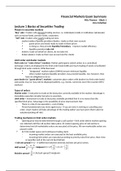
Financial Markets Exam Summary
MSc Finance – Block 1
Vera Scholten
Lecture 1 Basics of Securities Trading
Players in securities markets
“Buy” side = traders who demand trading services. i.e. individuals (retail) or institutions (wholesale)
such as mutual funds, pension funds, corporates.
“Sell” side = traders who supply trading services.
− market makers/liquidity providers/dealers: trade on their own account
quote prices and stand ready to trade at those prices
in doing so, they provide liquidity/immediacy – improve market efficiency
liquidity providers take risk
− brokers: trade on behalf on clients, do not take risk
− broker-dealers: trade on their own account and for clients
Limit order and dealer markets
limit order (or “order-driven”) markets: Market participants submit orders to a centralized
exchange; orders are displayed in the limit order book (LOB) and much trading of stocks is facilitated
through limit order markets. NYSE/Euronext:
“designated” market makers (DMMs) ensure minimum liquidity
other market markers/liquidity providers may provide liquidity, too; however, they
have no obligation to do so
pure dealer (or “quote-driven”) markets: customers place orders with dealers (no limit order book)
and quotes may (or may not) be displayed publicly. e.g., bonds, currencies (over-the-counter (OTC)
markets)
Types of orders
Market order = instruction to trade at the best price currently available in the market. Advantage is
immediate execution (mostly) but price is uncertain.
Limit order = instruction to trade at best price available provided that it is no worse than the
specified limit price. Advantage is the possibility of price improvement. But:
− There is a risk of non-execution + cost of delay
− Prices/fundamentals may move against you - if you are slow in revising or cancelling your
order, smart traders will take advantage of the trading option you have given them (adverse
selection/picking-off risk)
Trading mechanics in limit order markets
Opening price may be determined through a call auction = limit order before market opening
are collected until the call auction takes place. At market opening price of call auction is
determined and all marketable orders are executed at this price. All non-marketable orders are
placed in LOB.
At 9:30 market opens and continuous trading starts
− incoming market orders are executed at the best available price
− incoming limit orders are executed according to priority rules (first: price, then: time
or quantity) and at the current best bid/ask
A bid-ask spread S=a−b (difference between best bid and best ask price) arises.
S a−b S S
Half-spread
2
=
2
. Midpoint m=a+
2 ()
∨m=b−
2 ()
S
Relative spread= =(bid ask spread)/midpoint
m
, →Trading Costs & Liquidity Provider Profits
Assume mid-quote (m t =100) proxies fundamental value.
Transaction price per share pt
Trading cost per share are m t −p t – this is a liquidity providers gain. They benefit from bid-
ask spreads.
→ limit orders “make” liquidity
→ market orders “take” liquidity
Measuring market liquidity
Quoted Spread
quoted bid-ask spread = difference between best ask and best bid, S=a−b
a−b
relative quoted bid-ask spread: normalized by mid quote s=
m
a+ b
where: m= , half-spreads: S/2 and s/2. Measures the “round-trip” cost of a small transaction.
2
For larger transactions, round-trip costs may be much higher
á ( q ) −b́ ( q )
weighted-average bid-ask spread: s ( q )= where
m
o a¯(q): average execution price for a buy market order of size q
o b¯(q): average execution price for a sell market order of size q
the “slope” of s(q) is a measure of the inverse of market depth: the less sensitive the price to order
size, the deeper is the market
Effective half-spread
The LOB at price points beyond the “Best Bid and Offer” (BBO) may not be readily observable. A
widely-used trading cost measure that uses prices actually obtained by investors is the effective half-
spread: Se =dt ( pt −m t ) where:
o pt : actual execution price of a market order
o mt : mid price just before execution ¿)
o dt : order direction indicator (dt = 1: buy order, dt = −1: sell order)
Realized Half-Spread
realized half-spread: Sr =d t ( pt −m t +∆ ) where:
o pt : execution price at time
o tmt+∆: mid price some time after the transaction
we have: Sr =d t ( pt −mt +∆ ) =d t ( pt −mt ) −d t ( mt +∆ −mt ) < Se Where d t ( pt −mt )
is Se and d t ( mt +∆ −m t ) is the price impact
Measures based on return covariance
Roll (1984) proposed a clever way to measure bid-ask spreads based only on transaction prices. This
is particularly useful if bid-ask spread data are not readily observable, as is sometimes the case.
Suppose that a stock’s fundamental value, as captured by the mid quote, follows a random walk:
mt =mt−1 +ϵ t where ϵ t is mean-zero “white noise”. ϵ t accounts for the arrival of new information
between time t −1 and t
As the expected value is zero, the expected return is zero, too E [m t −m t−1 ]=0
MSc Finance – Block 1
Vera Scholten
Lecture 1 Basics of Securities Trading
Players in securities markets
“Buy” side = traders who demand trading services. i.e. individuals (retail) or institutions (wholesale)
such as mutual funds, pension funds, corporates.
“Sell” side = traders who supply trading services.
− market makers/liquidity providers/dealers: trade on their own account
quote prices and stand ready to trade at those prices
in doing so, they provide liquidity/immediacy – improve market efficiency
liquidity providers take risk
− brokers: trade on behalf on clients, do not take risk
− broker-dealers: trade on their own account and for clients
Limit order and dealer markets
limit order (or “order-driven”) markets: Market participants submit orders to a centralized
exchange; orders are displayed in the limit order book (LOB) and much trading of stocks is facilitated
through limit order markets. NYSE/Euronext:
“designated” market makers (DMMs) ensure minimum liquidity
other market markers/liquidity providers may provide liquidity, too; however, they
have no obligation to do so
pure dealer (or “quote-driven”) markets: customers place orders with dealers (no limit order book)
and quotes may (or may not) be displayed publicly. e.g., bonds, currencies (over-the-counter (OTC)
markets)
Types of orders
Market order = instruction to trade at the best price currently available in the market. Advantage is
immediate execution (mostly) but price is uncertain.
Limit order = instruction to trade at best price available provided that it is no worse than the
specified limit price. Advantage is the possibility of price improvement. But:
− There is a risk of non-execution + cost of delay
− Prices/fundamentals may move against you - if you are slow in revising or cancelling your
order, smart traders will take advantage of the trading option you have given them (adverse
selection/picking-off risk)
Trading mechanics in limit order markets
Opening price may be determined through a call auction = limit order before market opening
are collected until the call auction takes place. At market opening price of call auction is
determined and all marketable orders are executed at this price. All non-marketable orders are
placed in LOB.
At 9:30 market opens and continuous trading starts
− incoming market orders are executed at the best available price
− incoming limit orders are executed according to priority rules (first: price, then: time
or quantity) and at the current best bid/ask
A bid-ask spread S=a−b (difference between best bid and best ask price) arises.
S a−b S S
Half-spread
2
=
2
. Midpoint m=a+
2 ()
∨m=b−
2 ()
S
Relative spread= =(bid ask spread)/midpoint
m
, →Trading Costs & Liquidity Provider Profits
Assume mid-quote (m t =100) proxies fundamental value.
Transaction price per share pt
Trading cost per share are m t −p t – this is a liquidity providers gain. They benefit from bid-
ask spreads.
→ limit orders “make” liquidity
→ market orders “take” liquidity
Measuring market liquidity
Quoted Spread
quoted bid-ask spread = difference between best ask and best bid, S=a−b
a−b
relative quoted bid-ask spread: normalized by mid quote s=
m
a+ b
where: m= , half-spreads: S/2 and s/2. Measures the “round-trip” cost of a small transaction.
2
For larger transactions, round-trip costs may be much higher
á ( q ) −b́ ( q )
weighted-average bid-ask spread: s ( q )= where
m
o a¯(q): average execution price for a buy market order of size q
o b¯(q): average execution price for a sell market order of size q
the “slope” of s(q) is a measure of the inverse of market depth: the less sensitive the price to order
size, the deeper is the market
Effective half-spread
The LOB at price points beyond the “Best Bid and Offer” (BBO) may not be readily observable. A
widely-used trading cost measure that uses prices actually obtained by investors is the effective half-
spread: Se =dt ( pt −m t ) where:
o pt : actual execution price of a market order
o mt : mid price just before execution ¿)
o dt : order direction indicator (dt = 1: buy order, dt = −1: sell order)
Realized Half-Spread
realized half-spread: Sr =d t ( pt −m t +∆ ) where:
o pt : execution price at time
o tmt+∆: mid price some time after the transaction
we have: Sr =d t ( pt −mt +∆ ) =d t ( pt −mt ) −d t ( mt +∆ −mt ) < Se Where d t ( pt −mt )
is Se and d t ( mt +∆ −m t ) is the price impact
Measures based on return covariance
Roll (1984) proposed a clever way to measure bid-ask spreads based only on transaction prices. This
is particularly useful if bid-ask spread data are not readily observable, as is sometimes the case.
Suppose that a stock’s fundamental value, as captured by the mid quote, follows a random walk:
mt =mt−1 +ϵ t where ϵ t is mean-zero “white noise”. ϵ t accounts for the arrival of new information
between time t −1 and t
As the expected value is zero, the expected return is zero, too E [m t −m t−1 ]=0