Cognitive neuroscience
Part 1
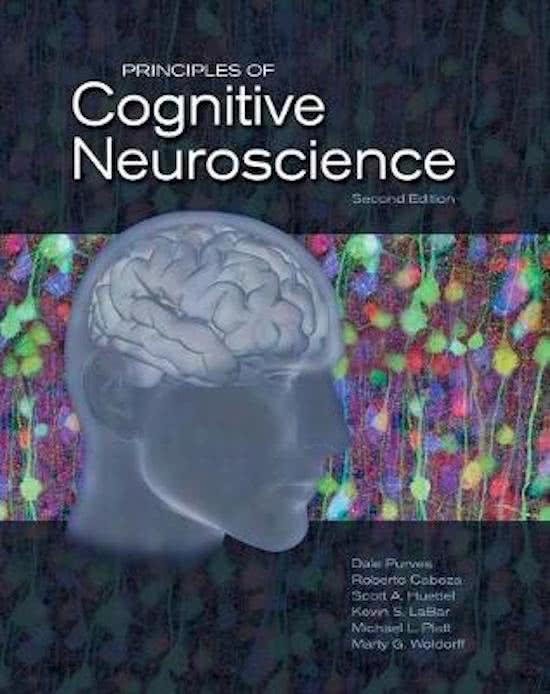
Chapters 1 to 7 of book Purves et al., Principles of Cognitive
Neuroscience, 2nd edition
ISBN 978-0-87893-573-4
Chapter 1: Cognitive neuroscience: definitions, themes, and approaches..........2
Chapter 2: The methods of Cognitive Neuroscience.........................................4
Chapter 3: Sensory systems and perception: vision.........................................6
Chapter 4: Sensory systems and perception: auditory, mechanical and chemical
senses......................................................................................................... 10
Chapter 5: Motor systems: the organization of action....................................18
Chapter 6: Attention and its effects on stimulus processing...........................22
Chapter 7: The control of attention...............................................................24
1
,Chapter 1: Cognitive neuroscience: definitions, themes, and
approaches
Relatively new discipline that has risen from the combination of neuroscience and cognitive
science
integrates investigations of brain structure and function, and seeks to measure cognitive
abilities and behavior to understand how the human brain works at all levels.
Cognition = set of processes that allow humans and many other animals to perceive external
stimuli, to extract key information and hold it in memory, and to generate thoughts and
actions that help reach desired goals
- Cognitive functions
- processing carried out by the mind (?), the mind is difficult to define. Consists of our
subjective, conscious experiences. not all processes studied are conscious.
Behaviorism = new emphasis on highly controlled experiments that matched objective
external stimuli to measurable behavior. as a result of growing dissatisfaction
with the lack of systematic progress in the study of mental processes.
- How changes in stimulus presentation could shape how individuals adapt their
behavior to the demands of the environment.
- Skinner: operant conditioning
- Advanced the scientific understanding of behavior: stimulus-response learning.
- Dismissed mental states and only discussed concepts in terms of experimental
manipulations
Cognitive science = research on mental processes regardless of the specific topic,
experimental approach, method or discipline.
- Information processing associated with cognitive functions.
- Interest in characterizing the phenomena and behavior associated with specific
cognitive functions, and in creating cognitive models (= describe underlying
psychological processes, predict how sensory input leads to behavioral output)
- Psychological constructs = elements of cognitive models that are created to help
explain diverse phenomena without reference to their ultimate causes in the brain. \
The field of neuroscience is concerned with how the nervous system of humans and other
animals is organized and functions.
- Cerebral cortex
Phrenology = approach of studying brain function where they believed that cognitive
functions and personality traits were associated with different parts of the cerebral cortex and
that the size of the cerebral cortex could be mapped by measuring bumps on the overlying
skull.
made an important contribution to modern neuroscience: it introduced the idea of
localization of function (= different parts of the brain contribute to different sorts of
information processing).
Neurons = separate cells that carry out cognitive processes
Action potentials = the electrical properties of neurons; shows that signals are transmitted
long distances along neuronal axons
2
, Neurotransmitters = the chemical substances that neurons use to stimulate the cells they
contact. Are released by the terminals of neuronal axons = synapses where neurotransmitters
bind to the receptor molecules on target neurons and other cells altering the membrane
potential of the cell contacted.
Cognitive neuroscience = work at the intersection of cognitive science and neuroscience.
- Think about the cognitive processes that shape our behavior and the contents of our
mental lives, and understand cognitive psychology and related fields
- Relate those processes and theories to underlying brain function
Neural correlates = mapping of the brain regions that are activated during a psychological
process. important role, but cognitive neuroscience goes well beyond creating maps of
brain function.
- Combines information about brain structure and function to create neurobiologically
grounded models of cognition.
Advantages of using multiple methods:
- Convergence = the approach of combining results from multiple experimental
paradigms to illuminate a single theoretical concept. When the same result is observed
across a range of experimental tasks, then that commonality leads to a stronger
inference that could be drawn from any one experiment. Often facilitated by meta-
analytic methods.
- Complementarity = each research method provides a different sort of information
about brain function. Many diverse physiological changes can be measured with
research methods that provide insight into these different aspects. Each technique
carries distinct strengths and limitations, so the results obtained from multiple
techniques are much more compelling than results derived from only one approach.
Summary:
1. Cognitive science seeks to understand the information processing associated with
functions like perception, memory, and decision making
2. Neuroscience seeks to characterize the structure and function of the nervous system
3. Cognitive neuroscience is a new discipline that applies research methods from
neuroscience to the functions and behaviors studied by cognitive science
4. Cognitive neuroscientists use diverse research methods and experimental paradigms to
develop models of mental function and behavior
3
Part 1
Chapters 1 to 7 of book Purves et al., Principles of Cognitive
Neuroscience, 2nd edition
ISBN 978-0-87893-573-4
Chapter 1: Cognitive neuroscience: definitions, themes, and approaches..........2
Chapter 2: The methods of Cognitive Neuroscience.........................................4
Chapter 3: Sensory systems and perception: vision.........................................6
Chapter 4: Sensory systems and perception: auditory, mechanical and chemical
senses......................................................................................................... 10
Chapter 5: Motor systems: the organization of action....................................18
Chapter 6: Attention and its effects on stimulus processing...........................22
Chapter 7: The control of attention...............................................................24
1
,Chapter 1: Cognitive neuroscience: definitions, themes, and
approaches
Relatively new discipline that has risen from the combination of neuroscience and cognitive
science
integrates investigations of brain structure and function, and seeks to measure cognitive
abilities and behavior to understand how the human brain works at all levels.
Cognition = set of processes that allow humans and many other animals to perceive external
stimuli, to extract key information and hold it in memory, and to generate thoughts and
actions that help reach desired goals
- Cognitive functions
- processing carried out by the mind (?), the mind is difficult to define. Consists of our
subjective, conscious experiences. not all processes studied are conscious.
Behaviorism = new emphasis on highly controlled experiments that matched objective
external stimuli to measurable behavior. as a result of growing dissatisfaction
with the lack of systematic progress in the study of mental processes.
- How changes in stimulus presentation could shape how individuals adapt their
behavior to the demands of the environment.
- Skinner: operant conditioning
- Advanced the scientific understanding of behavior: stimulus-response learning.
- Dismissed mental states and only discussed concepts in terms of experimental
manipulations
Cognitive science = research on mental processes regardless of the specific topic,
experimental approach, method or discipline.
- Information processing associated with cognitive functions.
- Interest in characterizing the phenomena and behavior associated with specific
cognitive functions, and in creating cognitive models (= describe underlying
psychological processes, predict how sensory input leads to behavioral output)
- Psychological constructs = elements of cognitive models that are created to help
explain diverse phenomena without reference to their ultimate causes in the brain. \
The field of neuroscience is concerned with how the nervous system of humans and other
animals is organized and functions.
- Cerebral cortex
Phrenology = approach of studying brain function where they believed that cognitive
functions and personality traits were associated with different parts of the cerebral cortex and
that the size of the cerebral cortex could be mapped by measuring bumps on the overlying
skull.
made an important contribution to modern neuroscience: it introduced the idea of
localization of function (= different parts of the brain contribute to different sorts of
information processing).
Neurons = separate cells that carry out cognitive processes
Action potentials = the electrical properties of neurons; shows that signals are transmitted
long distances along neuronal axons
2
, Neurotransmitters = the chemical substances that neurons use to stimulate the cells they
contact. Are released by the terminals of neuronal axons = synapses where neurotransmitters
bind to the receptor molecules on target neurons and other cells altering the membrane
potential of the cell contacted.
Cognitive neuroscience = work at the intersection of cognitive science and neuroscience.
- Think about the cognitive processes that shape our behavior and the contents of our
mental lives, and understand cognitive psychology and related fields
- Relate those processes and theories to underlying brain function
Neural correlates = mapping of the brain regions that are activated during a psychological
process. important role, but cognitive neuroscience goes well beyond creating maps of
brain function.
- Combines information about brain structure and function to create neurobiologically
grounded models of cognition.
Advantages of using multiple methods:
- Convergence = the approach of combining results from multiple experimental
paradigms to illuminate a single theoretical concept. When the same result is observed
across a range of experimental tasks, then that commonality leads to a stronger
inference that could be drawn from any one experiment. Often facilitated by meta-
analytic methods.
- Complementarity = each research method provides a different sort of information
about brain function. Many diverse physiological changes can be measured with
research methods that provide insight into these different aspects. Each technique
carries distinct strengths and limitations, so the results obtained from multiple
techniques are much more compelling than results derived from only one approach.
Summary:
1. Cognitive science seeks to understand the information processing associated with
functions like perception, memory, and decision making
2. Neuroscience seeks to characterize the structure and function of the nervous system
3. Cognitive neuroscience is a new discipline that applies research methods from
neuroscience to the functions and behaviors studied by cognitive science
4. Cognitive neuroscientists use diverse research methods and experimental paradigms to
develop models of mental function and behavior
3