WEEK 1
CHAPTER 1 - OPERATIONS MANAGEMENT
1.1 - What is operations management
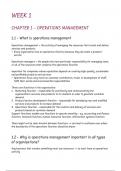
Operations management = the activity of managing the resources that create and deliver
services and products
- Every organisation has an operations function because they all create a product/
service
Operations managers = the people who have particular responsibility for managing some,
or all, of the resources that comprise the operations function
Important for companies whose reputation depends on creating high-quality, sustainable
and pro table products and services
- Operations focus very much on customer satisfaction, invest in development of sta ,
ful l their social and environmental responsibilities
Three core functions in the organisation:
1. Marketing function - responsible for positioning and communicating the
organisation’s services and products to its markets in order to generate customer
demand
2. Product/service development function - responsible for developing new and modi ed
services and products to increase demand
3. Operations function - responsible for the creation and delivery of services and
products based on customer demand
Support functions enable core functions to operate smoothly - e.g. accounting and nance
function, technical function, human resources function, information systems function
There might not be clear division between functions -> can lead to confusion over where
the boundaries of the operations function should be drawn
1.2 - Why is operations management important in all types
of organisations?
Any business that creates something must use resources -> so must have an operations
activity
fi fi fi fiff
,Smaller companies may have problems managing operations -> o en cannot have the
resources to dedicate individuals to speci c tasks, so people may have to do di erent jobs
as the need arises
- Can allow fast response to problems or opportunities
- BUT can make decision making confusing as roles overlap
fi ft ff
, Operations management in non-for-pro t organisations
- Managing operations in an animal welfare charity, hospital, research organisation or
government department is essentially the same as in commercial organisations
- Same decisions: how to create and deliver, invest in technology, devise performance
measures, improve operations performance etc
- BUT strategic objectives may be more complex + focus more on political, economic,
social or environmental objectives
Changes in business environment impacted operations managers -> due to changes in
demand, increased cost-based competition, technological changes, customers’ a itudes to
social and environmental issues etc
New operations agenda:
1. New technologies - process technologies are changing fast so hard to predict what
their e ect will be (but will radically alter operating practices of all operations)
2. Di erent supply arrangements - some markets may have become more global and
some constrained by politically inspired trade restrictions - some globalised supply
markets are opening up new sourcing options - o en opportunities for cost savings
must be balanced against supply chain vulnerability and ethical issues
3. Increased emphasis on social and environmental issues - customers, sta , investors
have been developing increased ethical and environmental sensitivity, leading to
operations changing the way they conceive and create products and services
ff
ff fi ft ff tt
CHAPTER 1 - OPERATIONS MANAGEMENT
1.1 - What is operations management
Operations management = the activity of managing the resources that create and deliver
services and products
- Every organisation has an operations function because they all create a product/
service
Operations managers = the people who have particular responsibility for managing some,
or all, of the resources that comprise the operations function
Important for companies whose reputation depends on creating high-quality, sustainable
and pro table products and services
- Operations focus very much on customer satisfaction, invest in development of sta ,
ful l their social and environmental responsibilities
Three core functions in the organisation:
1. Marketing function - responsible for positioning and communicating the
organisation’s services and products to its markets in order to generate customer
demand
2. Product/service development function - responsible for developing new and modi ed
services and products to increase demand
3. Operations function - responsible for the creation and delivery of services and
products based on customer demand
Support functions enable core functions to operate smoothly - e.g. accounting and nance
function, technical function, human resources function, information systems function
There might not be clear division between functions -> can lead to confusion over where
the boundaries of the operations function should be drawn
1.2 - Why is operations management important in all types
of organisations?
Any business that creates something must use resources -> so must have an operations
activity
fi fi fi fiff
,Smaller companies may have problems managing operations -> o en cannot have the
resources to dedicate individuals to speci c tasks, so people may have to do di erent jobs
as the need arises
- Can allow fast response to problems or opportunities
- BUT can make decision making confusing as roles overlap
fi ft ff
, Operations management in non-for-pro t organisations
- Managing operations in an animal welfare charity, hospital, research organisation or
government department is essentially the same as in commercial organisations
- Same decisions: how to create and deliver, invest in technology, devise performance
measures, improve operations performance etc
- BUT strategic objectives may be more complex + focus more on political, economic,
social or environmental objectives
Changes in business environment impacted operations managers -> due to changes in
demand, increased cost-based competition, technological changes, customers’ a itudes to
social and environmental issues etc
New operations agenda:
1. New technologies - process technologies are changing fast so hard to predict what
their e ect will be (but will radically alter operating practices of all operations)
2. Di erent supply arrangements - some markets may have become more global and
some constrained by politically inspired trade restrictions - some globalised supply
markets are opening up new sourcing options - o en opportunities for cost savings
must be balanced against supply chain vulnerability and ethical issues
3. Increased emphasis on social and environmental issues - customers, sta , investors
have been developing increased ethical and environmental sensitivity, leading to
operations changing the way they conceive and create products and services
ff
ff fi ft ff tt