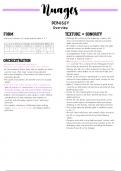
Nuages
DEBUSSY
Overview
Form Texture + sonority
Series of rotations of 2 main melodic ideas X + Y O
Although the scoring at the beginning is sparse, the
:
choice of instruments (clarinets, bassoons and oboe)
make the sonority richer
&
The timbre is much clearer and lighter when the same
material returns on divided violins in bar 11
O
High, divided violins also provide the main
accompaniment in bar 7 after the rich sound of the cor
anglais accompanied by bassoons and clarinets from
the main Y material at bar 5
Orchestration O
The homophonic (homorhythmic) parallel motion in the
Strings are often divided and muted strings at bar 14 is a characteristic Debussyian texture
Harps are used subtly to add a distinctive colouring O
The strings are muted at the opening and at bar 23,
In the woodwind, flutes, oboes and cor anglais are often Debussy also asks for cellos and basses to play over the
used for solos, their lower ranges being exploited fingerboard, which makes for an even more light and
Horns and trumpets, often muted, are heard in short delicate sound
pianissimo phrases O
At bar 33 the texture is pared back to 2 lines but with
Percussion instruments are another source of unusual extensive octave doubling in both lower strings for one
timbre line and woodwind for the other
Expressive scope of the strings section is augmented, O
When Y returns in bar 43, the texture is given a new
with all manner of combinations of arco and pizzicato, colour by on-beat bowed strings being joined by off-beat
divisi part writing, ‘sul tasto’ and tremolo, resulting in plucking (pizzicato)
a new variety, flexibility and beauty of string sound
&
At bar 57, the relatively bare texture from the
Exploits the instrument’s wide range to create timbral beginning is given a bit more warmth by means of an
juxtapositions of deep, dramatic bass registers in added viola line
contrast with the higher register’s more ‘glittering’ O
At bar 64, the gentle sustained string chord, scored
sonorities across a wide register accompanies some interesting
The complex resonances of Debussy’s piano writing doublings in the melody, starting with harp and flute
require careful use of the pedals, the damper pedal in O
The strings take the melody, again in doubled octaves
particular in bar 71
O
The rich chord with horns and tremolo lower strings in
bar 82 is a very characteristical and lush Debussy
timbre
O
The piece ends with a very dark and quiet texture, with
basses and cellos very low and close together at bar 92
and many other low sonorities, including the tremolo
between B and D on the timpani
, Nuages
ROTATION 1
(BARS 1-10)
OVERVIEW Analysis
O
Bars 1-4
o
In # time, which creates 'metrical dissonance', and spans a
↳
B octatonic with hints of minor in top part tritone from the lowest to the highest pitch (B-F)
↳
A↳ in lower part is also chromatic to B octatonic
O
Has no sense of tonality or key
↳
Establishes B as a centre but only weakly
O
The opening bars of 'Nuages' have their own distinctive
&
Bars 5-10 timbre
↳
Cor anglais melody and harmony is pure B octatonic
O
Like the opening to the 'Prélude a l'apres-midi d'un faune',
↳
G7 in first inversion (B drone in bass) is main sonority the musical content is quite minimal
↳
Cor anglais melody is in I , against the prevailing &
↳
The earlier music's breathy, sensuous, unaccompanied
solo flute in its lower register in 'Nuages' becomes a 2
part motif doubled at the lower octave in the slightly
cooler, less 'emotional', reedy tones of clarinets and
bassoons, joined by the oboe in bar 3, all well above their
lower register
The oboe picks out and sustains the 1st clarinet's notes
-
on beat 1, 3 and 5, its falling line anticipating
melodically, 'rhythmically' and even, to some extent,
timbrally, the downward stepwise motion of the
following cor anglais melody
In some respects, too, the cor anglais solo in bars 5-8
*
is reminiscent of the 'Prélude's' solo flute
Its content is purely octatonic, spanning a tritone
&
from B-F, while the 'Prélude's' flute solo, which also
moves entirely by step and initially spans the same
interval (from G to C#), disguises its octatonic basis
by introducing two (chromatic) passing notes
↳
Immediate repetition of bars 1 and 3 in 'Nuages', in the
same way as the 'Prélude's' flute solo directly repeats its
opening bar
↳
Chromatic decoration of the octatonic scale, but in a
rather complex manner
O
Bars 1-4 = X
↳
Consists of steady crotchets, though the time signature
is ambiguous, fluctuating between ↳ and 3 , with a
predominance of open 5ths
↳
Timbre is quite expressionless
&
Bars 5-10 = Y
↳
The cor anglais motif (bars 5-8) is meant to evoke the
foghorn of a passing boat on the Seine
↳
Unlike the opening of X, this motif retains its original
thematic shape, register and timbre for the rest of the
movement
It's repetitive, refrain-like quality is a crucial feature
-
that differentiates it from the varied version of the
bars 1-5 material
↳
The melodic fragment itself is repeated and expanded in
later rotations, and both the accompanying harmony
and timbre are changed, but it continues to function as
the concluding phase of each of the rotations
In spite of this, it never achieves a clear sense of
-
tonality, remaining open-ended
DEBUSSY
Overview
Form Texture + sonority
Series of rotations of 2 main melodic ideas X + Y O
Although the scoring at the beginning is sparse, the
:
choice of instruments (clarinets, bassoons and oboe)
make the sonority richer
&
The timbre is much clearer and lighter when the same
material returns on divided violins in bar 11
O
High, divided violins also provide the main
accompaniment in bar 7 after the rich sound of the cor
anglais accompanied by bassoons and clarinets from
the main Y material at bar 5
Orchestration O
The homophonic (homorhythmic) parallel motion in the
Strings are often divided and muted strings at bar 14 is a characteristic Debussyian texture
Harps are used subtly to add a distinctive colouring O
The strings are muted at the opening and at bar 23,
In the woodwind, flutes, oboes and cor anglais are often Debussy also asks for cellos and basses to play over the
used for solos, their lower ranges being exploited fingerboard, which makes for an even more light and
Horns and trumpets, often muted, are heard in short delicate sound
pianissimo phrases O
At bar 33 the texture is pared back to 2 lines but with
Percussion instruments are another source of unusual extensive octave doubling in both lower strings for one
timbre line and woodwind for the other
Expressive scope of the strings section is augmented, O
When Y returns in bar 43, the texture is given a new
with all manner of combinations of arco and pizzicato, colour by on-beat bowed strings being joined by off-beat
divisi part writing, ‘sul tasto’ and tremolo, resulting in plucking (pizzicato)
a new variety, flexibility and beauty of string sound
&
At bar 57, the relatively bare texture from the
Exploits the instrument’s wide range to create timbral beginning is given a bit more warmth by means of an
juxtapositions of deep, dramatic bass registers in added viola line
contrast with the higher register’s more ‘glittering’ O
At bar 64, the gentle sustained string chord, scored
sonorities across a wide register accompanies some interesting
The complex resonances of Debussy’s piano writing doublings in the melody, starting with harp and flute
require careful use of the pedals, the damper pedal in O
The strings take the melody, again in doubled octaves
particular in bar 71
O
The rich chord with horns and tremolo lower strings in
bar 82 is a very characteristical and lush Debussy
timbre
O
The piece ends with a very dark and quiet texture, with
basses and cellos very low and close together at bar 92
and many other low sonorities, including the tremolo
between B and D on the timpani
, Nuages
ROTATION 1
(BARS 1-10)
OVERVIEW Analysis
O
Bars 1-4
o
In # time, which creates 'metrical dissonance', and spans a
↳
B octatonic with hints of minor in top part tritone from the lowest to the highest pitch (B-F)
↳
A↳ in lower part is also chromatic to B octatonic
O
Has no sense of tonality or key
↳
Establishes B as a centre but only weakly
O
The opening bars of 'Nuages' have their own distinctive
&
Bars 5-10 timbre
↳
Cor anglais melody and harmony is pure B octatonic
O
Like the opening to the 'Prélude a l'apres-midi d'un faune',
↳
G7 in first inversion (B drone in bass) is main sonority the musical content is quite minimal
↳
Cor anglais melody is in I , against the prevailing &
↳
The earlier music's breathy, sensuous, unaccompanied
solo flute in its lower register in 'Nuages' becomes a 2
part motif doubled at the lower octave in the slightly
cooler, less 'emotional', reedy tones of clarinets and
bassoons, joined by the oboe in bar 3, all well above their
lower register
The oboe picks out and sustains the 1st clarinet's notes
-
on beat 1, 3 and 5, its falling line anticipating
melodically, 'rhythmically' and even, to some extent,
timbrally, the downward stepwise motion of the
following cor anglais melody
In some respects, too, the cor anglais solo in bars 5-8
*
is reminiscent of the 'Prélude's' solo flute
Its content is purely octatonic, spanning a tritone
&
from B-F, while the 'Prélude's' flute solo, which also
moves entirely by step and initially spans the same
interval (from G to C#), disguises its octatonic basis
by introducing two (chromatic) passing notes
↳
Immediate repetition of bars 1 and 3 in 'Nuages', in the
same way as the 'Prélude's' flute solo directly repeats its
opening bar
↳
Chromatic decoration of the octatonic scale, but in a
rather complex manner
O
Bars 1-4 = X
↳
Consists of steady crotchets, though the time signature
is ambiguous, fluctuating between ↳ and 3 , with a
predominance of open 5ths
↳
Timbre is quite expressionless
&
Bars 5-10 = Y
↳
The cor anglais motif (bars 5-8) is meant to evoke the
foghorn of a passing boat on the Seine
↳
Unlike the opening of X, this motif retains its original
thematic shape, register and timbre for the rest of the
movement
It's repetitive, refrain-like quality is a crucial feature
-
that differentiates it from the varied version of the
bars 1-5 material
↳
The melodic fragment itself is repeated and expanded in
later rotations, and both the accompanying harmony
and timbre are changed, but it continues to function as
the concluding phase of each of the rotations
In spite of this, it never achieves a clear sense of
-
tonality, remaining open-ended