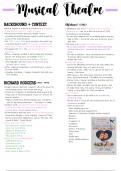
Musical Theatre
Background + context 'Oklahoma!' (1943)
O
Musical theatre is a diverse art form as it encompasses O
‘Oklahoma!’ was the first musical written by Rogers +
many different genres + styles of music Hammerstein + ran for a then record run of 2,212
O
All musicals contain spectacle, drama + music, performances on Broadway
including integrated musical numbers which propel the ↳
It was later adapted into an academy award winning
action of the story forwards film in 1955, + the writers also won a Pulitzer prize a
G
The 1950s + early 1960s were considered the golden age year later
of musical theatre, with book musicals establishing the &
The show is an example of a book musical
importance of music + story as an integrated art form ↳
It contains leitmotif + recurring themes which help
g
Throughout the 1970s the rock musical grew in develop characters + integrate the story into the
popularity music
O
Often, composers worked in partnership with the same ↳
As well as dialogue + song, the musical also contains a
lyricist over many years, for example Rogers + 15 minute ballet sequence depicting Laurey’s
Hammerstein or Andrew Lloyd Webber + Tim Rice dream-like state
↳
This highlights the importance of the relationship O
A brief plot synopsis:
between lyrics + music ↳
Set in the Oklahoma territory in the early 1900s, the
O
Other composers sometimes wrote both lyrics + music musical tells the story of 2 pairs of lovers
for their works ↳
2 cowboys, Curly + Will, try to capture the hearts of
↳
Stephen Sondheim + Stephen Schwartz both fall into Laurey + Ado Annie
this category ↳
Both Laurey + Ado Annie have attention from other
men, Jud (a farm hand) + Ali Hakim (a street pedlar)
↳
During Curly + Laurey’s wedding, a drunken Jud tries
Richard rodgers (1902 - 1979) ↳
to attack Curly with a knife
During the fight, Jud falls onto his own knife + dies
O
Rodgers was an American composer who wrote music for ↳
A judge finds Curly ‘not guilty’ of any wrongdoing +
43 Broadway shows + more than 900 songs Laurey + Curly depart for their honeymoon
O
His gift as a composer of melody has made many of his g
Orchestration:
songs some of the most popular songs ever written for ↳
The orchestration of the show is for a traditional
musical theatre orchestral setup
↳
Many of them have become popular jazz standards, ↳
As this show is not at all jazz-influenced, there are no
such as ‘My Funny Valentine’ + ‘The Lady is a Tramp’ saxophones included
O
Rodgers’ work can largely be split into 2 sections ↳
There are parts for:
according to which of 2 lyricists he worked with Flute (doubling piccolo)
-
↳
Lorenz Hart + Oscar Hammerstein II Oboe (with optional English horn)
-
O
Richard Rogers’ musicals were written as book musicals, Clarinets I-II (clarinet I doubles as bass clarinet)
-
integrating dialogue + songs together + many of them Bassoon
-
had successful film adaptations, such as ‘Pal Joey’, ‘The Horns I-II
-
Sound of Music’, ‘South Pacific’ Trumpets I-II
-
g
Work with Lorenz Hart: Trombone
-
↳
‘A Conneticut Yankee’ (1927) Percussion
-
↳
‘On Your Toes’ (1936) Violins, A-B (divisi)
--
↳
‘Babes in Arms’ (1937) Viola (divisi)
-
↳
‘Pal Joey’ (1940-1941) Cello
-
↳
‘By Jupiter’ (1942) Double bass
-
O
Work with Oscar Hammerstein II: Guitar (doubling banjo)
-
↳
‘Oklahoma!’ (1943) Harp
-
↳
‘Carousel’ (1945)
↳
‘State Pacific’ (1949)
↳
‘Cinderella’ (1957)
↳
‘The Sound of Music’ (1959)
Background + context 'Oklahoma!' (1943)
O
Musical theatre is a diverse art form as it encompasses O
‘Oklahoma!’ was the first musical written by Rogers +
many different genres + styles of music Hammerstein + ran for a then record run of 2,212
O
All musicals contain spectacle, drama + music, performances on Broadway
including integrated musical numbers which propel the ↳
It was later adapted into an academy award winning
action of the story forwards film in 1955, + the writers also won a Pulitzer prize a
G
The 1950s + early 1960s were considered the golden age year later
of musical theatre, with book musicals establishing the &
The show is an example of a book musical
importance of music + story as an integrated art form ↳
It contains leitmotif + recurring themes which help
g
Throughout the 1970s the rock musical grew in develop characters + integrate the story into the
popularity music
O
Often, composers worked in partnership with the same ↳
As well as dialogue + song, the musical also contains a
lyricist over many years, for example Rogers + 15 minute ballet sequence depicting Laurey’s
Hammerstein or Andrew Lloyd Webber + Tim Rice dream-like state
↳
This highlights the importance of the relationship O
A brief plot synopsis:
between lyrics + music ↳
Set in the Oklahoma territory in the early 1900s, the
O
Other composers sometimes wrote both lyrics + music musical tells the story of 2 pairs of lovers
for their works ↳
2 cowboys, Curly + Will, try to capture the hearts of
↳
Stephen Sondheim + Stephen Schwartz both fall into Laurey + Ado Annie
this category ↳
Both Laurey + Ado Annie have attention from other
men, Jud (a farm hand) + Ali Hakim (a street pedlar)
↳
During Curly + Laurey’s wedding, a drunken Jud tries
Richard rodgers (1902 - 1979) ↳
to attack Curly with a knife
During the fight, Jud falls onto his own knife + dies
O
Rodgers was an American composer who wrote music for ↳
A judge finds Curly ‘not guilty’ of any wrongdoing +
43 Broadway shows + more than 900 songs Laurey + Curly depart for their honeymoon
O
His gift as a composer of melody has made many of his g
Orchestration:
songs some of the most popular songs ever written for ↳
The orchestration of the show is for a traditional
musical theatre orchestral setup
↳
Many of them have become popular jazz standards, ↳
As this show is not at all jazz-influenced, there are no
such as ‘My Funny Valentine’ + ‘The Lady is a Tramp’ saxophones included
O
Rodgers’ work can largely be split into 2 sections ↳
There are parts for:
according to which of 2 lyricists he worked with Flute (doubling piccolo)
-
↳
Lorenz Hart + Oscar Hammerstein II Oboe (with optional English horn)
-
O
Richard Rogers’ musicals were written as book musicals, Clarinets I-II (clarinet I doubles as bass clarinet)
-
integrating dialogue + songs together + many of them Bassoon
-
had successful film adaptations, such as ‘Pal Joey’, ‘The Horns I-II
-
Sound of Music’, ‘South Pacific’ Trumpets I-II
-
g
Work with Lorenz Hart: Trombone
-
↳
‘A Conneticut Yankee’ (1927) Percussion
-
↳
‘On Your Toes’ (1936) Violins, A-B (divisi)
--
↳
‘Babes in Arms’ (1937) Viola (divisi)
-
↳
‘Pal Joey’ (1940-1941) Cello
-
↳
‘By Jupiter’ (1942) Double bass
-
O
Work with Oscar Hammerstein II: Guitar (doubling banjo)
-
↳
‘Oklahoma!’ (1943) Harp
-
↳
‘Carousel’ (1945)
↳
‘State Pacific’ (1949)
↳
‘Cinderella’ (1957)
↳
‘The Sound of Music’ (1959)