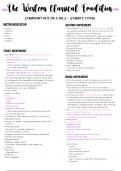
The Western Classical Tradition
SYMPHONY IN D OP.3 NO.2 - STAMITZ (1750)
INSTRUMENTATION SECOND MOVEMENT
O
Strings O
This movement is in a loose rounded binary form, in this
O
Continuo case without ay repeats (the B section starts on the 3rd
O
Oboes page with D major version of the opening)
O
Horns O
Whilst later Classical and Romantic symphonists began to
O
Trumpets write slower and more impassioned Adagio-type 2nd
O
Timpani movements, this relaxed Andante in the subdominant key
with a simple MDH texture is very typical of the earlier
Classical period
&
Oboe gets the tune
FIRST MOVEMENT O
Mannheim birds
O
Mannheim birds
O
The form is somewhat like sonata form but there are O
Modulation to the dominant (D)
several differences O
Inverted pedals
↳
The development is not that different from the G
Changes in sonority
exposition O
Antiphonal phrases
It just presents themes in their entirety in a range
-
O
Short symphony
of closely related keys ↳
Contrast to the first movement
↳
The recapitulation reverses the order of the subjects &
Chains of thirds
(2nd then 1st) and the tonic returns in the
equivalent of the development as well as at this point
O
The most important principles in mature sonata form THIRD MOVEMENT
of a fragmented and modulatory development followed O
The 3rd movement is quite old fashioned in some of its
by a 'double return' of the tonic and the opening features, for example the fact that 1st and 2nd violins
thematic material at the beginning of the play the same throughout
recapitulation is not yet established ↳
The reduction of forces in the trio (no trumpets) is
O
Circle of 5ths standard, but the relatively independent woodwind parts
O
Some crescendos are more innovative
O
Melody:
G
The B section of the rounded binary minuet starts with a
↳
Decorated new idea before the A' brings back the opening material
↳
Sighs
↳
Composers later in the Classical period nearly always
↳
Range of articulation treated the beginning of the B section a bit like a sonata
development, modulating whilst fragment ideas from the
↳
Octave range A section rather than introducing anything new
↳
Rhythmic diminution O
The trio is, like most early 3rd movements, short and
Note values getting shorter (as the piece goes on)
-
similar in feel to the minuet
↳
4 and 5 bar phrases? ↳
Later composers would write Trio that were both more
O
Instruments offer like punctuation to the sections substantial and more contrasting
O
Diminished chords O
Binary form
O
D major + E major = secondary dominant (chord V of O
A section (12 bars):
chord V) ↳
Mannheim birds
&
Dominant pedal ↳
Mannheim sighs
↳
No move to secondary dominant ↳
Goes to A major (dominant)
O
1st and 3rd beats accented O
B section:
O
Polyphonic element, but mostly melody dominated ↳
Doesn't really contrast to the A section
O
Intricate articulation ↳
Strings have tune again
O
Mannheim birds ↳
Woodwind and brass come in at the end of phrases
&
Rhythmic augmentation O
Trio:
↳
Crotchets, then minims, then semibreves ↳
First 16 bars
O
Sequence 3 parts
-
O
Decoration 4 instruments
-
↳
Appoggiaturas Includes basso continuo
*
O
Pedal note Gives an oboe solo
-
O
Dotted rhythms In octaves
-
Not in unison, as they aren't the same pitch
*
In D major
-
, The Western Classical Tradition
SYMPHONY IN D OP.3 NO.2 - STAMITZ (1750)
DEVELOPMENT OF THE ORCHESTRA Rhythm
O
As with all early symphonies this would have been played O
The rhythmic structure of the music in the Galant style
with continuo keyboard favours regularity and simplicity
↳
However, the orchestra is larger than the often-used ↳
The opening of the 1st movement, for example, starts
'Sinfonia a 8' configuration with added trumpets and with a 4 bar idea, followed by an 8 bar Mannheim roller
timpani Typically, this 8 bar idea is divided into a 4 bar phrase
-
O
Stamitz used a wide variety of sizes of ensemble ranging that is repeated up the octave, which itself is made up
from this more lavish grouping to strings and continuo of a 2 bar phrase
alone
O
In the 2nd movement there are some good examples of
Stamitz's pioneering orchestration, in which he gives
independent lines to the woodwind
↳
The tune is played on the strings but then the oboes
take over with the strings reduced to an accompanying
role
HARMONY/TONALITY
O
Very simple and direct harmony with lots of pedals and
primary chords
&
In terms of tonality, the double return of tonic and
thematic material that would become standard in sonata
form is not yet establisehed
↳
Tonic returns in the development as well
Drama/progression
O
The dramatic opening of the 1st movement is typical of
the Mannheim style with 3 opening tonic chords in
rhythmic unison, followed by sudden drop to piano that
marks the beginning of a gradual crescendo that is
partially achieved by adding instruments to the texture as
it continues
O
This opening is also a good example of the Mannheim roller
Melody/theme
O
Galant music makes much use of simple, diatonic material
with lots of motivic repetition
g
The last movement begins with a rising arpeggio
Texture
&
Galant writing is typically melody-dominated homophony
↳
The 2nd movement provides very clear examples
, The Western Classical Tradition
SYMPHONY NO.5 - HAYDN (1757)
INSTRUMENTATION Fourth movement
O
Oboes C
Quick-paced finale starts with rush of strings
O
Bassoon O
Unison passages played by strings
&
Horns O
Violins speed off with melody
O
Strings &
Quick and dramatic changes in dynamic
O
Continuo ↳
Add to drama of finale
Very quiet sections quickly dim the loud sections
-
First movement
O
Shortest of all 4 movements
O
Concludes on perfect resolution
&
Adagio, ma non troppo- slow but not too much O
Polyphonic
&
Scalic patterns
&
Opening movement features horns
High part in places
↳
O
Lyrical melody led by upper strings and embellished by
woodwind
O
Stately style
O
Sonata form
O
Development section sees the highly-pitched horns return
O
Main theme revisited in recapitulation
Orchestra head towards poignant conclusion
↳
&
Polyphonic
SECOND MOVEMENT
o time
O
Marked allegro
&
Pedal notes
O
More energetic than 1st movement
O
Uses fast string work and colourful woodwind to create
orchestra swells in music
O
Horns offer unique timbre
&
Solo passage with woodwind as short interlude to main
string theme
O
Homophonic
Third movement
O
Minuet and trio movement shines light on horns
O
Scalic runs
&
Stab chords
&
After short bursts of orchestral sound, theme is picked up
by strings
O
Horns and upper woodwind embellish melody with short
passages of music
O
Trio is woodwind-heavy as theme is developed
O
Polyphonic
SYMPHONY IN D OP.3 NO.2 - STAMITZ (1750)
INSTRUMENTATION SECOND MOVEMENT
O
Strings O
This movement is in a loose rounded binary form, in this
O
Continuo case without ay repeats (the B section starts on the 3rd
O
Oboes page with D major version of the opening)
O
Horns O
Whilst later Classical and Romantic symphonists began to
O
Trumpets write slower and more impassioned Adagio-type 2nd
O
Timpani movements, this relaxed Andante in the subdominant key
with a simple MDH texture is very typical of the earlier
Classical period
&
Oboe gets the tune
FIRST MOVEMENT O
Mannheim birds
O
Mannheim birds
O
The form is somewhat like sonata form but there are O
Modulation to the dominant (D)
several differences O
Inverted pedals
↳
The development is not that different from the G
Changes in sonority
exposition O
Antiphonal phrases
It just presents themes in their entirety in a range
-
O
Short symphony
of closely related keys ↳
Contrast to the first movement
↳
The recapitulation reverses the order of the subjects &
Chains of thirds
(2nd then 1st) and the tonic returns in the
equivalent of the development as well as at this point
O
The most important principles in mature sonata form THIRD MOVEMENT
of a fragmented and modulatory development followed O
The 3rd movement is quite old fashioned in some of its
by a 'double return' of the tonic and the opening features, for example the fact that 1st and 2nd violins
thematic material at the beginning of the play the same throughout
recapitulation is not yet established ↳
The reduction of forces in the trio (no trumpets) is
O
Circle of 5ths standard, but the relatively independent woodwind parts
O
Some crescendos are more innovative
O
Melody:
G
The B section of the rounded binary minuet starts with a
↳
Decorated new idea before the A' brings back the opening material
↳
Sighs
↳
Composers later in the Classical period nearly always
↳
Range of articulation treated the beginning of the B section a bit like a sonata
development, modulating whilst fragment ideas from the
↳
Octave range A section rather than introducing anything new
↳
Rhythmic diminution O
The trio is, like most early 3rd movements, short and
Note values getting shorter (as the piece goes on)
-
similar in feel to the minuet
↳
4 and 5 bar phrases? ↳
Later composers would write Trio that were both more
O
Instruments offer like punctuation to the sections substantial and more contrasting
O
Diminished chords O
Binary form
O
D major + E major = secondary dominant (chord V of O
A section (12 bars):
chord V) ↳
Mannheim birds
&
Dominant pedal ↳
Mannheim sighs
↳
No move to secondary dominant ↳
Goes to A major (dominant)
O
1st and 3rd beats accented O
B section:
O
Polyphonic element, but mostly melody dominated ↳
Doesn't really contrast to the A section
O
Intricate articulation ↳
Strings have tune again
O
Mannheim birds ↳
Woodwind and brass come in at the end of phrases
&
Rhythmic augmentation O
Trio:
↳
Crotchets, then minims, then semibreves ↳
First 16 bars
O
Sequence 3 parts
-
O
Decoration 4 instruments
-
↳
Appoggiaturas Includes basso continuo
*
O
Pedal note Gives an oboe solo
-
O
Dotted rhythms In octaves
-
Not in unison, as they aren't the same pitch
*
In D major
-
, The Western Classical Tradition
SYMPHONY IN D OP.3 NO.2 - STAMITZ (1750)
DEVELOPMENT OF THE ORCHESTRA Rhythm
O
As with all early symphonies this would have been played O
The rhythmic structure of the music in the Galant style
with continuo keyboard favours regularity and simplicity
↳
However, the orchestra is larger than the often-used ↳
The opening of the 1st movement, for example, starts
'Sinfonia a 8' configuration with added trumpets and with a 4 bar idea, followed by an 8 bar Mannheim roller
timpani Typically, this 8 bar idea is divided into a 4 bar phrase
-
O
Stamitz used a wide variety of sizes of ensemble ranging that is repeated up the octave, which itself is made up
from this more lavish grouping to strings and continuo of a 2 bar phrase
alone
O
In the 2nd movement there are some good examples of
Stamitz's pioneering orchestration, in which he gives
independent lines to the woodwind
↳
The tune is played on the strings but then the oboes
take over with the strings reduced to an accompanying
role
HARMONY/TONALITY
O
Very simple and direct harmony with lots of pedals and
primary chords
&
In terms of tonality, the double return of tonic and
thematic material that would become standard in sonata
form is not yet establisehed
↳
Tonic returns in the development as well
Drama/progression
O
The dramatic opening of the 1st movement is typical of
the Mannheim style with 3 opening tonic chords in
rhythmic unison, followed by sudden drop to piano that
marks the beginning of a gradual crescendo that is
partially achieved by adding instruments to the texture as
it continues
O
This opening is also a good example of the Mannheim roller
Melody/theme
O
Galant music makes much use of simple, diatonic material
with lots of motivic repetition
g
The last movement begins with a rising arpeggio
Texture
&
Galant writing is typically melody-dominated homophony
↳
The 2nd movement provides very clear examples
, The Western Classical Tradition
SYMPHONY NO.5 - HAYDN (1757)
INSTRUMENTATION Fourth movement
O
Oboes C
Quick-paced finale starts with rush of strings
O
Bassoon O
Unison passages played by strings
&
Horns O
Violins speed off with melody
O
Strings &
Quick and dramatic changes in dynamic
O
Continuo ↳
Add to drama of finale
Very quiet sections quickly dim the loud sections
-
First movement
O
Shortest of all 4 movements
O
Concludes on perfect resolution
&
Adagio, ma non troppo- slow but not too much O
Polyphonic
&
Scalic patterns
&
Opening movement features horns
High part in places
↳
O
Lyrical melody led by upper strings and embellished by
woodwind
O
Stately style
O
Sonata form
O
Development section sees the highly-pitched horns return
O
Main theme revisited in recapitulation
Orchestra head towards poignant conclusion
↳
&
Polyphonic
SECOND MOVEMENT
o time
O
Marked allegro
&
Pedal notes
O
More energetic than 1st movement
O
Uses fast string work and colourful woodwind to create
orchestra swells in music
O
Horns offer unique timbre
&
Solo passage with woodwind as short interlude to main
string theme
O
Homophonic
Third movement
O
Minuet and trio movement shines light on horns
O
Scalic runs
&
Stab chords
&
After short bursts of orchestral sound, theme is picked up
by strings
O
Horns and upper woodwind embellish melody with short
passages of music
O
Trio is woodwind-heavy as theme is developed
O
Polyphonic