Overview lecture
Purposes
- To provide an overview of the course
- To help you in the preparation of the unit test
Not a summary of all what you need to know
Parts of the course
- Case 1 introduces students to the economic approach of healthcare
- Case 2 presents economic theories that are needed to understand and analyze innovations
of healthcare
- Case 3 is about economic evaluation of healthcare interventions
- Case 4 is related to organizational innovations
- Case 5 presents the pharmaceutical market and drug development process
- Case 6 discusses patient involvement in healthcare decisions/HTA
Case 1: The economic approach of healthcare
Aims
- Economy as a scientific discipline
- The economic approach of health and healthcare
- The past, present and the future of ‘health economics’ as a discipline
Some definitions
Economics
- Study of choices under conditions of scarcity
- Aim: to increase efficiency
Health economics
- Applied field of economics
- Study the choices/behavior of individuals, healthcare providers, public and private
organizations, and governments in health decision-making
- Study how (scarce) resources are allocated to and within the health system
Health care economics
- The subject of analysis is the health (medical) care industry, not health
Some other key concepts
Scarcity: tension between unlimited needs and limited possibilities to fulfill those needs
Allocation of scarce resources among competing demands
All resource uses have an opportunity cost (cost of the best alternative option)
Allocate efficiency (or Pareto efficiency) as a distribution or use of resources (allocation) in which no
one can be made better off without making someone worse off
If one or more of efficiency conditions are not fulfilled, then we are faced with a market failure
Perfect competition (four conditions)
Explanation and relationship between concepts
Specific characteristics of healthcare government interference
- Presence of externalities (e.g. smoking, vaccination) smoking bans/national vaccination
program
- High R&D cost patent protection for drug innovation
- Market power (monopoly) drug price regulation
- Uncertainty health insurance (several problems, e.g. moral hazard, adverse selection, etc.)
- Expected behavior of the physician no advertising and pricing competition, etc.
- Etc.
, Development and prospect of health economics
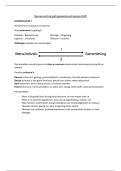
Williams’ diagram: most important subject of health economics
Health economics is divided into eight distinct topics (the relationship will not be asked)
The future of health economics
To meet new challenges, new theoretical, empirical and methodological methods needed
- Behavioral economics: methods and theories from cognitive psychology when specifically
addressing individual economic decision-making
- Experimental economics: experiments to study the decision-making of individual and market
outcomes
- From ‘healthcare economics’ to ‘health economics’
- Proper role of market and institutions
- More socioeconomic model
- More original data collection (big data)
- Etc.
Paradigms
To understand past and future evolution of health economics
Some paradigms
- Kuhn: knowledge develops gradually over a number of years and continues as a result of a
revolution new paradigm
- Lakatos: a set of ‘hard core assumptions’ often favored for the evolution of health
economics (pros of the neoclassical theory)
- Phelps: health economics needs to undertake a fundamental reformation over the next 20
years
Case 2: The economics of innovations
Aims
- What is innovation, according to economists?
- Why is innovation important from an economic point of view?
- How do economists look at innovation? Which economic theories on innovations are there?
What is innovation?
Definition: successful exploitation of new ideas
Model of innovation: research and creativity invention design and development innovation
Types of innovation (definition, example(s), not graphs): product innovation, process innovation,
organizational innovation
Why is innovation important from an economic point of view?
- Innovation can be costly
- Innovation can lead to progresses in the fight against certain diseases and thus to certain
economic benefits
- Knowledge is a public good and cannot easily be appropriated by one agent
- The diffusion of innovations creates (positive) externalities
How do economists look at innovation? Which economic theories on innovations are there?
Explanation, keywords, application in health, focus/drivers of innovation
Purposes
- To provide an overview of the course
- To help you in the preparation of the unit test
Not a summary of all what you need to know
Parts of the course
- Case 1 introduces students to the economic approach of healthcare
- Case 2 presents economic theories that are needed to understand and analyze innovations
of healthcare
- Case 3 is about economic evaluation of healthcare interventions
- Case 4 is related to organizational innovations
- Case 5 presents the pharmaceutical market and drug development process
- Case 6 discusses patient involvement in healthcare decisions/HTA
Case 1: The economic approach of healthcare
Aims
- Economy as a scientific discipline
- The economic approach of health and healthcare
- The past, present and the future of ‘health economics’ as a discipline
Some definitions
Economics
- Study of choices under conditions of scarcity
- Aim: to increase efficiency
Health economics
- Applied field of economics
- Study the choices/behavior of individuals, healthcare providers, public and private
organizations, and governments in health decision-making
- Study how (scarce) resources are allocated to and within the health system
Health care economics
- The subject of analysis is the health (medical) care industry, not health
Some other key concepts
Scarcity: tension between unlimited needs and limited possibilities to fulfill those needs
Allocation of scarce resources among competing demands
All resource uses have an opportunity cost (cost of the best alternative option)
Allocate efficiency (or Pareto efficiency) as a distribution or use of resources (allocation) in which no
one can be made better off without making someone worse off
If one or more of efficiency conditions are not fulfilled, then we are faced with a market failure
Perfect competition (four conditions)
Explanation and relationship between concepts
Specific characteristics of healthcare government interference
- Presence of externalities (e.g. smoking, vaccination) smoking bans/national vaccination
program
- High R&D cost patent protection for drug innovation
- Market power (monopoly) drug price regulation
- Uncertainty health insurance (several problems, e.g. moral hazard, adverse selection, etc.)
- Expected behavior of the physician no advertising and pricing competition, etc.
- Etc.
, Development and prospect of health economics
Williams’ diagram: most important subject of health economics
Health economics is divided into eight distinct topics (the relationship will not be asked)
The future of health economics
To meet new challenges, new theoretical, empirical and methodological methods needed
- Behavioral economics: methods and theories from cognitive psychology when specifically
addressing individual economic decision-making
- Experimental economics: experiments to study the decision-making of individual and market
outcomes
- From ‘healthcare economics’ to ‘health economics’
- Proper role of market and institutions
- More socioeconomic model
- More original data collection (big data)
- Etc.
Paradigms
To understand past and future evolution of health economics
Some paradigms
- Kuhn: knowledge develops gradually over a number of years and continues as a result of a
revolution new paradigm
- Lakatos: a set of ‘hard core assumptions’ often favored for the evolution of health
economics (pros of the neoclassical theory)
- Phelps: health economics needs to undertake a fundamental reformation over the next 20
years
Case 2: The economics of innovations
Aims
- What is innovation, according to economists?
- Why is innovation important from an economic point of view?
- How do economists look at innovation? Which economic theories on innovations are there?
What is innovation?
Definition: successful exploitation of new ideas
Model of innovation: research and creativity invention design and development innovation
Types of innovation (definition, example(s), not graphs): product innovation, process innovation,
organizational innovation
Why is innovation important from an economic point of view?
- Innovation can be costly
- Innovation can lead to progresses in the fight against certain diseases and thus to certain
economic benefits
- Knowledge is a public good and cannot easily be appropriated by one agent
- The diffusion of innovations creates (positive) externalities
How do economists look at innovation? Which economic theories on innovations are there?
Explanation, keywords, application in health, focus/drivers of innovation