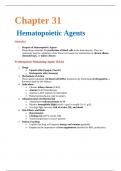
Chapter 31
Hematopoietic Agents
Overview
1. Purpose of Hematopoietic Agents
These drugs stimulate the production of blood cells in the bone marrow. They are
commonly used in conditions where blood cell counts are reduced due to chronic illness,
chemotherapy, or kidney disease.
Erythropoiesis-Stimulating Agents (ESAs)
2. Drugs
o Epoetin alfa (Epogen, Procrit)
o Darbepoetin alfa (Aranesp)
3. Mechanism of Action
These agents stimulate red blood cell (RBC) production by mimicking erythropoietin, a
hormone made by the kidneys.
4. Indications
o Chronic kidney disease (CKD)
o Anemia from chemotherapy
o Anemia in HIV patients on zidovudine
o Reducing transfusion need in surgery
5. Administration and Monitoring
o Administered subcutaneously or IV
o Monitor hemoglobin (Hgb) levels—goal is usually 10–11 g/dL
o Too high Hgb increases risk of stroke, MI, and death
6. Side Effects and Risks
o Hypertension
o Clotting risk (DVT, stroke, MI)
o Tumor progression in cancer patients
7. Patient Teaching
o Explain that drug will improve energy and stamina gradually
o Emphasize the importance of iron supplements (needed for RBC production)
,Colony-Stimulating Factors (CSFs
8. Granulocyte Colony-Stimulating Factors (G-CSFs)
Stimulate white blood cell (neutrophil) production
o Filgrastim (Neupogen)
o Pegfilgrastim (Neulasta) – long-acting form
9. Indications
o Neutropenia from chemotherapy
o Bone marrow transplant support
o Severe chronic neutropenia
10. Administration and Monitoring
Subcutaneous or IV
Monitor ANC (absolute neutrophil count)
Discontinue when counts return to safe range
11. Side Effects
Bone pain (common)
Injection site reactions
Rare: splenic rupture
12. Patient Advice
Use acetaminophen for bone pain
Report left upper abdominal pain or shoulder pain (possible spleen issue)
Granulocyte-Macrophage CSFs (GM-CSFs)
13. Drug Example
Sargramostim (Leukine)
14. Indications
Used after bone marrow transplant to accelerate recovery
Stimulates multiple types of white cells (neutrophils, monocytes, macrophages)
15. Side Effects
Fever, chills, muscle aches
Fluid retention, capillary leak syndrome (rare but serious)
,Thrombopoietic Agents
16. Used for Platelet Production
Treat thrombocytopenia from chemotherapy or bone marrow failure
Oprelvekin (Neumega): Older agent, not widely used due to side effects
Newer agents (e.g., eltrombopag, romiplostim) stimulate thrombopoietin receptors
17. Side Effects
Fluid retention, tachycardia
Vision changes (retinal effects)
Increased risk of blood clots
Key Teaching Points for All Hematopoietic Agents
These drugs support blood counts, but are not cures
Require close lab monitoring (Hgb, ANC, platelets)
Risk of hypertension, clots, and organ damage
Adherence and follow-up are essential for safe use
, Chapter 32
Drugs for Asthma and COPD
Overview
1. Asthma vs. COPD
o Asthma: Chronic inflammatory airway disorder, often triggered by allergens,
reversible airflow obstruction
o COPD: Progressive airflow limitation, mainly from smoking or irritant exposure,
not fully reversible
2. Treatment Goals
o Relieve acute symptoms (bronchodilation)
o Prevent exacerbations
o Reduce airway inflammation
o Improve quality of life and lung function
Drug Classes for Asthma and COPD
1. Beta₂-Adrenergic Agonists
3. Short-Acting (SABA)
o Example: Albuterol (Ventolin, ProAir)
o Rapid relief of acute bronchospasm
o Rescue inhaler
o Side effects: Tachycardia, tremor, nervousness
4. Long-Acting (LABA)
o Examples: Salmeterol, Formoterol
o Maintenance therapy—not for acute use
o Must be combined with inhaled corticosteroid (ICS) in asthma to avoid
increased mortality risk
Hematopoietic Agents
Overview
1. Purpose of Hematopoietic Agents
These drugs stimulate the production of blood cells in the bone marrow. They are
commonly used in conditions where blood cell counts are reduced due to chronic illness,
chemotherapy, or kidney disease.
Erythropoiesis-Stimulating Agents (ESAs)
2. Drugs
o Epoetin alfa (Epogen, Procrit)
o Darbepoetin alfa (Aranesp)
3. Mechanism of Action
These agents stimulate red blood cell (RBC) production by mimicking erythropoietin, a
hormone made by the kidneys.
4. Indications
o Chronic kidney disease (CKD)
o Anemia from chemotherapy
o Anemia in HIV patients on zidovudine
o Reducing transfusion need in surgery
5. Administration and Monitoring
o Administered subcutaneously or IV
o Monitor hemoglobin (Hgb) levels—goal is usually 10–11 g/dL
o Too high Hgb increases risk of stroke, MI, and death
6. Side Effects and Risks
o Hypertension
o Clotting risk (DVT, stroke, MI)
o Tumor progression in cancer patients
7. Patient Teaching
o Explain that drug will improve energy and stamina gradually
o Emphasize the importance of iron supplements (needed for RBC production)
,Colony-Stimulating Factors (CSFs
8. Granulocyte Colony-Stimulating Factors (G-CSFs)
Stimulate white blood cell (neutrophil) production
o Filgrastim (Neupogen)
o Pegfilgrastim (Neulasta) – long-acting form
9. Indications
o Neutropenia from chemotherapy
o Bone marrow transplant support
o Severe chronic neutropenia
10. Administration and Monitoring
Subcutaneous or IV
Monitor ANC (absolute neutrophil count)
Discontinue when counts return to safe range
11. Side Effects
Bone pain (common)
Injection site reactions
Rare: splenic rupture
12. Patient Advice
Use acetaminophen for bone pain
Report left upper abdominal pain or shoulder pain (possible spleen issue)
Granulocyte-Macrophage CSFs (GM-CSFs)
13. Drug Example
Sargramostim (Leukine)
14. Indications
Used after bone marrow transplant to accelerate recovery
Stimulates multiple types of white cells (neutrophils, monocytes, macrophages)
15. Side Effects
Fever, chills, muscle aches
Fluid retention, capillary leak syndrome (rare but serious)
,Thrombopoietic Agents
16. Used for Platelet Production
Treat thrombocytopenia from chemotherapy or bone marrow failure
Oprelvekin (Neumega): Older agent, not widely used due to side effects
Newer agents (e.g., eltrombopag, romiplostim) stimulate thrombopoietin receptors
17. Side Effects
Fluid retention, tachycardia
Vision changes (retinal effects)
Increased risk of blood clots
Key Teaching Points for All Hematopoietic Agents
These drugs support blood counts, but are not cures
Require close lab monitoring (Hgb, ANC, platelets)
Risk of hypertension, clots, and organ damage
Adherence and follow-up are essential for safe use
, Chapter 32
Drugs for Asthma and COPD
Overview
1. Asthma vs. COPD
o Asthma: Chronic inflammatory airway disorder, often triggered by allergens,
reversible airflow obstruction
o COPD: Progressive airflow limitation, mainly from smoking or irritant exposure,
not fully reversible
2. Treatment Goals
o Relieve acute symptoms (bronchodilation)
o Prevent exacerbations
o Reduce airway inflammation
o Improve quality of life and lung function
Drug Classes for Asthma and COPD
1. Beta₂-Adrenergic Agonists
3. Short-Acting (SABA)
o Example: Albuterol (Ventolin, ProAir)
o Rapid relief of acute bronchospasm
o Rescue inhaler
o Side effects: Tachycardia, tremor, nervousness
4. Long-Acting (LABA)
o Examples: Salmeterol, Formoterol
o Maintenance therapy—not for acute use
o Must be combined with inhaled corticosteroid (ICS) in asthma to avoid
increased mortality risk