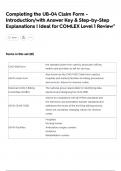
Completing the UB-04 Claim Form -
Introduction/with Answer Key & Step-by-Step
Explanations | Ideal for COMLEX Level 1 Review”
Save
Terms in this set (81)
the standard claim form used by physician's offices,
CMS-1500 form
health-care providers to bill for services,
Also known as the CMS-1450. Claim form used by
UB-04 claim form hospitals and medical facilities for billing procedures
and services. Allows for revenue codes
National Uniform Billing The national group responsible for identifying data
Committee (NUBC) elements and designing the CMS-1500.
Allows for compliance with all HIPAA standards and
the electronic documentation transfer standards and
UB-04 (CMS-1450) addresses the issues of the evolving billing process,
which are constantly changing. Allows for revenue
codes
Hospitals
Nursing homes
UB-04 Facilities Ambulatory surgery centers
Hospices
Rehabilitation centers
, If palpation of the LEFT lower quadrant of a person's
abdomen increases the pain felt in the RIGHT lower
Roving's sign
quadrant, the patient is said to have a positive
Rovsing's sign and may have appendicitis.
inpatient hospital billing, such as for supplies used
ICD-10-PCS codes
during surgery, is done using ICD-10 PCS codes.
A single-page form UB-04
containing 81 numbered
items on the front and
additional info on the
back?
The boxes located on the UB-04. Each form locator is
assigned a number and requires designated
information to be entered into that field. Unlike the
Form Locator (FL)
CMS-1500, the items will be presented in the order of
the form locators and not grouped by the type of
information requested.
an electronic handbook create by the National
Official UB-04 Data Uniform Billing Committee that explains and defines
Specifications Manual each form locator and explains how to properly
complete the form.
Unique alphanumeric identifier assigned by a provider
Patient Control number to facilitate retrieval of individual case records and
(PCN) posting of payments and correspondence. Found on
the UB-04.
permanent patient record number that's tied to the
Medical Record Number patient's history and information that does not change
from one visit to the next. Assigned by the facility.
A four-digit code; the first digit is a leading zero, the
second digit identifies the type of facility where
services were rendered (i.e. hospital), the third digit
Type of bill (TOB)
classifies the type of care being billed (i.e. outpatient),
and the fourth digit, a "frequency" code, indicates the
sequence of the bill within a given episode of care.
Introduction/with Answer Key & Step-by-Step
Explanations | Ideal for COMLEX Level 1 Review”
Save
Terms in this set (81)
the standard claim form used by physician's offices,
CMS-1500 form
health-care providers to bill for services,
Also known as the CMS-1450. Claim form used by
UB-04 claim form hospitals and medical facilities for billing procedures
and services. Allows for revenue codes
National Uniform Billing The national group responsible for identifying data
Committee (NUBC) elements and designing the CMS-1500.
Allows for compliance with all HIPAA standards and
the electronic documentation transfer standards and
UB-04 (CMS-1450) addresses the issues of the evolving billing process,
which are constantly changing. Allows for revenue
codes
Hospitals
Nursing homes
UB-04 Facilities Ambulatory surgery centers
Hospices
Rehabilitation centers
, If palpation of the LEFT lower quadrant of a person's
abdomen increases the pain felt in the RIGHT lower
Roving's sign
quadrant, the patient is said to have a positive
Rovsing's sign and may have appendicitis.
inpatient hospital billing, such as for supplies used
ICD-10-PCS codes
during surgery, is done using ICD-10 PCS codes.
A single-page form UB-04
containing 81 numbered
items on the front and
additional info on the
back?
The boxes located on the UB-04. Each form locator is
assigned a number and requires designated
information to be entered into that field. Unlike the
Form Locator (FL)
CMS-1500, the items will be presented in the order of
the form locators and not grouped by the type of
information requested.
an electronic handbook create by the National
Official UB-04 Data Uniform Billing Committee that explains and defines
Specifications Manual each form locator and explains how to properly
complete the form.
Unique alphanumeric identifier assigned by a provider
Patient Control number to facilitate retrieval of individual case records and
(PCN) posting of payments and correspondence. Found on
the UB-04.
permanent patient record number that's tied to the
Medical Record Number patient's history and information that does not change
from one visit to the next. Assigned by the facility.
A four-digit code; the first digit is a leading zero, the
second digit identifies the type of facility where
services were rendered (i.e. hospital), the third digit
Type of bill (TOB)
classifies the type of care being billed (i.e. outpatient),
and the fourth digit, a "frequency" code, indicates the
sequence of the bill within a given episode of care.