DNA
DNA Discovery
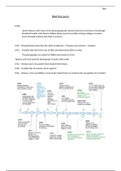
1950s
- James Watson and Francis Crick did postgraduate research that the University of Cambridge
- Rosalind Franklin and Maurice Wilkins doing research on DNA at Kings College in London
- Erwin Chargaff working with DNA in America
1949 – Chargaff determines that the ratios of Adenine = Thymine and Cytosine = Guanine
1952 – Franklin take the first X-rays of DNA and determines DNA is a helix
The photographs are stolen by Wilkins and shown to Crick
Watson and Crick used the photograph to build a 3D model
1953 – Watson and Crick publish their double-helix theory
1958 – Franklin dies of ovarian cancer aged 37
1962 – Watson, Crick and Wilkins received the Nobel Prize for medicine (No recognition for Franklin)
, DNA
DNA Structure
DNA stands for Deoxyribonucleic Acid
DNA is a double helix
- When unwound it looks like a ladder
DNA is a polymer
- It is made up of monomers called nucleotides
Nucleotides are made up of 3 parts
- Sugar molecule (Deoxyribose sugar)
- Phosphate group
- Nitrogenous base (A=T and C=G)
o Adenine (Purine)
o Thymine (Pyrimidine)
o Guanine (Purine)
o Cytosine (Pyrimidine)
Purine bases are larger than pyrimidine bases
Covalent bonds hold together the sugar-phosphate backbone
Hydrogen bonds hold together the nitrogenous bases of complementary strands
- 3 hydrogen bonds between Cytosine and Guanine
- 2 hydrogen bonds between Adenine and Thymine
The sequence of bases can occur in any order so long as Adenine is bonded with Thymine and
Cytosine is bonded with Guanine
- This creates complementary strands
, DNA
Mitochondrial DNA (mtDNA)
This is extranuclear DNA that is mound in mitochondria
- It is not related to chromosomal DNA
- It is short and circular
mtDNA codes for enzymes that control cellular
respiration
- Mitochondria are responsible for providing
energy
The origin of mitochondria is debated
- It became an organelle through endosymbiosis
- It was thought to be a bacterium originally
o It entered the cell and was not digested
o It became an organelle with its own DNA
mtDNA is inherited through the maternal line
- Sperm contain 0.1% of the mtDNA that is in the egg
- Most of sperm mtDNA is found in the base of the tail which breaks off during fertilization
- The zygote thus only has female mtDNA
mtDNA does not undergo meiosis
- It remains mostly unchanged over generations
- By comparing modern mtDNA to older mtDNA you can determine relatedness
o A closer match is a closer relation
DNA Discovery
1950s
- James Watson and Francis Crick did postgraduate research that the University of Cambridge
- Rosalind Franklin and Maurice Wilkins doing research on DNA at Kings College in London
- Erwin Chargaff working with DNA in America
1949 – Chargaff determines that the ratios of Adenine = Thymine and Cytosine = Guanine
1952 – Franklin take the first X-rays of DNA and determines DNA is a helix
The photographs are stolen by Wilkins and shown to Crick
Watson and Crick used the photograph to build a 3D model
1953 – Watson and Crick publish their double-helix theory
1958 – Franklin dies of ovarian cancer aged 37
1962 – Watson, Crick and Wilkins received the Nobel Prize for medicine (No recognition for Franklin)
, DNA
DNA Structure
DNA stands for Deoxyribonucleic Acid
DNA is a double helix
- When unwound it looks like a ladder
DNA is a polymer
- It is made up of monomers called nucleotides
Nucleotides are made up of 3 parts
- Sugar molecule (Deoxyribose sugar)
- Phosphate group
- Nitrogenous base (A=T and C=G)
o Adenine (Purine)
o Thymine (Pyrimidine)
o Guanine (Purine)
o Cytosine (Pyrimidine)
Purine bases are larger than pyrimidine bases
Covalent bonds hold together the sugar-phosphate backbone
Hydrogen bonds hold together the nitrogenous bases of complementary strands
- 3 hydrogen bonds between Cytosine and Guanine
- 2 hydrogen bonds between Adenine and Thymine
The sequence of bases can occur in any order so long as Adenine is bonded with Thymine and
Cytosine is bonded with Guanine
- This creates complementary strands
, DNA
Mitochondrial DNA (mtDNA)
This is extranuclear DNA that is mound in mitochondria
- It is not related to chromosomal DNA
- It is short and circular
mtDNA codes for enzymes that control cellular
respiration
- Mitochondria are responsible for providing
energy
The origin of mitochondria is debated
- It became an organelle through endosymbiosis
- It was thought to be a bacterium originally
o It entered the cell and was not digested
o It became an organelle with its own DNA
mtDNA is inherited through the maternal line
- Sperm contain 0.1% of the mtDNA that is in the egg
- Most of sperm mtDNA is found in the base of the tail which breaks off during fertilization
- The zygote thus only has female mtDNA
mtDNA does not undergo meiosis
- It remains mostly unchanged over generations
- By comparing modern mtDNA to older mtDNA you can determine relatedness
o A closer match is a closer relation